LittleJudeonFood

One kid's adventures in gastronomy


1 Comment

Back to back holidays

How can anyone keep all these holidays straight? Between my daycare’s crafts and Mama’s half-hearted window decorations, I didn’t know if a leprechaun was coming to hide eggs or a giant bunny was snoozing under a rainbow with a bunch of money. It’s all very confusing to a 2-year-old, having Easter follow so closely on the heels of St. Patrick’s day. I’ll just tell you a little bit of what I ate on both days.

For the former, I helped Mama make Irish soda bread. We’ve made this before, only this time I really helped form my own loaf. (I gave it to my teacher.)
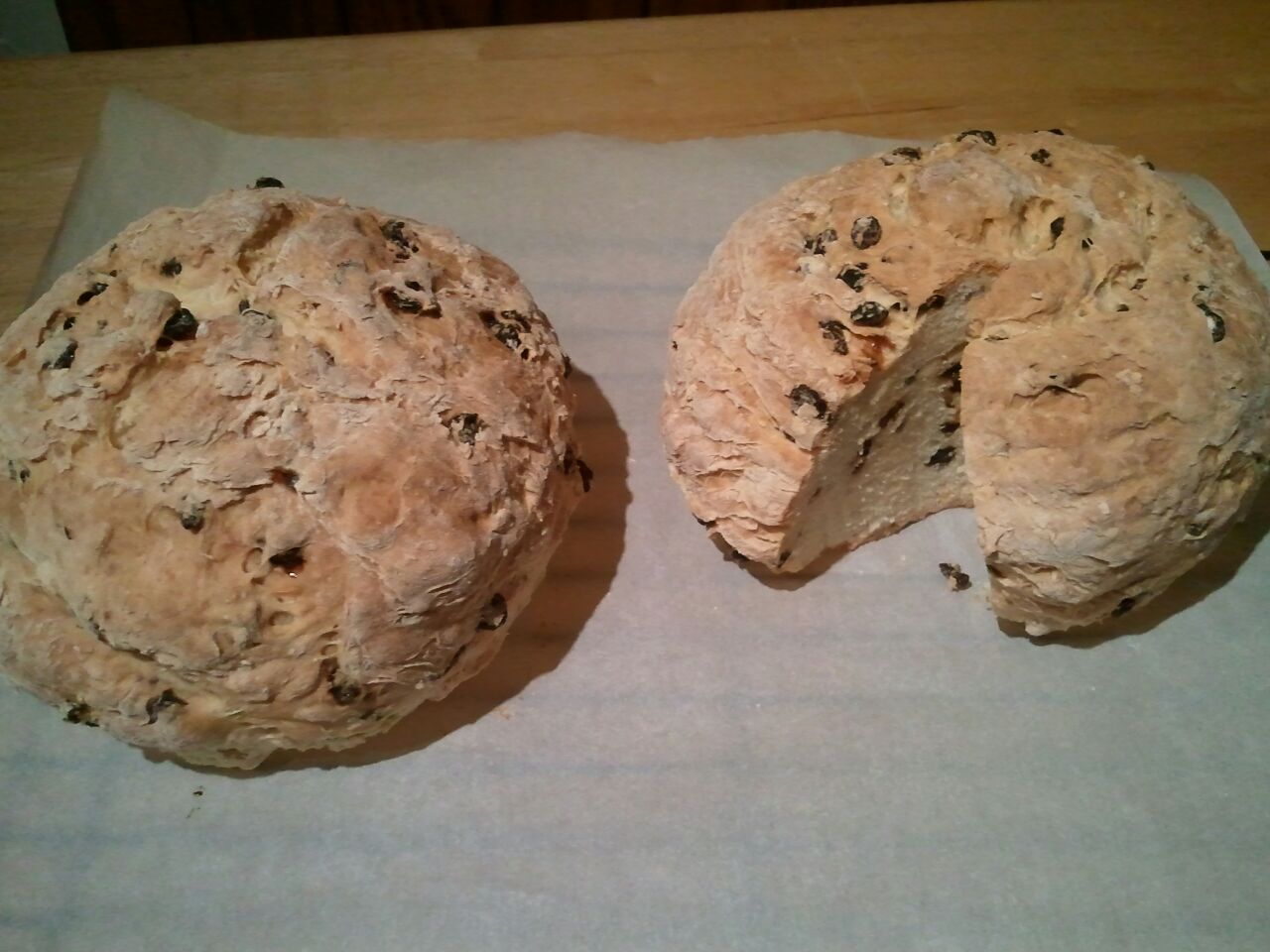
Soda bread just out of the oven

Soda bread just out of the oven

Mama made her honey butter, too, and it was really yummy when the bread first came out of the oven and was still warm enough to melt the butter. Mmmm…
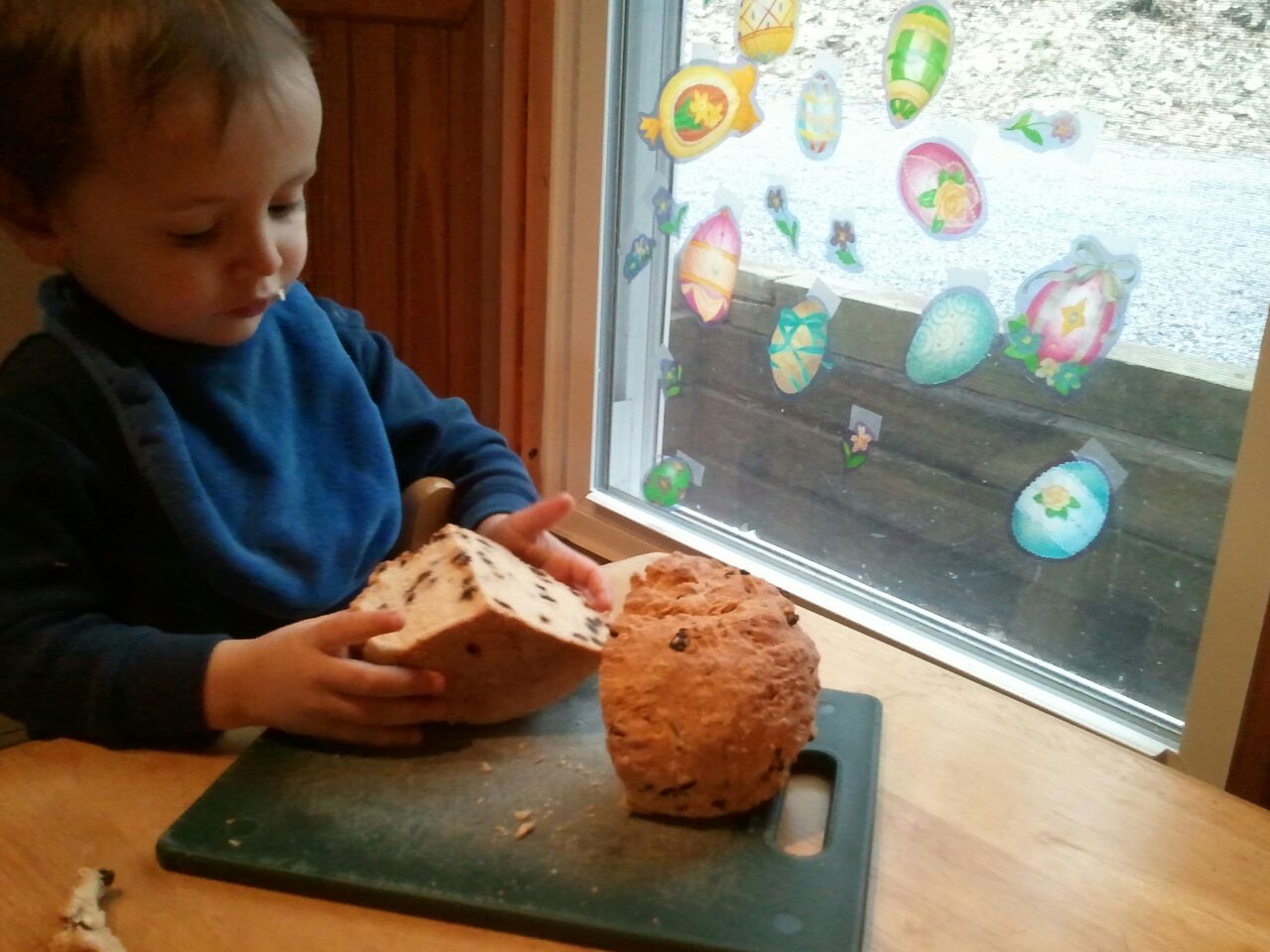
I like picking out the currants.

I like picking out the currants.

Actually, we made it the day before St. Patrick’s day, so the next morning, Mama sliced it and made French toast out of it. Even better.
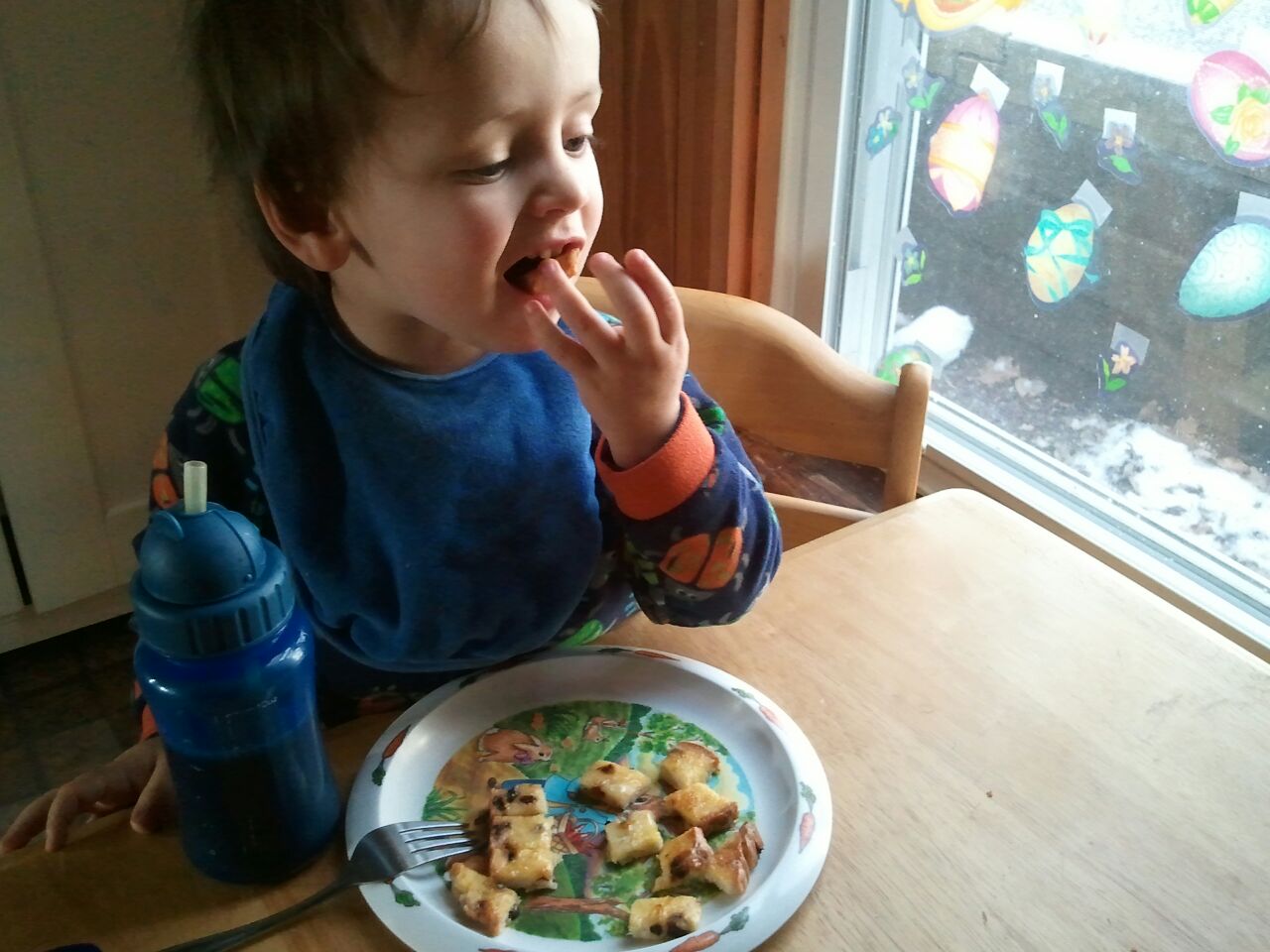
Though I wanted syrup, the honey butter really was enough for this French toast.

Though I wanted syrup, the honey butter really was enough for this French toast.

Next up: Easter. Many have asked me about what I found in my eggs that fine morning. Depending on who’s doing the asking, they either empathize with Mama or feel sorry for me. I’ll just say that I loved it all! I ate what came out of those eggs so fast, I hardly had time to share any of it (but I did, because I’ve always been known as a “good sharer”). There were chocolate-graham bunny crackers and gummy bunnies (just a few) and prunes and apricots. And 2 cars. And lots of coins to add to my piggy bank. Then I ran around the house screaming and jumping on the furniture for about an hour.

Doesn't everybody get chocolate-bunny grahams and prunes for Easter?

Doesn’t everybody get chocolate-bunny grahams and prunes for Easter?

For dinner, Mama decided to treat us to something new. Since we tend to have buttermilk in the house for pancakes, Mama decided to marinate some chicken thighs in it, then fry them up. I’ve never eaten anything like it before! They were crispy, yet succulent. But I ate only a couple bites. As for the rest of the meal, I give it a “meh.” She pureed lima beans with a bit more buttermilk and some herbs. She thought I would eat this up, considering my affinity for the little bean, but I didn’t like that I couldn’t pick them up. Even the sweet potato tater tots didn’t hold my attention. I guess that’s what happens when a kid finally comes down from a sugar high.
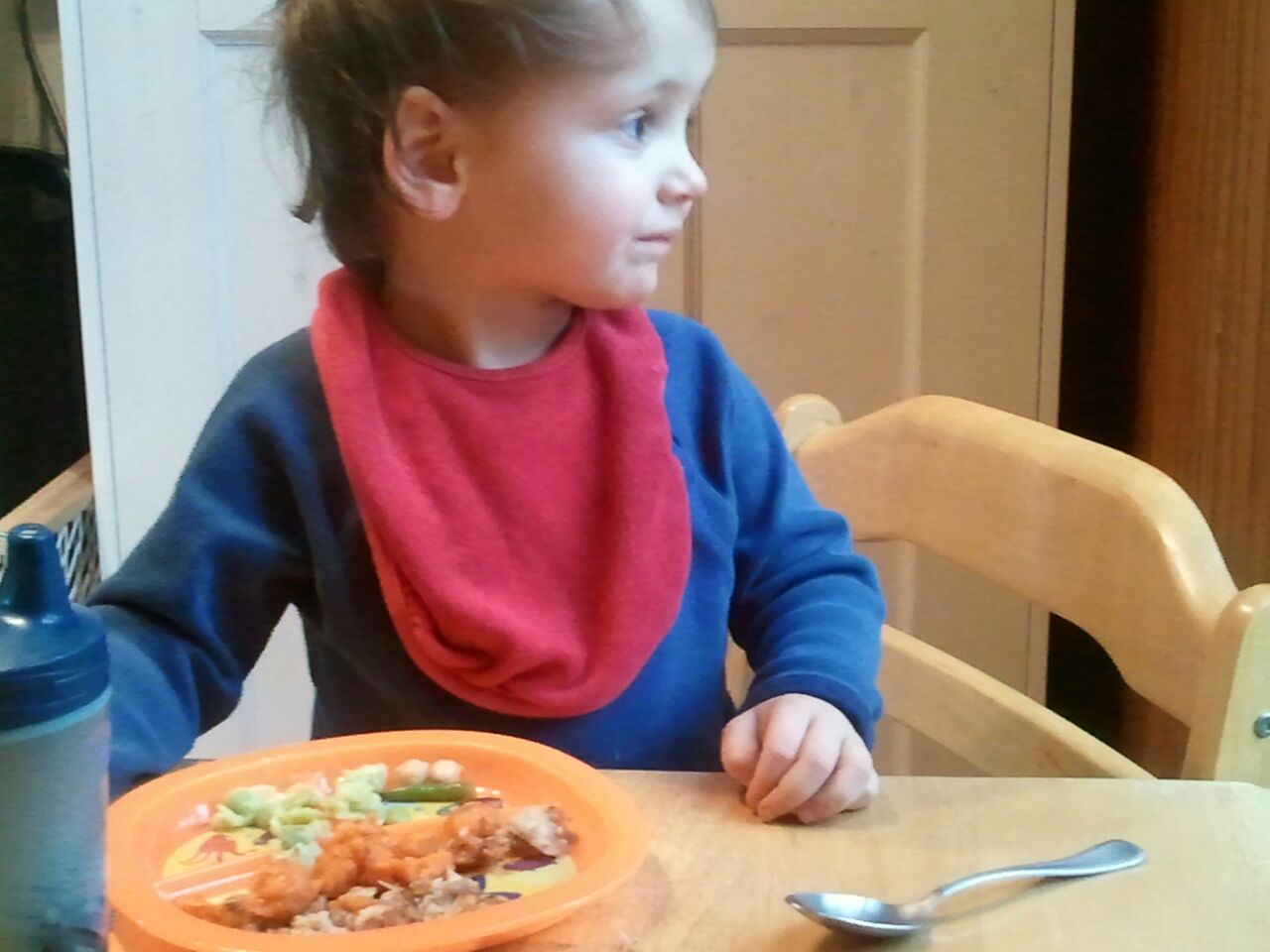
I couldn't really focus on Easter dinner. I just wanted to play outside.

I couldn’t really focus on Easter dinner. I just wanted to play outside.

Overall, I enjoyed both holidays. I saw a parade on St. Patrick’s day, and I got to play with both Mama and Papa all day on Easter. There’s not much more that a kid can ask for. Except maybe more cars.

Love, Jude

Buttermilk Fried Chicken

1 pound boneless, skinless chicken thighs (preferably organic)
Salt and pepper
Buttermilk
Vegetable oil
Flour
Other spices, as desired

Rinse the thighs and set them in a shallow baking dish. Season with salt and pepper. Pour in enough buttermilk just to cover. Cover the dish and refrigerate for a few hours. When ready to cook, heat about 1 inch oil in a large frying pan over medium-high heat until a few flecks of flour sizzle in it (about 365°F). Pour about 1 cup flour into a large ziptop plastic bag and season it with salt and pepper and any other spices you like (paprika, chili powder, garlic powder, etc.). Take a thigh, shake off the excess buttermilk, and put it in the bag. Add a few more thighs (but don’t crowd the bag too much). Give it all a few hardy shakes until all the thighs are coated with flour, then take them out and either set them on a plate or gently place them in the hot oil. (Repeat with the remaining thighs–add more flour, if necessary.) Cook the thighs for 7 or 8 minutes, until golden brown, then gently turn and fry until golden on the other side and the chicken is cooked through. Remove to a plate covered with a paper towel.

Makes enough for dinner + leftovers

2 Comments

With just a few hours notice…

…you can make a pizza. From scratch.

You know that Mama and I have made pizza before. Back when I first wrote about it, I’m embarrassed to admit, I was a bit on the fence about the stuff. That’s no longer the case.

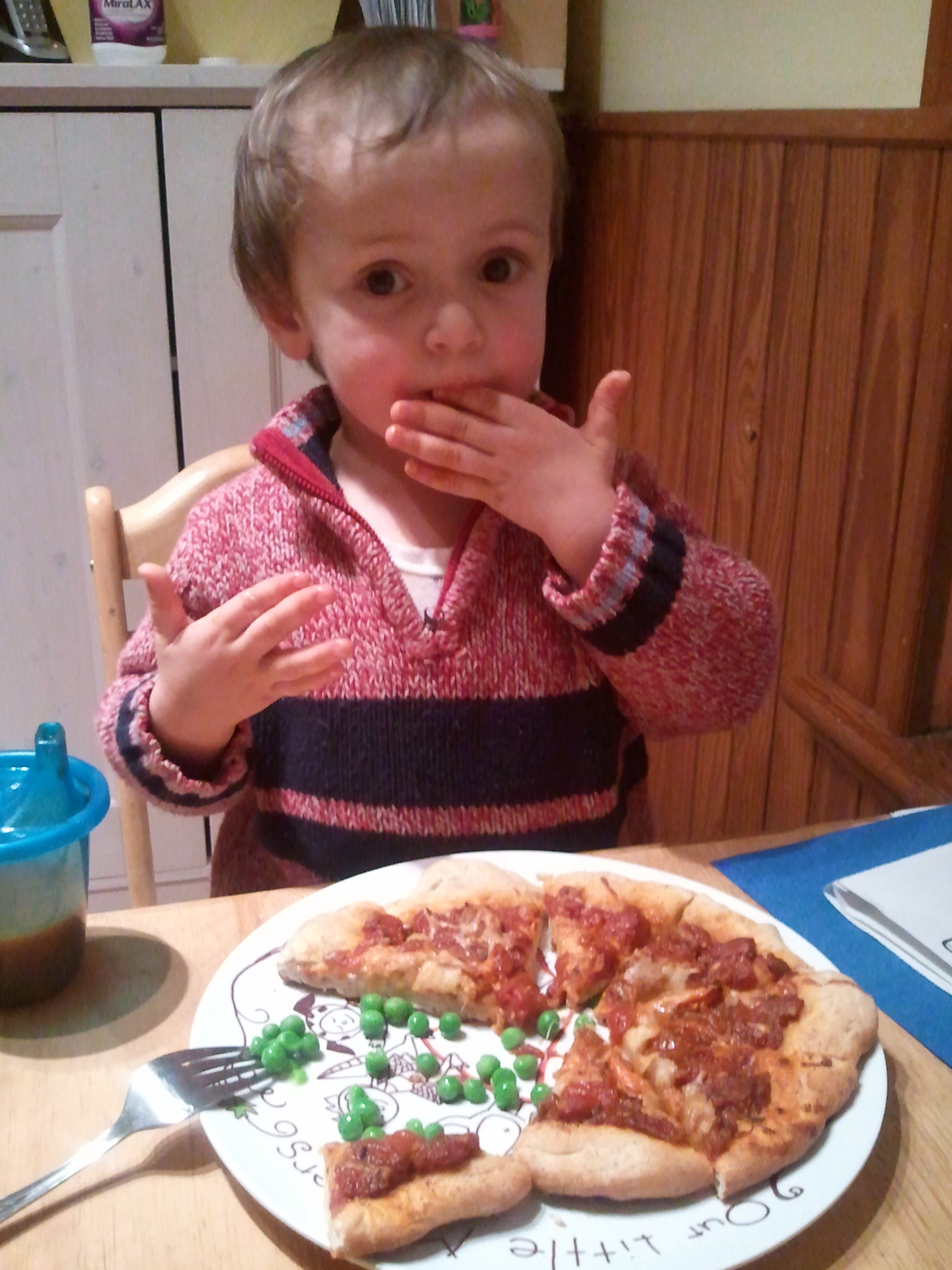
Mama got a yen for pizza around 4:00, and that’s all the time that was needed to make the dough and a sauce from some home-canned tomatoes. She set the dough on the oven, so it proofed really quickly, then she made personal pizzas for each of us. Mine had roasted carrots, capers, and uncured bacon on it. Papa’s had carrots, capers, onions, bacon, and arugula. Mama had the same, minus the bacon. (She swears by arugula on pizza, but I wouldn’t touch it.)

A side of peas made this one good dinner.

A side of peas made this one good dinner.

The best part was that since most of this dinner made itself, Mama could play with me!

Love, Jude

Pizza Sauce

1 tablespoon olive oil
1 shallot, thinly sliced
2 cloves garlic, minced
1/2 quart home-canned tomatoes with their juice, chopped (or a 15-oz can diced tomatoes)
1-2 tablespoons tomato paste
Pinch sugar
Kosher salt and freshly ground black pepper
Oregano (fresh or dried)
Basil (fresh or dried)

Heat the oil in a medium saucepan over medium heat. Cook the shallots until soft and golden, then add the garlic and cook 30-60 seconds more, until fragrant. Add the tomatoes, tomato paste, and sugar. Bring to a simmer, then let it cook down, stirring occasionally, until it begins to thicken. Season to taste with salt, pepper, oregano, and basil. Lower heat to medium-low and simmer sauce until it thickens to desired consistency. Marvel to yourself at how good the sauce tastes, then spread over pizza dough as is.

Yield: Mama really likes a saucy pizza, so this amount covered 4 6″ pizzas (or 1 medium-large pie)


3 Comments

“I don’t like cauliflower.”

Which is what I told Mama for at least the 20th time. (I can count that high now, so I should know.) She didn’t seem to believe me. She kept saying that wasn’t true, that there were potatoes and cheese involved, and that I needed to have “just 1 bite.” I think if she thought about it hard enough, she’d realize that I really don’t like cauliflower. I couldn’t tell you the last time I ate the stuff. I even took more bites of my meatloaf as a peace offering, but she wasn’t buying. Our standoff eventually escalated beyond “no grapes” and “no Caillou” to “and you’ll go straight to bed.” So I took a stinkin’ bite (while my mouth was full of meatloaf). She asked if it was okay, and I nodded. Then she asked if I would take another bite, and I said, “No, thank you.” Then, “I want my grapes!” and “I want Caillou!” So you see…everyone wins.

Love, Jude

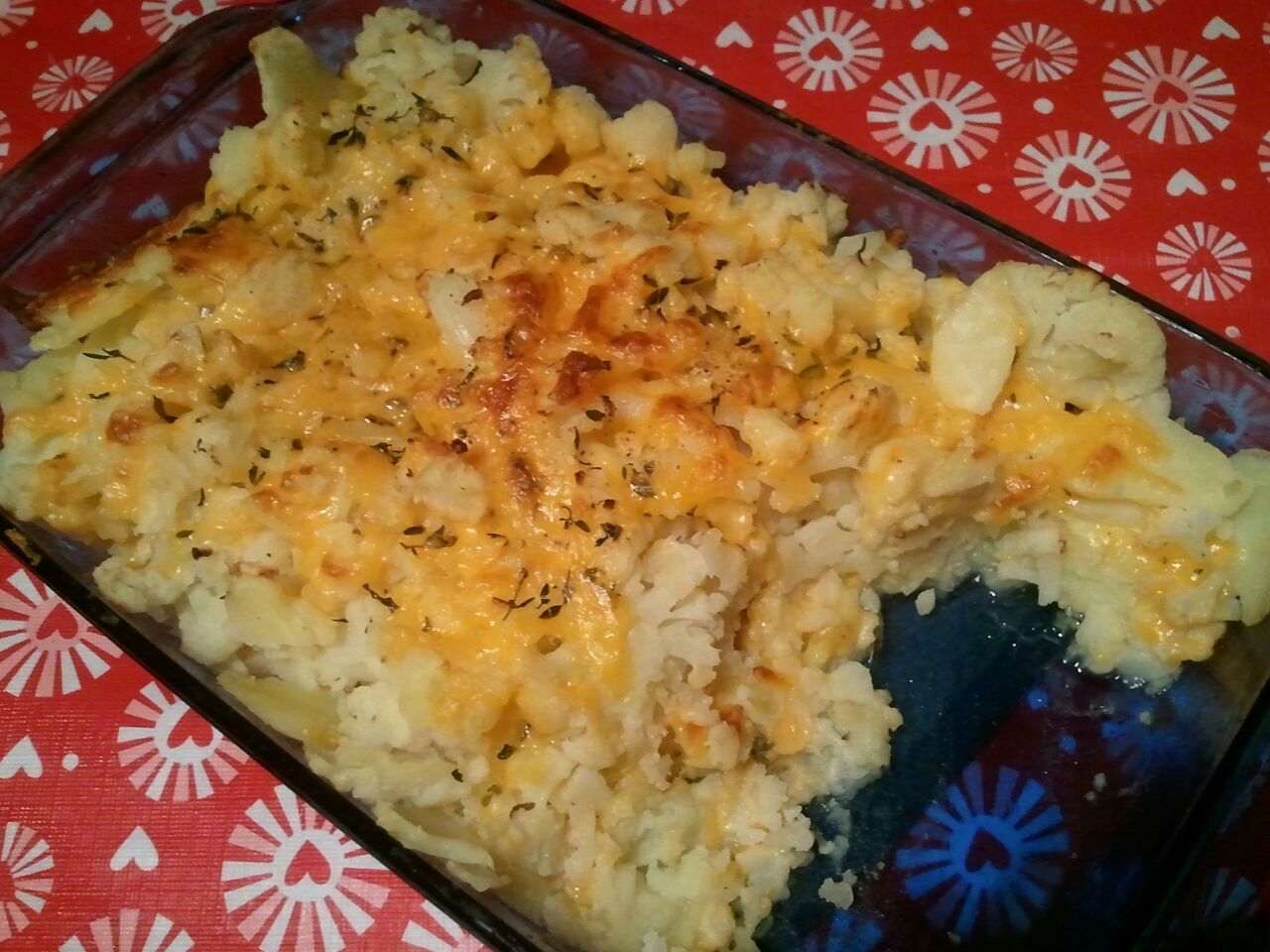
Baked Cheesy Potatos and Cauliflower

3–4 medium potatoes (Mama used yellow ones; choose whatever’s smallish and organic)
1 head cauliflower (organic ones tend to be smaller)
A few sprigs of fresh thyme, leaves stripped (you may also use dill or parsley)
Salt & pepper
A Tbsp or so of butter (optional)
Couple handfuls shredded cheese of choice (Mama used Cheddar)
½ cup veggie broth (or milk)

Preheat the oven to 450ºF. Butter an 8 x 11″ baking dish (or even a 9 x 13″).

Peel and slice the potatoes. Slice the cauliflower into “steaks” and pull away the bottom-most core. (Did you know you could do that? I didn’t!) Place in a large pot, cover with a couple inches of cold water, add salt, and bring to a boil. Boil for about 10 minutes, until the potatoes are tender and the cauliflower just starts to get tender. (Don’t worry if you go over. You can’t hurt it.) Drain.

Spread ½ the potato-cauliflower mixture in the prepared dish. Sprinkle with half the thyme and some salt and pepper. Sprinkle with a handful of cheese (as much as you like). Repeat with the remaining potato-cauliflower mix, thyme, and cheese. Pour the broth over it, then dot with a couple small cubes of butter, if you like. Bake for 15–20 minutes, until the cheese is melty and golden.

I don't care how much cheese is on there, I'm not eating it!

I don’t care how much cheese is on there, I’m not eating it!

Note: If you really want to make this a funky-looking dish, choose purple or orange cauliflower and purple potatoes! Also, Mama says it’s important that you buy a block of cheese then grate it yourself. Those packs of pre-shredded cheese have a lot more stuff in them than cheese, like cornstarch. Eww!


Leave a comment

A Sort-of-French Dinner

I suppose it was too much to ask that Mama continue her “easier is better” streak. She had crêpes on the brain (isn’t that a silly image?), so she made the batter before she left for work, as it’s better if it rests a couple hours. Her plan was to fill the thin French pancakes with roasted asparagus and top them with Hollandaise sauce.

Since that wouldn’t be enough of a meal for Papa, she called him on her way home and asked him to turn the oven on and trim a pork tenderloin. What a funny looking thing that was. Papa took a sharp knife and cut away the visible bits of fat and something shiny looking, what Mama called “silver skin.” She said this is a tough membrane that runs along some muscle meats, and it never gets tender, so best to just cut it away.

Usually, Mama sears the tenderloin in a frying pan before putting it in the oven (to give it extra flavor), or she butterflies it and stuffs it with other forms of yumminess, but tonight she had other designs. She rubbed the entire loin with olive oil, then coated it in herbs that smelled like summer and sunshine. She called it herbes de Provence, which is a lovely blend of things like savory, thyme, lavender, fennel, oregano, and basil (like curry, recipes vary). While the tenderloin roasted, Mama took a small saucepan and combined a bit of fig jam with a splash of water, to thin it, and some balsamic vinegar for tartness; she would heat this later as a sauce for the pork.

Then she started the crêpes (she took the batter out of the fridge when she got home so that it wasn’t cold-cold). Even if you use a well-seasoned pan or a nonstick crêpe pan, it’s really difficult to make quick work out of crêpes. You can make only 1 at a time! I saw lots of pan swirling as Mama made crêpe after crêpe. Luckily, you can just stack them on a plate and eat them when you’re ready.

After the pork finished roasting, it had to rest, so Mama put the asparagus in the oven and started the Hollandaise sauce. She said that even Eric Ripert makes his in a blender these days, but Mama dislikes getting out the blender and prefers to make her sauce by hand. She might want to reconsider, as her first attempt “broke.” I saw her trying to save it, muttering under her breath, but in the end, she scrapped it and made a fresh batch with new melted butter and a new egg yolk. I hope she and Papa enjoyed it because I wouldn’t touch the stuff—it didn’t look like any egg I’ve ever eaten.

I dutifully dipped my juicy pork in the sweet fig sauce. I ate my skinny spears of asparagus, after sprinkling some Parmesan on them. And I munched my soft crêpe. (I like regular pancakes better, though.) All in all, a pretty tasty meal. And I’m pretty sure Mama’s eyeing the leftover crêpes for breakfast with bananas and a smear of Nutella. It’s just a guess.

Love, Jude

Provençal-Kissed Pork Tenderloin with Fig Sauce and Roasted Asparagus Crêpes with Hollandaise Sauce

For the pork:
1 pork tenderloin (1–1¼ pound), trimmed
Olive oil to coat
Herbes de Provence (or other herb blend) to coat (about 2 Tbsp)

For the sauce:
½ cup fig jam or preserves (or any flavor that you feel complements pork, such as apricot, peach, apple, plum)
2 Tbsp water (plus more to thin, if necessary)
1 tsp balsamic vinegar

For the asparagus:
1 pound asparagus, bottom inch trimmed
1 Tbsp olive oil
Salt and pepper

For the crêpes:
1 cup whole-wheat flour (pastry flour will yield a lighter crêpe)
1/2 cup + 2 Tbsp water
1/2 cup milk
2 eggs
1 Tbsp oil
1/4 tsp salt

For the Hollandaise:
2 Tbsp clarified butter for every egg yolk (but Mama says she’ll reserve this lesson for another day)

Preheat the oven to 400ºF. (If you’re in a hurry, you could go as high as 425ºF.) Coat the tenderloin with oil, then with the herbs. Set on a baking sheet and roast for about 20 minutes (internal temp between 140ºF and 145ºF). Remove from the oven and let rest for 10 minutes before slicing.

Combine the fig sauce ingredients in a small saucepan and warm over low heat. Add more water to obtain desired consistency. Serve over pork.

Arrange the aspargus on a baking sheet and drizzle with olive oil. Roll or toss gently to coat. Season with salt and pepper. Roast at 400º (or 425º) until tender and browned, about 10 minutes, depending on thickness of stalks.

In a blender or with an immersion blender, combine the crêpe ingredients and blend until smooth. Cover and refrigerate at least 2 hours. Bring to room temperature before proceeding. Heat an 8-inch seasoned skillet or nonstick crêpe pan over medium heat. Add butter or oil, if desired. Stir batter to reincorporate ingredients, then pour ¼ cup batter into hot pan. Swirl pan so liquid runs along the outer edge—it will set as it heats. Cook for 1–1½ minutes, until set, then flip crêpe. (Do not overcook.) Cook for about 30 seconds more, then remove to a plate. Repeat with remaining batter, stacking finished crêpes. Makes 8. Wrap a crêpe around a few spears of asparagus and drizzle Hollandaise over it.


2 Comments

I helped make dinner!

Since it was just Mama and me for dinner, Mama didn’t feel like dirtying the whole kitchen. She’s starting to catch on that easier is better when it comes to weeknight meals. And because I helped from start to finish, this one took us less than half an hour to make. (Mama says the quick-cooking items helped, too.) Here’s what we did:

Mama rinsed a pint of baby tomatoes under the faucet then showed me the bag of frozen, peeled & deveined shrimp she had (quick-cooking item #1), explaining that they come from the ocean. “I want to eat that,” I said, but she said that the shrimp needed to be thawed and cooked first. Into a colander they went, and she ran cool water over them.

I turned my attention to eating the tomatoes as I handed them to Mama, one by one, naming their colors, so she could slice them in half. (This happened after I dumped nearly the whole bowl of them onto the floor…and they had to be rinsed again.) Mama put the halved tomatoes (quick-cooking item #2) on a baking sheet and added the thawed shrimp. (They thawed that quickly!) She drizzled olive oil over it and mixed everything with her hands. Then we sprinkled kosher salt and pepper over everything. (One shrimp may have received the lion’s share of my salt sprinkles…) As Mama put the shrimp under the broiler, she said we had to be very careful because the oil we put on the wet shrimp and tomatoes is going to “jump away” from the water once it gets hot. Then we danced like jumping-beans.

While the shrimp cooked, and after we danced, Mama measured and I poured couscous and water into a saucepan (quick-cooking item #3). (She didn’t have thawed stock, otherwise she would’ve used that.) Using a scissors, she cut a handful of dried apricots and added those while trying to keep me from eating them up. Ditto with the handful of golden raisins. She stirred it together, covered it, got it hot on the stove, then just let it sit. (Alternatively, she could have added hot water to the couscous without ever turning on a burner.)

By the time the shrimp was done—just when they turned pink and their tails curled—the couscous was ready. Mama and I tossed in a few pine nuts, and she cut in some mint leaves with her scissors before fluffing it with a fork.

I love eating couscous. It’s funny trying to keep it on my fork or spoon. I especially liked the sweet apricots and raisins. The shrimp were really yummy, too. We even had leftovers for Papa when he came home. That’s the kind of cook I am.

Love, Jude

Roasted Shrimp & Tomatoes with Fruity Couscous

1 pound peeled and deveined shrimp (smaller cook quicker)
1 pint cherry or grape tomatoes, halved
Olive oil to drizzle
Salt and pepper

½ cup couscous
6–8 dried apricots, quartered (or chopped)
2 Tbsp golden raisins
Pinch sea salt
¾ cup water (or chicken or vegetable stock)
1–2 Tbsp pine nuts, toasted if desired
3 mint leaves, chopped (optional)

Preheat the broiler. Combine the shrimp and the tomatoes on a baking sheet. Drizzle with olive oil and toss to coat. Sprinkle with salt and pepper. Broil 6–8″ from heat source until the shrimp turn opaque and their tails start to curl, 3–4 minutes. (Some tomatoes will start to char, as well.)

Meanwhile, combine the couscous, apricots, raisins, and salt in a small saucepan. Bring the water (or stock) to a boil, then pour over the couscous. Stir to combine, cover, then set aside until cooked through, about 5 minutes. Add the mint, if using, then fluff with a fork. (Alternatively, combine the ingredients up through the mint, bring to a boil, then immediately take off the heat and cover.)

Serves 2 adults and 1 or 2 kids


3 Comments

Breaking Bread

I have a lot of friends whose mamas make bread. (I have more friends whose mamas buy it from the store.) Mama falls somewhere in between. She likes making it, but she doesn’t always have the time or inclination. (This is what she tells me, as I don’t know what inclination is.)

Knowing me like she does, however, she thought I’d enjoy learning how to make it. We’ve made lots of cakes and scones and cookies and even pizza dough, but I haven’t made a yeast bread yet. I have to say it’s about as scary as roasting a whole chicken: once you do it, you realize it wasn’t so bad. (It’s especially easy when you have a stand mixer, as it does all the kneading for you.) Here’s how we did it:

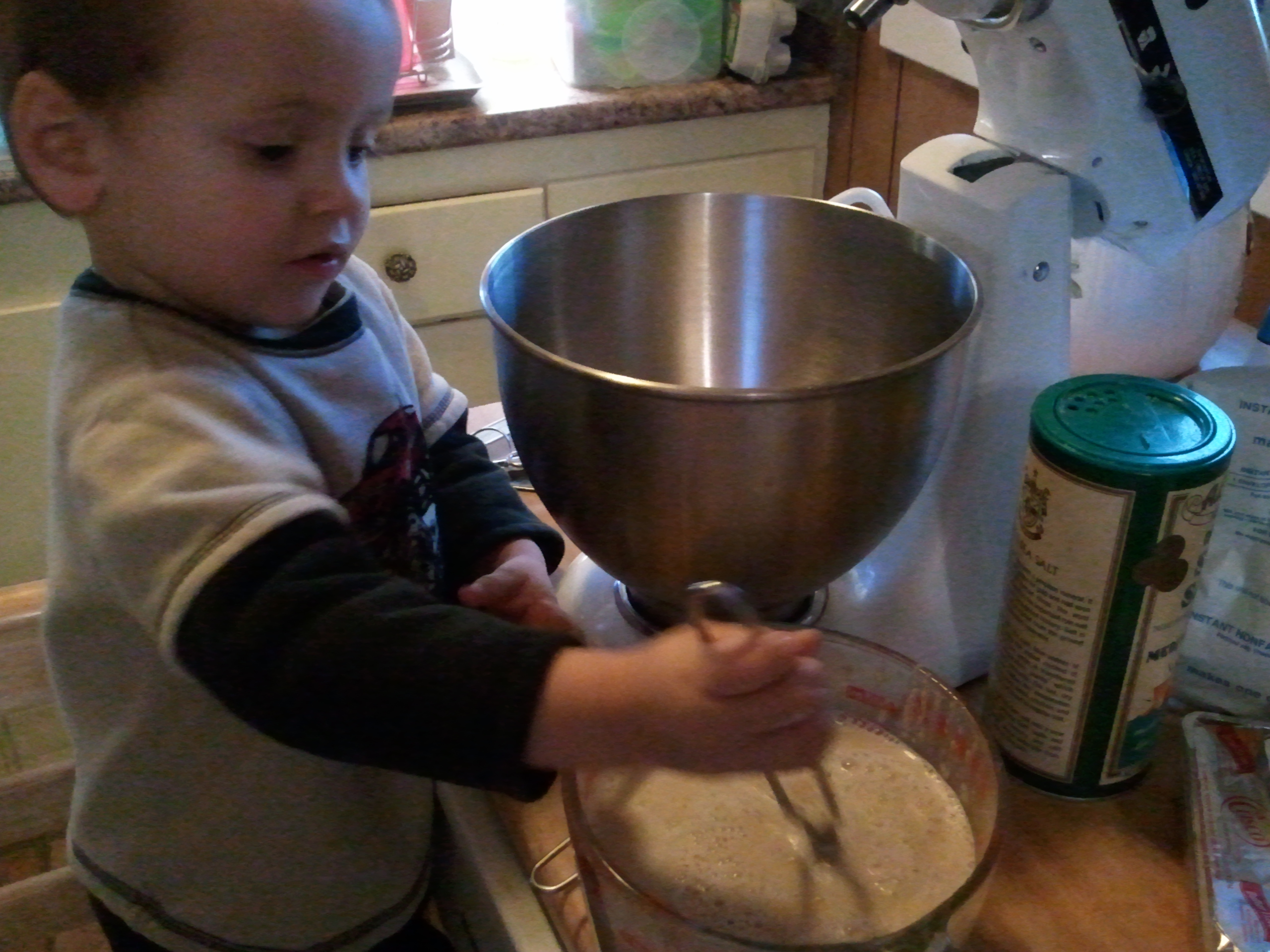
In a small bowl, add the yeast to the warmed water. Whisk until all the yeast is dissolved, getting into all the corners of the bowl (the liquid will foam). Let sit while you pull together the other ingredients.

Make sure all the yeast is dissolved in the water.

Make sure all the yeast is dissolved in the water.

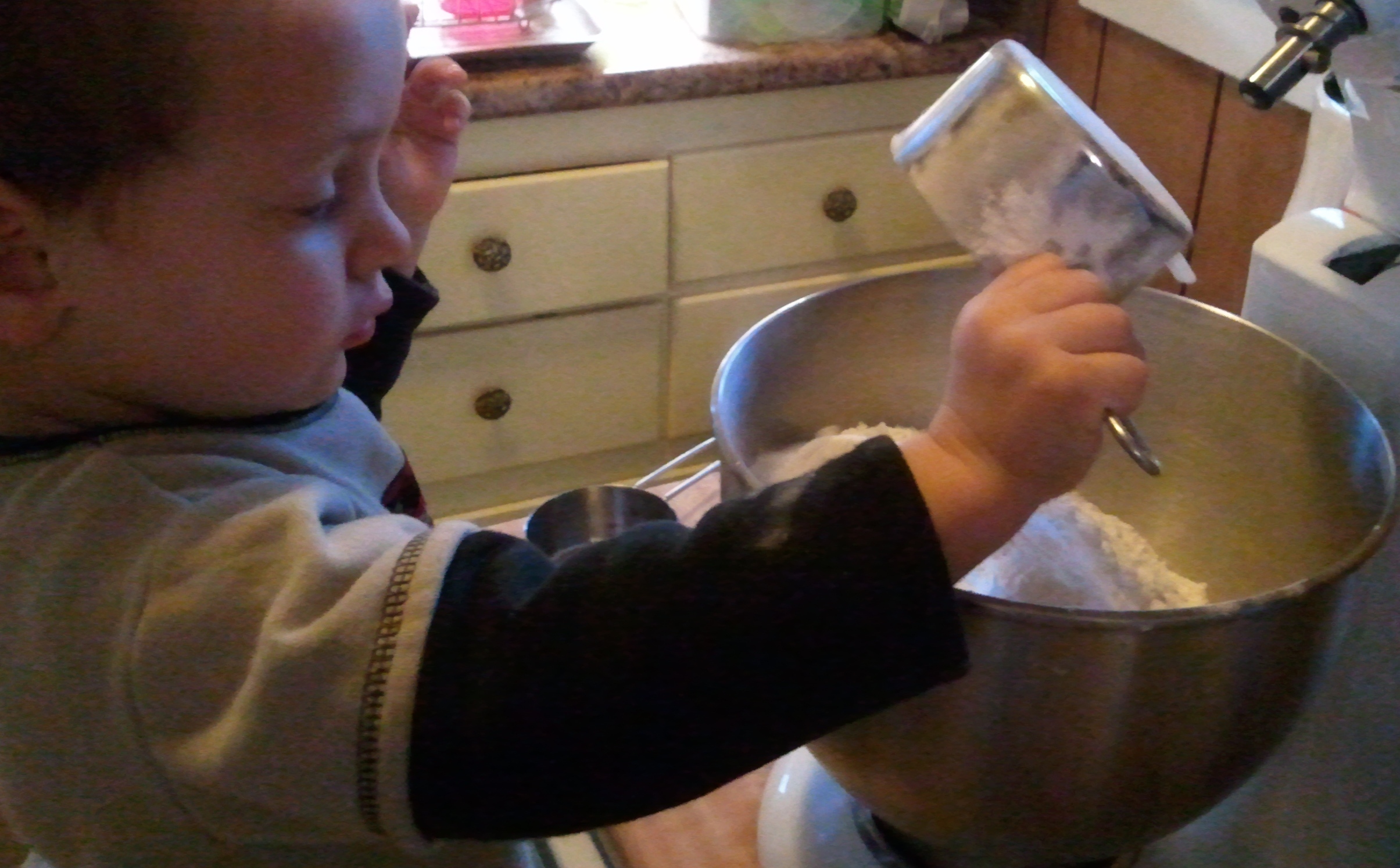
In the bowl of a stand mixer, pour the flours, salt, sugar, shortening, and dry milk.

Look at how well I can add the flour.

I’m pretty good at getting all this stuff into the bowl. Well, most of it, anyway.

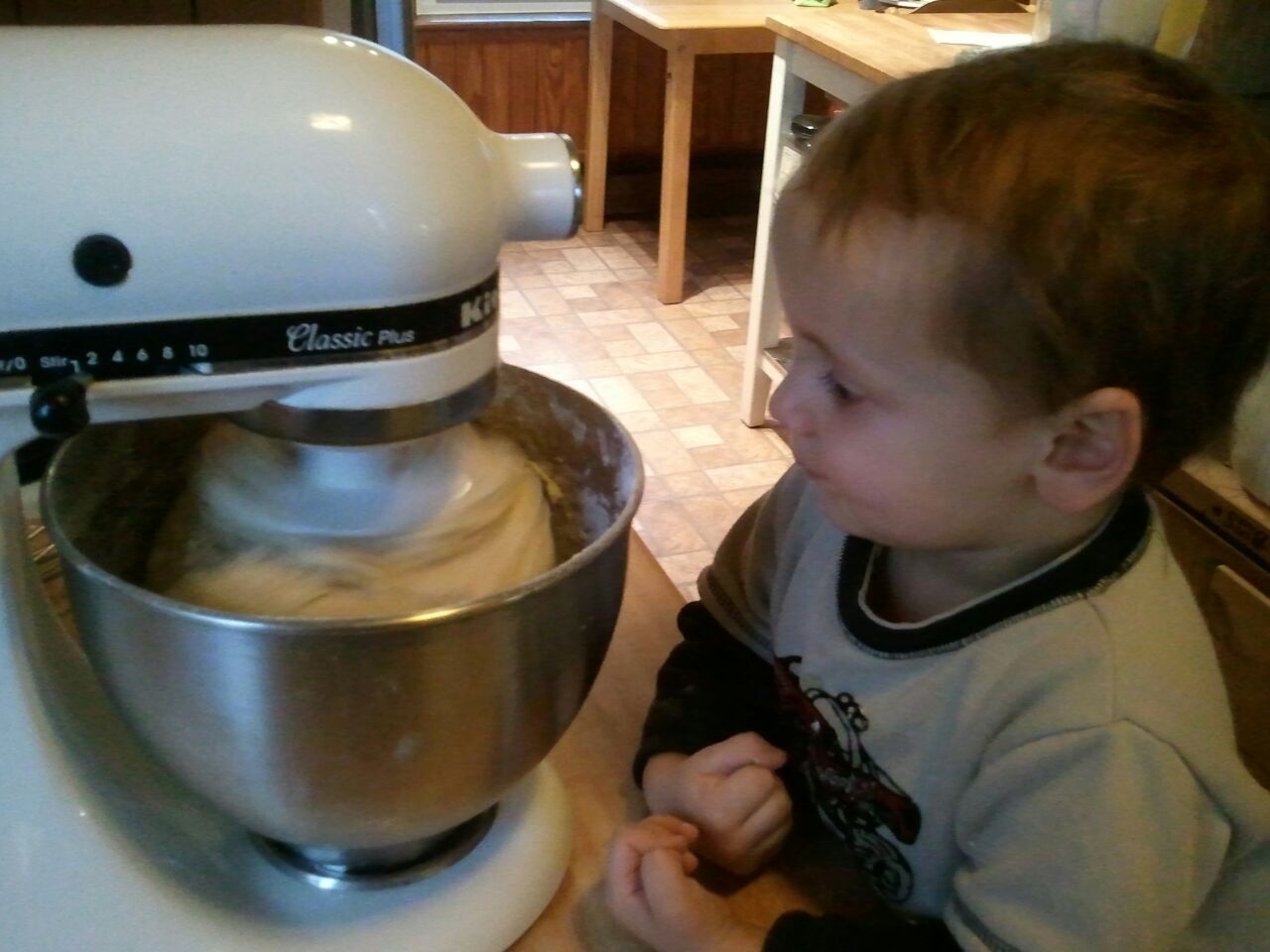
Pour in the yeast mixture. 

The mixer's really full, so start on the lowest setting. (I made it go really fast, and it was very funny.)

The mixer’s really full, so start on the lowest setting. (I made it go really fast, and it was very funny.)

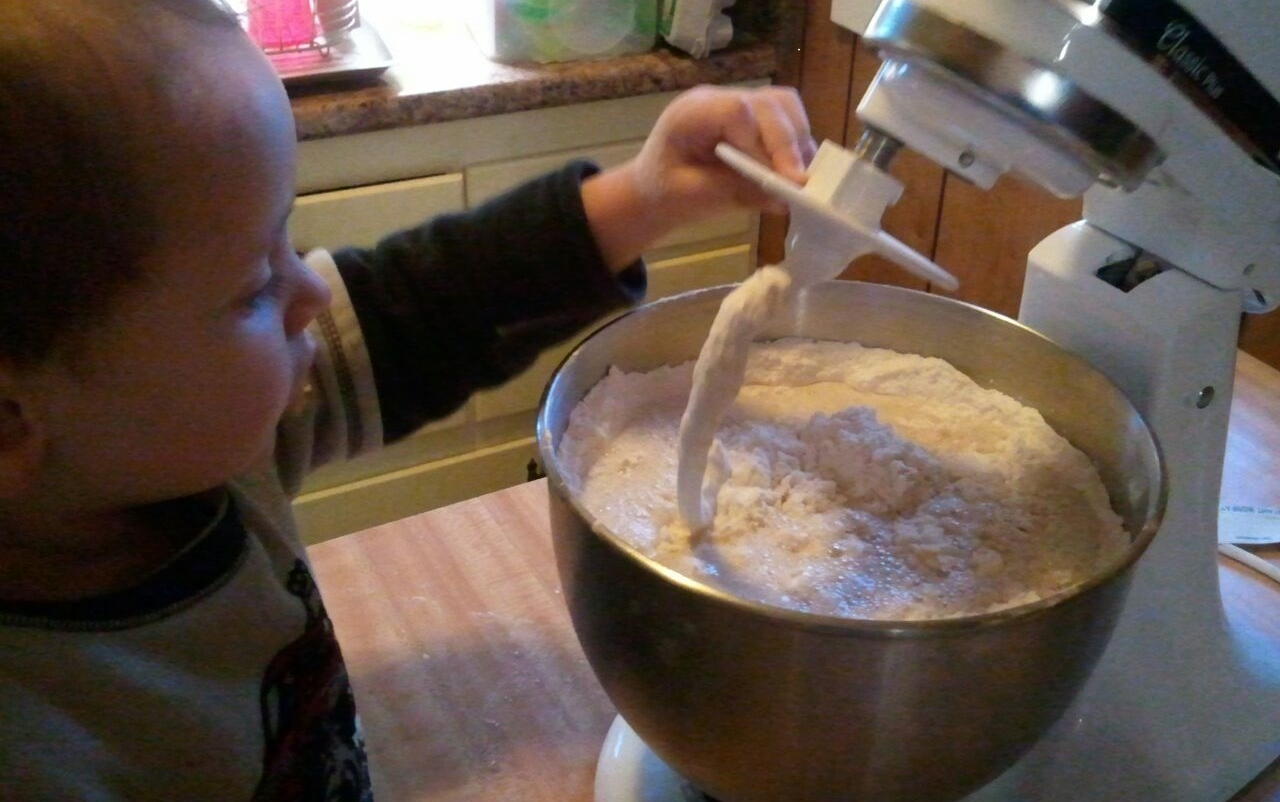
With the dough hook attachment, mix the dough on low setting until dough forms, 5–8 minutes. Stop the mixer and pull out a small chunk of dough. Stretch it. The dough should thin to the point of breaking, but not readily tear apart (a small hole is okay). This is called the gluten window. If the dough pulls right apart, return it to the mixer and continue mixing another 2 minutes, then recheck the dough. Mama says it’s important that you don’t overmix your dough, or you’ll overdevelop the gluten, and you’ll have tough bread. (Remember our bread pudding?)

The dough was a little frightening as it flopped around the bowl.

The dough was a little frightening as it flopped around the bowl. Mama didn’t get a picture of the gluten window. (I really couldn’t see it anyway.)

Lightly grease a large bowl or cookie sheet with cooking spray or vegetable oil. Place dough in/on it, then cover with a clean dishtowel. Let it set out on the counter until it doubles in size, 1–2 hours. This is called proofing.

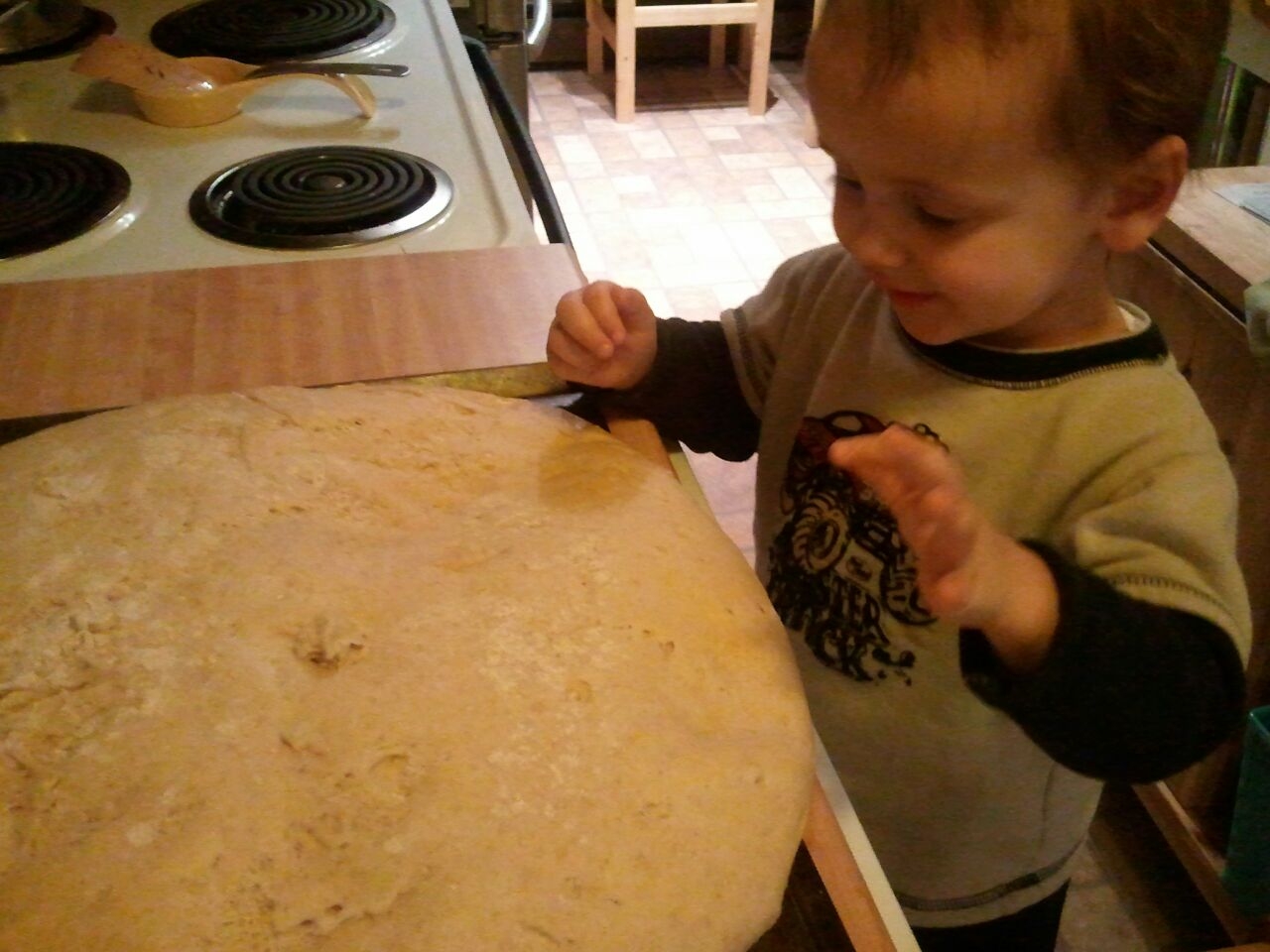
Holy proof!

Holy proof!

Once the dough has finished proofing, punch it down and give it a few more kneads with your hands to get out any air bubbles. This was my favorite part! Divide the dough in half.

Lightly grease 2 standard-size (9″ x 5″) bread loaf pans and set aside.

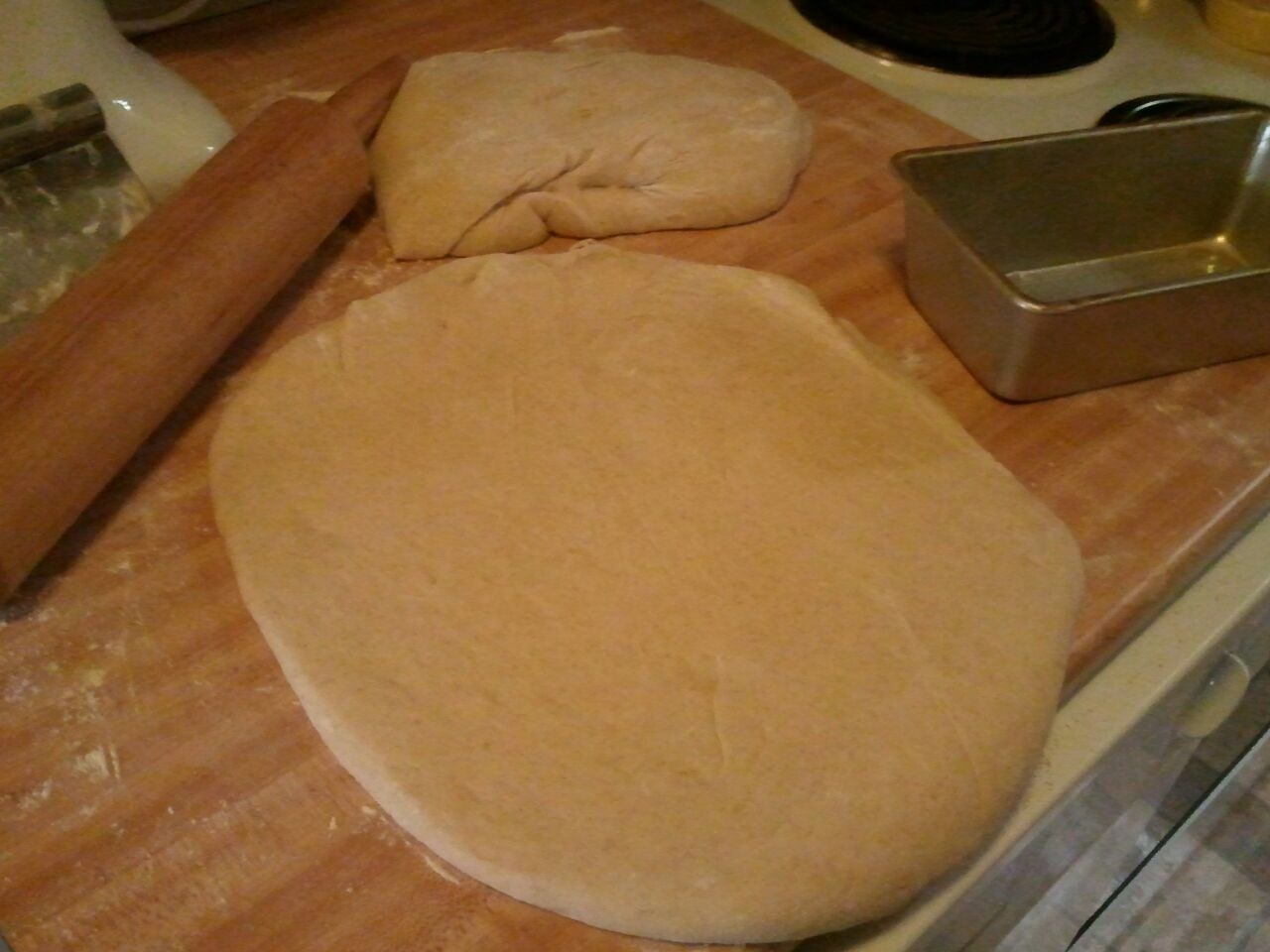
Lightly flour a work surface and, using a rolling pin, roll the dough to about the length of the loaf pan.

The dough is really soft, so it doesn't take but a few quick rolls to stretch it out.

The dough is really soft, so it doesn’t take but a few quick rolls to stretch it out.

With your hands, roll the dough like a jellyroll then place it in the loaf pan, seam side down. (Mama says if you wanted to add a flavor to your dough, like roasted garlic or herbs, lay them on the dough before you roll it, then your flavors will be swirled in the bread.) With a sharp knife, cut a slit, about ½ inch deep, down the length of the loaf, across the top. Repeat with second loaf. Cover the pans with the dishtowel and set aside to proof a second time.

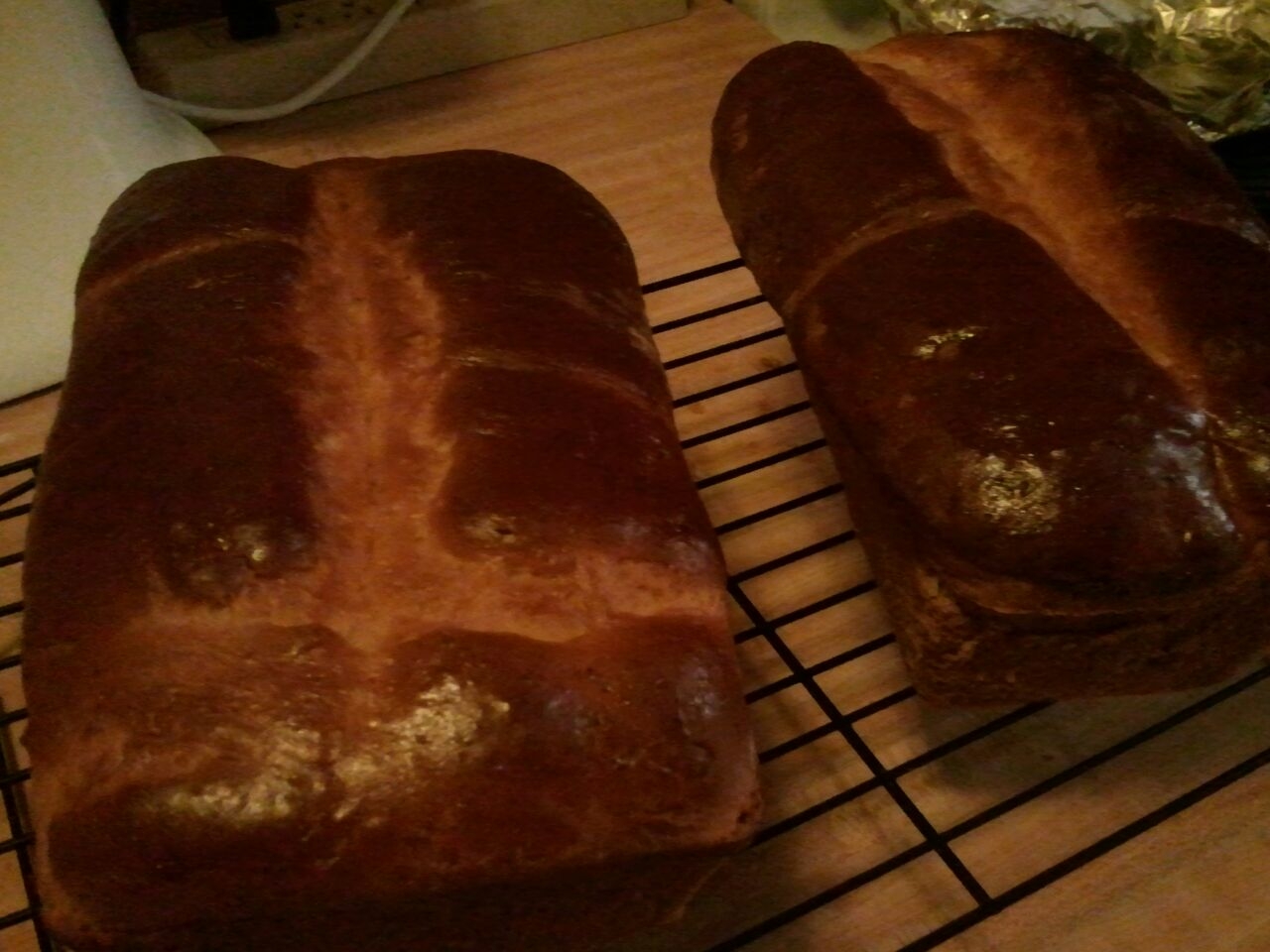
Heat the oven to 350°F. When the loaves are again doubled in size, lightly brush them with egg wash (1 egg, beaten with about 1 tablespoon of water or milk). This will give them a nice golden color. Bake in the center of the oven until an internal temperature reaches 190°F (about 50 minutes). You can see that ours got a bit dark. This was all Mama’s fault, since I’m not allowed near the oven. If your bread is getting too dark, too quickly, tent foil over it for the remainder of the bake time.

Unmold the loaves within 5 minutes of taking them out of the oven, and set on a rack to cool completely before cutting. The waiting is the hardest part, but Mama says you’ll crush all the lovely airiness of your bread if you cut it while it’s warm.

Mama says they're a little dark and a little lopsided, but neither one of us care.

Mama says they’re a little dark and a little lopsided, but neither one of us care.

Mama declared the loaves imperfect, but still a terrific freshman attempt on my part, even though I took a nap somewhere during all that proofing.

Love, Jude

Wheat Bread

3 ¼ cup + 2 tablespoons water, 105–110F°
1/3 cup + 2 teaspoons yeast
3/4 cup whole-wheat flour
7 cups bread flour
2 tablespoons sea salt
1/2 cup sugar
4 ounces (1/2 cup) shortening
3/4 cup dry milk

Makes 2 (9″ x 5″) loaves

Note: Mama tried really hard to convert her weighted measurements to cuppage. To get as close as you can to Mama’s measures, spoon your flours into your measuring cups, rather than dipping your cups into the flour.


2 Comments

Breakfast Worth Waiting For

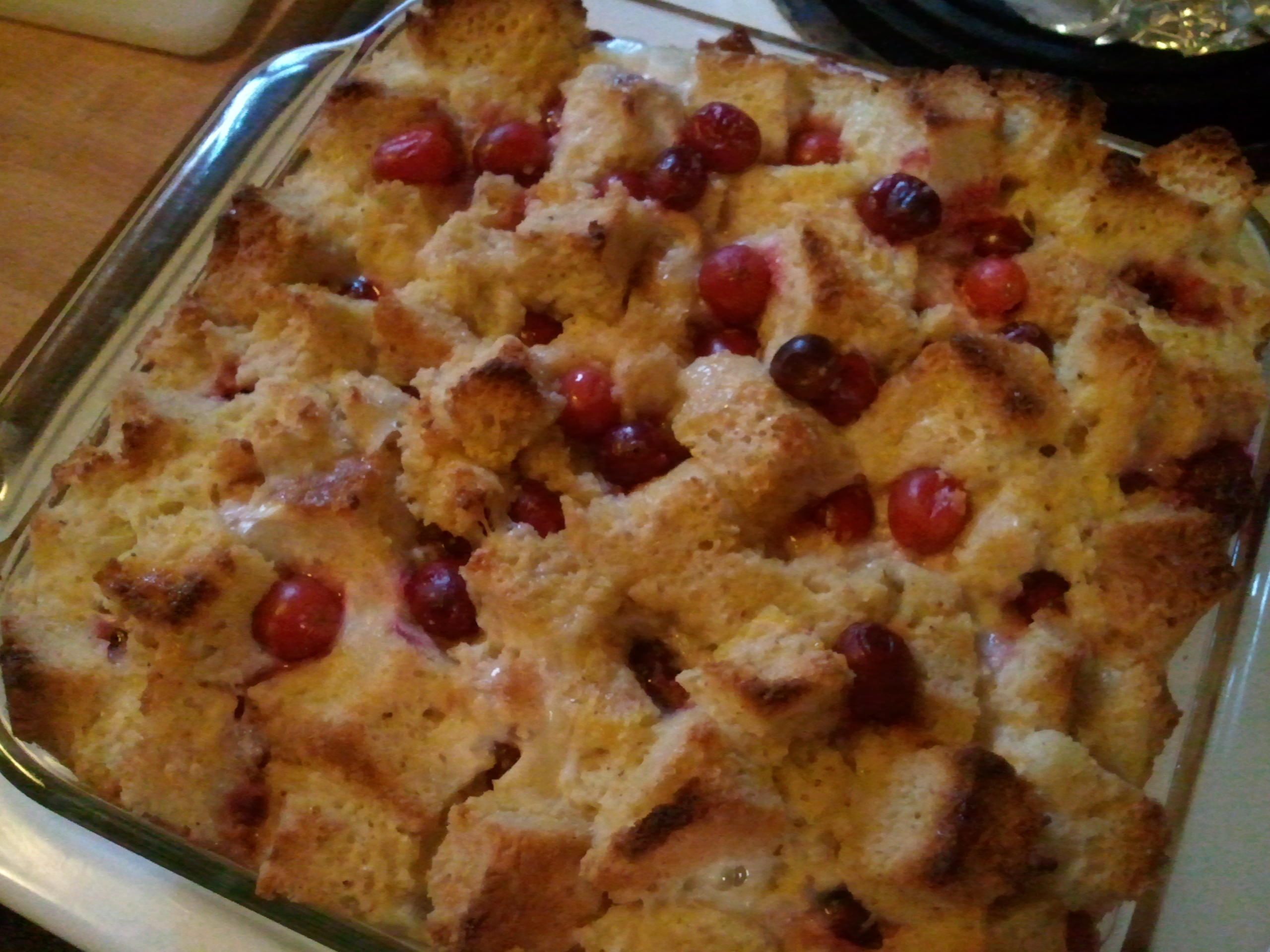
Yesterday, Mama showed me how to make bread (I’ll tell you all about it some day). She thought we’d have French toast today, but last night, she had other designs. She cut one of the loaves into cubes, laid them in an 8 x 8 baking pan, added cranberries, and poured a mixture of egg and milk over it. Then this morning, she baked it. It took a really long time, but it was really yummy. (I had some after I’d had my oatmeal.) Parts of it were kind of crunchy, and parts were soft and creamy. Then there was the tart zing of cranberry.

Baked cranberry goodness

Baked cranberry goodness

I can get used to mornings like this.

Love, Jude

Cranberry Bread Pudding

This one’s really easy:

1 cup bread cubes + 1 cup heavy cream (or whole milk) + 1 egg (increase as necessary)

Added fruits, nuts, flavorings

Generously grease a baking pan. Add cubed bread (day-old works best). Mix in blueberries, cranberries, bananas, dried apricots, walnuts, pecans, or whatever suits your fancy. In a separate bowl, mix together cream/milk and eggs. Add vanilla, cinnamon, brown sugar, maples syrup, and any other flavorings as desired. Mama says you can even put bourbon in it, whatever that is. Pour over bread cubes, making sure all the bread is submerged. Cover and refrigerate overnight.

In the morning, uncover and bake at 350°F until set and puffy. (Ours took about 1 hour, 10 minutes. You can see why I needed to eat my oatmeal first.) All you have to do is peek at the center. If it’s still liquidy, it’s not ready. If your bread is browning too fast, tent foil over it for the remainder of your bake time. You can also start with the foil for the first half hour, then remove it for the last half hour.


5 Comments

Figs: Not Just for Newtons

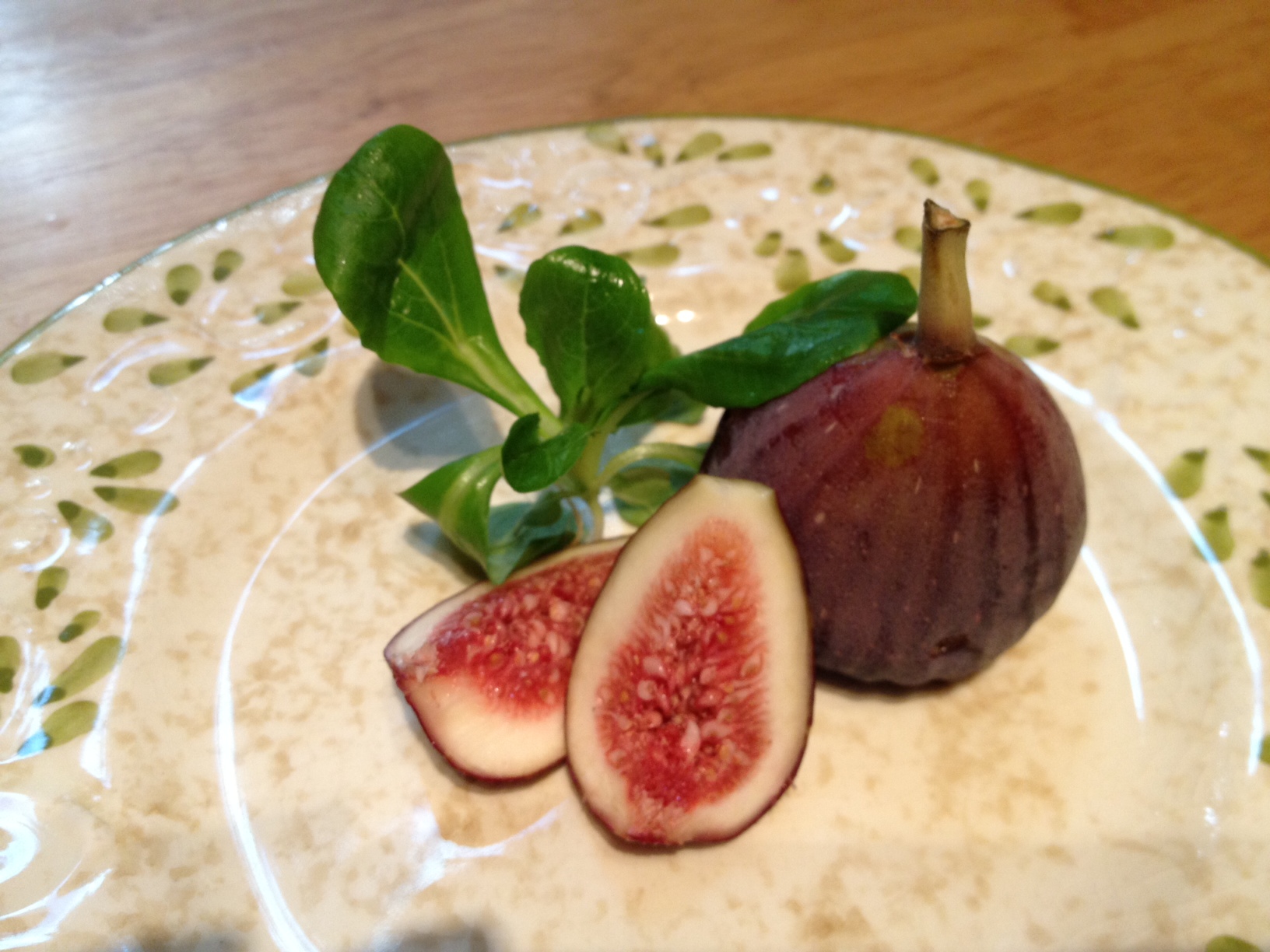
I ate my first figs this week. I didn’t want to, but Mama and Papa kept cajoling me. They were relentless. “It’s sweet,” she’d say. “It tastes kind of like a grape,” he’d say. “You’ll like it,” they’d say. Finally, I took a tentative bite. Then another. The supple flesh yielded a delicate sweetness. I took another bite. Where have these been all my life?

Turns out, they’re not always available. My friend Milo recently picked the first figs from his tree. And, like pomegranates, figs aren’t in stores year-round. You have to wait for them, so savor them!

Incidentally, Fig Newtons are named for the place where they’re made: Newton, MA. Mama says it’s a nice place to visit, particularly in the fall. You also might be interested to know that figs need tiny wasps to pollinate them—wasps that lose their antennae and wings as they excavate a path toward the center of the fruit. I’m sure you can understand what that means: they don’t make it back out! But don’t worry: the fig ends up digesting the wasp, much as we digest the fig, so it’s not like you’re really eating a tiny wasp with every fig. It’s kind of funny to think that, though, isn’t it?

Don’t you just want to take a bite?

Mama gave me some ideas to get you started. There are no recipes, as this is just what she’d put together.

  • Toast pine nuts in a dry pan while you’re blanching or steaming green beans (which are in season right now!) until bright green. Add the beans to the pan with quartered figs, a pat of butter, then finish with a toss of sea salt and a drizzle of balsamic reduction. Serve alongside a grilled or roasted pork tenderloin.
  • Whisk together 1 part fig-balsamic vinaigrette and a smidge of Dijon mustard with 2–3 parts olive oil until combined. Season to taste with salt & pepper. Pour over fresh greens, halved figs, crumbled goat cheese, and torn prosciutto.
  • Halve figs and place them, cut side up, on a baking sheet (lined with foil or parchment). Drizzle honey over them and bake at 350°F until figs are soft and releasing their juices, about 10 minutes. Terrific on their own as a snack, over ice cream, or serve with strawberries or raspberries and Brie or blue cheese.
  • Caramelize onions or leeks in butter, layer them in a pastry shell (either premade or store bought—or heck, break out the phyllo or puff pastry), top with figs, goat cheese, and fresh thyme, then bake until the crust is done. Finish with a swirl of balsamic reduction. Or skip the tart and pile all this loveliness on a pita, naan, or flatbread for a personal pizza; add some arugula or mache for a subtle peppery or nutty note.
  • Cook equal parts chopped figs & sugar in a saucepan over medium-low heat until thickened, squishing the fruit as you go along. Now you have jam!
  • Poach figs in port or Grand Marnier with the seeds of a vanilla bean, and a strip of lemon or orange peel, and aromatics like a cinnamon stick, cloves, or star anise. Then reduce the liquid until it’s of a syrupy consistency. Serve over ice cream, panna cotta, tapioca, or angel food cake.
  • Slice them, dehydrate them (in a very low oven or in a dehydrator), then toss into salads or granola or mashed sweet potatoes—or simply snack on them as they are.
  • Bake a basic yellow or almond cake in a jelly roll pan (lined with parchment paper). Carefully lift the cake out of the pan, and cut in half. Spread your fig jam over one half of the cake, lay the other half on top, and slice into even squares. How’s that for a fig newton??

I hope you enjoy figs as much as I do.

Love, Jude


5 Comments

It’s my birthday!!

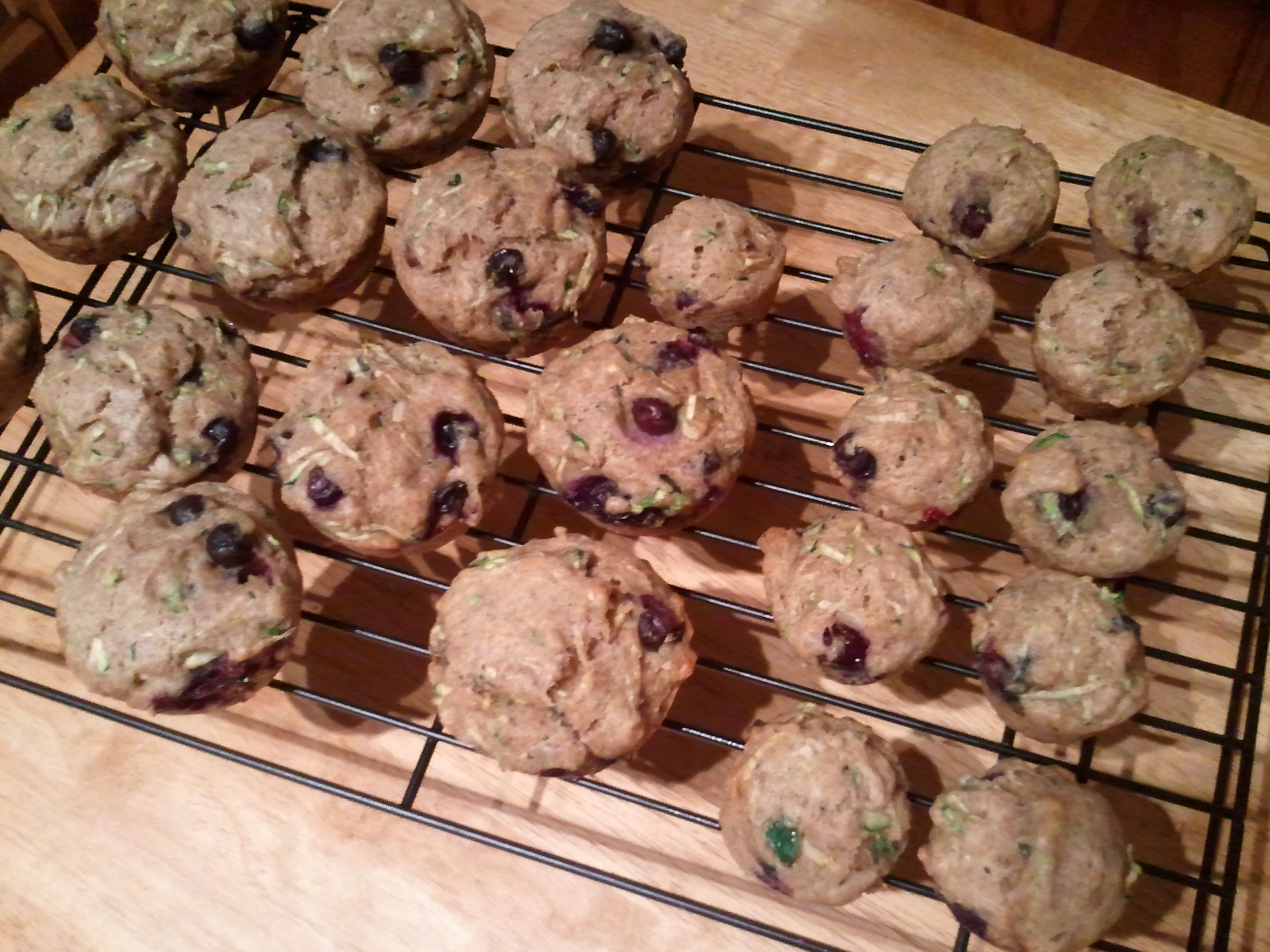
Last year, when I turned 1, Mama made me banana muffins. She made them again this year, but she also made some of her zucchini muffins with all the fresh zucchini we picked up at the farm stand. And she added our bluebies to them!

9 dozen muffins later….

Look at all the blueberries! They burst in my mouth. So yummy.

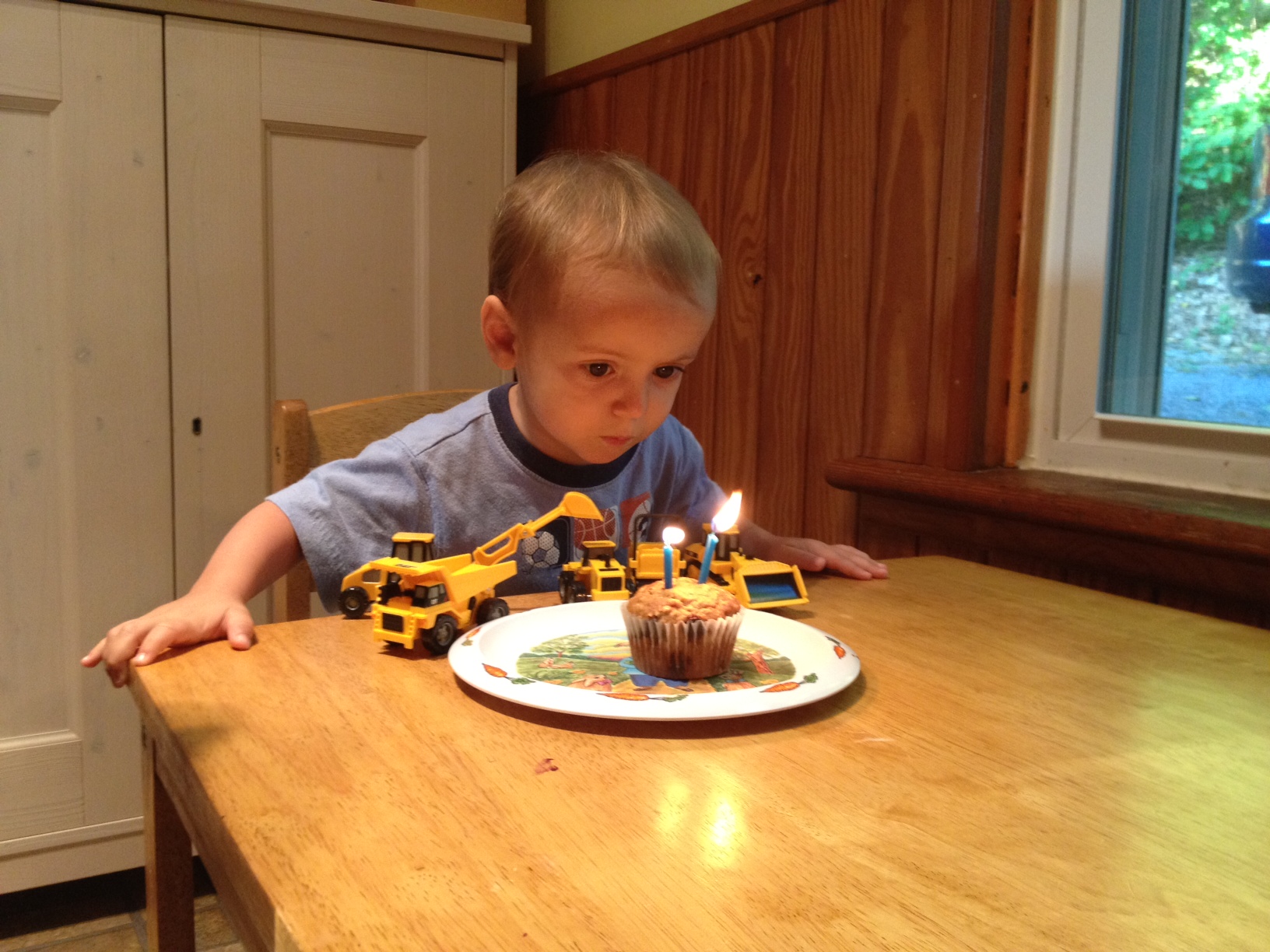
I like the mini-muffins because I can shove just about the whole thing in my mouth (even though Mama and Papa say, “Don’t stuff!”). I opened my presents and got to blow out candles, all before breakfast.

My new birthday trucks didn’t get in the way of my blowing out the candles on the first try.

Some may speculate now whether I should change the name of my blog, as I’m technically no longer a baby. “Toddler Jude” just doesn’t have the same ring to it. What do you think?

Love, Jude (who’s 2!)

Blueberry-Zucchini Muffins (Dairy-Free)

2 cups unbleached all-purpose flour
1 cup whole-wheat flour
1 tsp. cinnamon
1/2 tsp. nutmeg
2 large farm-fresh eggs
1/3 cup packed brown sugar
2 tsp vanilla
3 cups freshly grated zucchini, drained
2/3 cup canola oil
2 tsp. baking soda
1/2 tsp. sea salt
1 cup frozen organic blueberries

Preheat oven to 350F. Line muffin tins with paper liners or spray/butter the tins.

In a large bowl, whisk together the flours, cinnamon, and nutmeg.

In a separate bowl, whisk together the eggs, brown sugar, and vanilla. Stir in the zucchini. Add the oil, soda, and salt, and stir to combine.

Add to the wet ingredients to the dry, and stir until just combined, and all the flour is moistened. Gently stir in the blueberries.

Scoop the batter into prepared muffin tins and bake for 15-20 minutes (about 19 for regular muffins, 15 for minis). The muffins should be firm to the touch, and a pick inserted in the center should come out clean. Cool in the pans for 5 minutes, then remove to a wire rack to cool completely.

Yield: 1 dozen regular muffins & 1 dozen minis, or 18 regular muffins

Note: Mama advises grating your zucchini first and putting it in a collander set over a bowl while you gather the rest of your ingredients. And she says these muffins freeze really well!


2 Comments

Stuff It

In an effort to fill a Sunday, Mama and I traipsed around to different farm stands (with a stop at the zoo somewhere in between). Next to the zucchini that was almost as big as me, she spied some gorgeous giant yellow peppers and thought they would make good stuffers. At a later stand, she bought a couple ears of sweet corn (this is important, so pay attention).

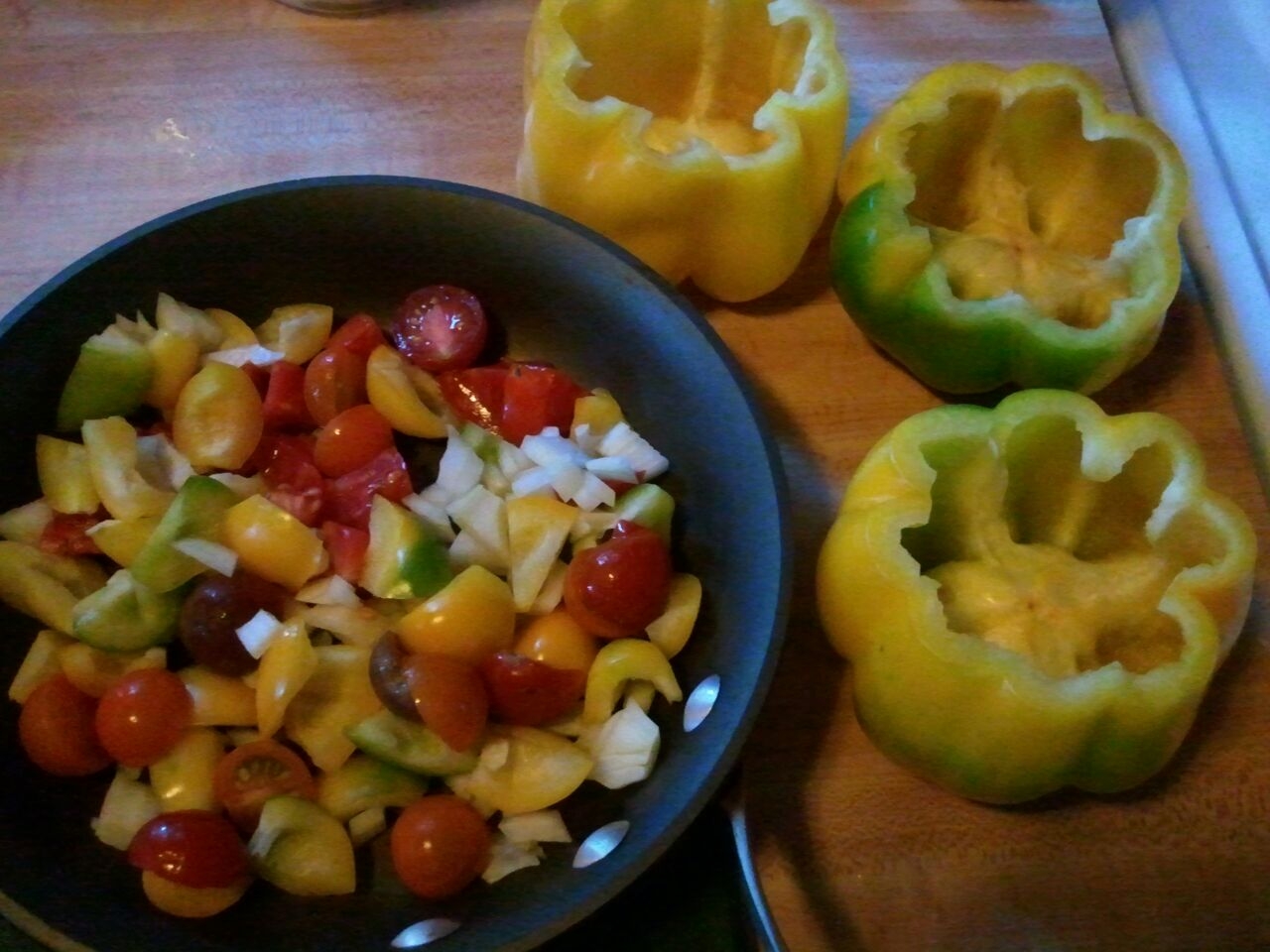
Much like our ham-and-pea roll-ups, these peppers were stuffed with things we already had in the house. Mama says you can cram practically anything into them. She cut around the top of the pepper and pulled out the seedy core. Then she broke off the pieces of the pepper top and chopped it so she could add it to the pepper stuffing mix. We still had some tiny heirloom tomatoes from my friend Walter, and we had an already-cut onion in the fridge. She put these veggies into a small frying pan with olive oil, cumin, coriander, and salt & pepper and sautéed them until the pepper and onion were soft and the tomatoes were cooked down. She added the kernels from an ear of corn and some crumbled veggie meatballs she had made a few weeks ago and had in the freezer.

How can these not be good?

How can these not be good?

She stuffed a pepper for me, then added to the rest of the stuffing some adobo sauce from a can of chipotle peppers that were also leftover in the freezer. Mama tented foil over the peppers and baked them in a 375°F oven until they softened, 20–30 minutes. She took the foil off towards the end of cooking, to brown the tops of the peppers.

You can see the added corn & broken up "meat"balls added to the filling.

You can see the added corn & broken up “meat”balls added to the filling.

Meanwhile, Mama cooked some brown rice, but she could very well have used quinoa or couscous. You can certainly add this to the pepper stuffing, but she kept it on the side and added it to the peppers before we ate them. She also made a fast guacamole and baked some tortilla chips by breaking up a whole-wheat wrap, spraying the pieces with cooking spray, and putting them in the oven for 10 minutes while the peppers cooked. (You can season these with salt & cumin, but Mama left them plain.)

Though I’m generally a fan of avocados, I wasn’t too keen on the guacamole. I did dip my chips in it (just barely), though. And to everyone’s surprise, I ate more than a few bites of the pepper stuffing. I had to examine each bite first to figure out what was on my fork, and I wasn’t much in the mood to eat (having missed my nap), but eat it I did. Mama and Papa kept asking, “Isn’t it silly that there’s a pepper for a bowl?” I’ll tell you what’s silly: they ate their bowls. Now, isn’t that silly?

Love, Jude

Peppers Stuffed with Summer Goodness

1 teaspoon + 1 tablespoon olive oil
12 ounces extra-lean ground beef, ground pork, or soy crumbles [optional]
4 sturdy bell peppers (any color)
1 onion, finely chopped
1 pint cherry or grape tomatoes, halved
1 teaspoon ground cumin
1 teaspoon ground coriander
1 ear corn, kernels removed (about 3/4 cup)
1 chipotle pepper in adobo sauce, chopped [optional]

Preheat the oven to 375°F.

In a medium skillet over medium heat, heat 1 teaspoon olive oil. Add the beef and cook, stirring occasionally, until just barely cooked through, about 6 minutes. (If using frozen soy crumbles, cook until heated through.)

Meanwhile, carefully cut around the top of each pepper, right below the “shoulder,” then pull out the seedy core. (Save the tops.) Pull out any remaining ribs and seeds. Set cored peppers aside. Break off the pepper tops from the stems, and roughly chop.

To the skillet, add the remaining tablespoon olive oil, if necessary. Add the chopped pepper tops, onion, tomatoes, cumin, coriander, and salt and pepper to taste. Cook, stirring occasionally, until the pepper and onion are soft and the tomatoes have cooked down, about 8 minutes.

Add the corn and the chipotle pepper, if using, with as much adobo sauce as clings to it. Stir to heat through.

Divide the mixture among the peppers, setting them in a baking dish just big enough to hold them, such as a pie plate or 8 x 8” pan. Loosely tent the peppers with aluminum foil, then bake for 20 minutes. Remove the foil, then bake another 10 minutes, or until the peppers are softened and the tops are browned.