Mama read a book on how French kids sit still at mealtimes and eat whatever’s on their plates. She thought she could implement the same system with me. (What she doesn’t know is that she almost succeeded, but then she started working, and now I eat at a very American daycare with very American kids.) But the point of this blog post isn’t to document Mama’s frustrations with me as I continue to throw food (though I do think she’s pretty funny when she’s annoyed); it’s to tell you about the lovely cake we made! The book talks about children helping out in the kitchen, something I’ve been doing for a long time now. It goes further to share a recipe for yogurt cake, or gâteau au yaourt, which is the first thing many French kids learn to bake.
I can see why. It’s so simple! Of course, there’s yogurt in it, and then almost all the other ingredients are measured with the empty yogurt containers. Mama bought lemon yogurt, which she poured into a large bowl. She spooned sugar into one container, which I dutifully dumped in. I then stirred the sugar and yogurt together, testing as I went along to make sure everything tasted right. Then Mama added a teaspoon of vanilla, a little less than a container of canola oil, and 2 eggs. She let me continue to stir but said I couldn’t taste anymore because of the eggs.
Now that the eggs are in, I had to stop sampling. (Note my yogurt mustache.)
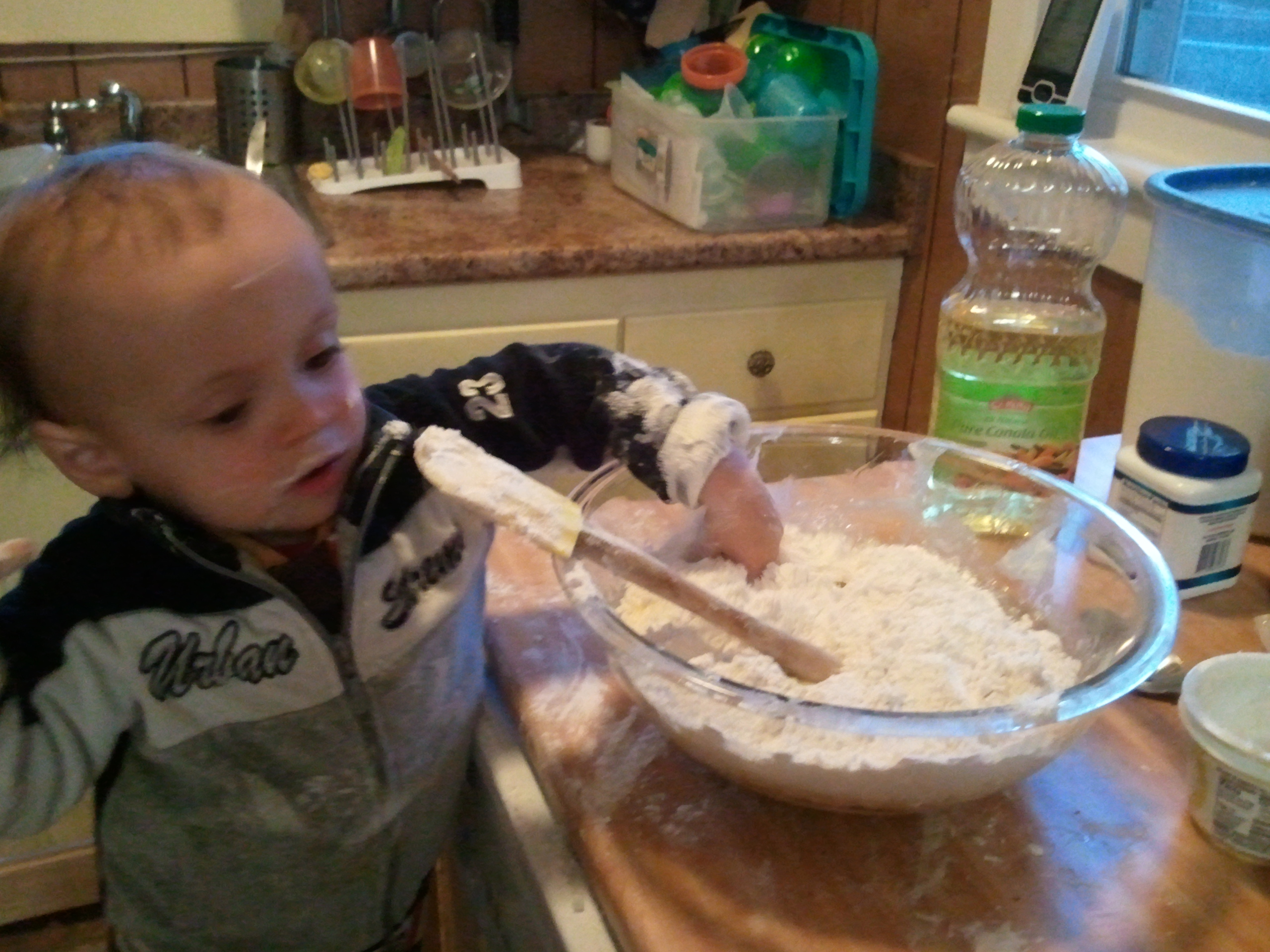
Then she spooned flour into the containers (4 of them, in total) and let me dump them into another bowl. She had to show me how to do it because I started to pour the flour towards me, instead of away from me and into the big bowl! (How was I supposed to know?) Mama added half a tablespoon baking powder and let me stir it all together. I liked using my hands to mix it, and it looked so nice on the countertop… and the chair and the floor and my clothes. After that, she added the flour to the egg bowl and stirred it really well. (She thought this might be a better job for her.)
I don’t know why anyone would bother with a spatula to stir a cake when a hand works so much better.
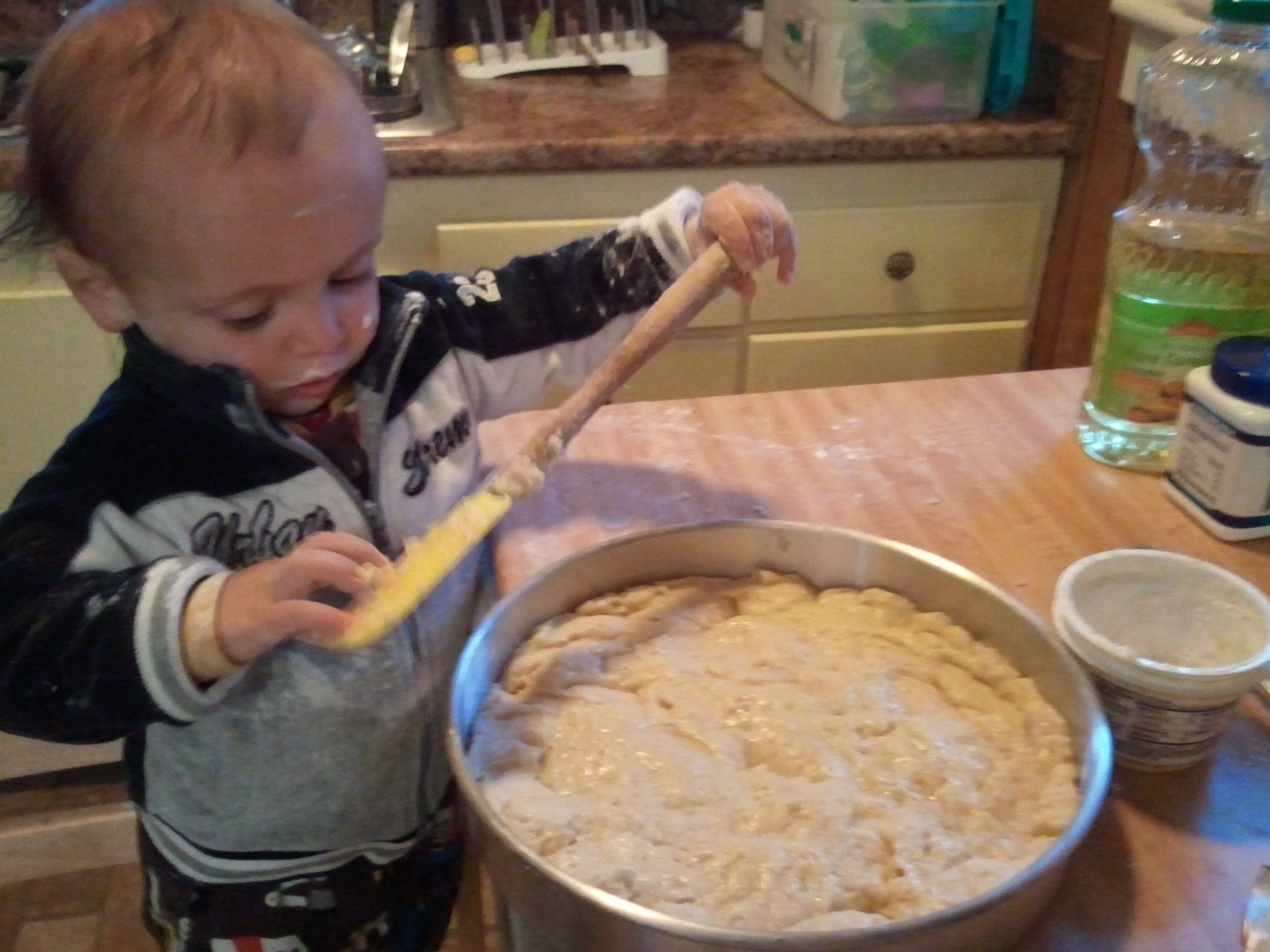
Mama showed me how to grease the cake pan with the canola oil, then she poured the cake batter into it. I smoothed out the cake, and into a 375° oven it went.
I’ve heard cake batter is pretty good, but Mama stopped me before I could taste any.
I nearly forgot about it, but I suppose it took 30–40 minutes to bake, and before I knew it, there was a cake! Mama cut a slice to share with me. She said it’s not the prettiest cake she’s ever made, but it sure tasted the best since we made it together. (To be honest, it seemed like I did most of the work.)
It looks like I made this cake in my play kitchen, but I didn’t.
I liked the lemony taste to the cake, and it wasn’t too sweet. (It would be delicious with blueberries or raspberries!) It was heavy, though, so I didn’t feel like I needed a whole piece to myself. (Mama, however, had other designs in mind.) I like helping Mama in the kitchen, and Papa was very pleased to see we baked a cake. If this is what being a French kid is all about, then sign me up. In fact, my passport arrived last week.
By now, it’s no secret that I love eggs. I’ll take them any way I can get them. But Mama says people are a little afraid of soufflés because they have a reputation for being temperamental [insert joke about soufflés being like Mama here]. Kidding aside, Mama showed me that there’s nothing to fear about this puffy little delicacy whose name comes from the French word for “blow.” I blow on my food when it’s hot, and just yesterday I blew my first bubbles outside, so I’m excited to learn how to make these.
First, Mama said we have to make a “roo.” We’ve made this before by melting butter in a saucepan, then whisking in flour until it’s all cooked and bubbly. Then we add milk. Mama says some people say to use cold milk, while others say to use hot milk. She “splits the difference” by using milk that’s been taken out of the fridge for a little while, “just to take the chill off.” Once the milk’s added to the saucepan, we stir and stir until it thickens. (Well, Mama took care of the stirring because it was very hot.) She said this is what’s called a béchamel, but it looked like a white sauce to me.
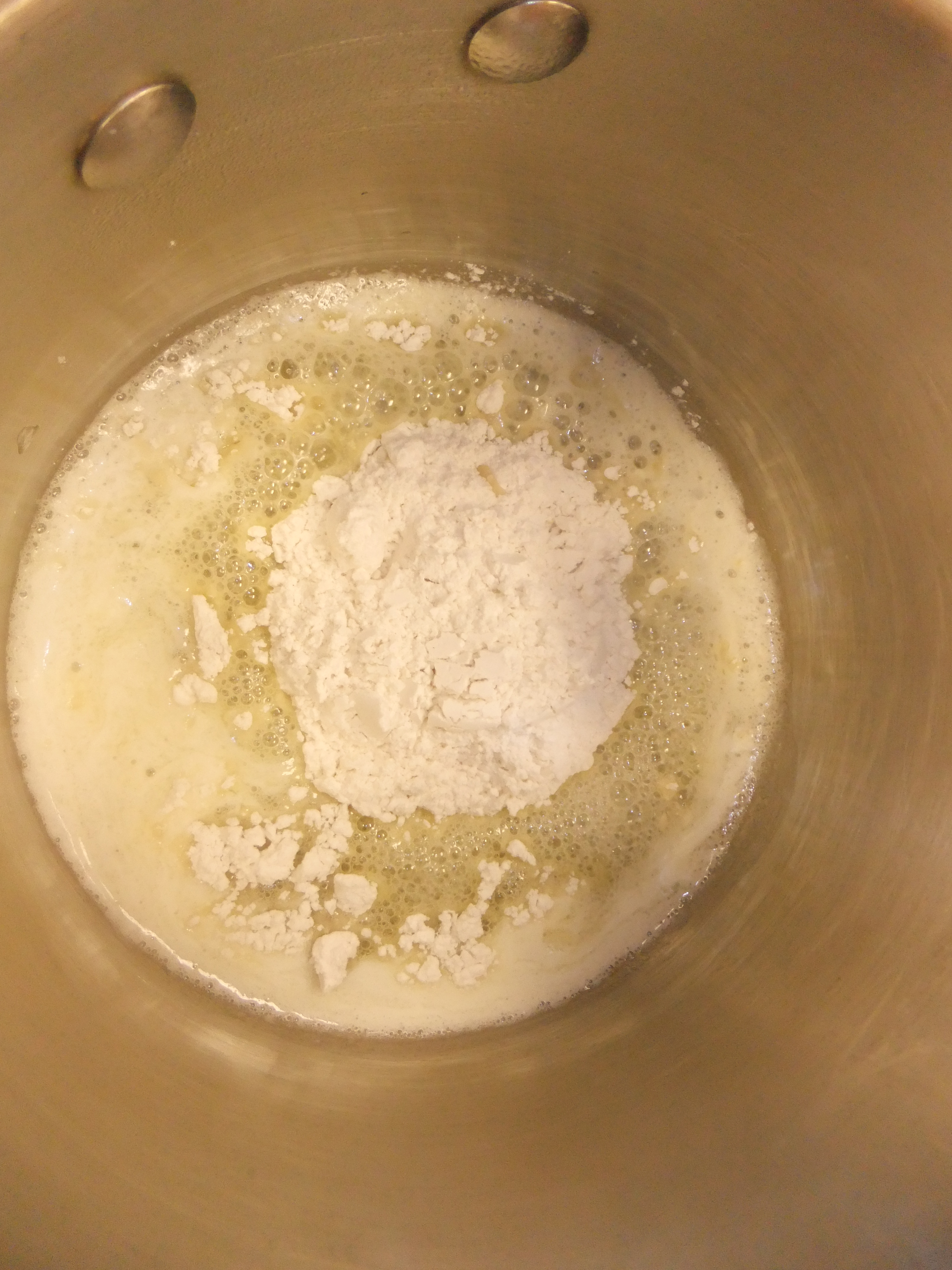
When butter’s all foamy, add the flour all at once and start whisking.
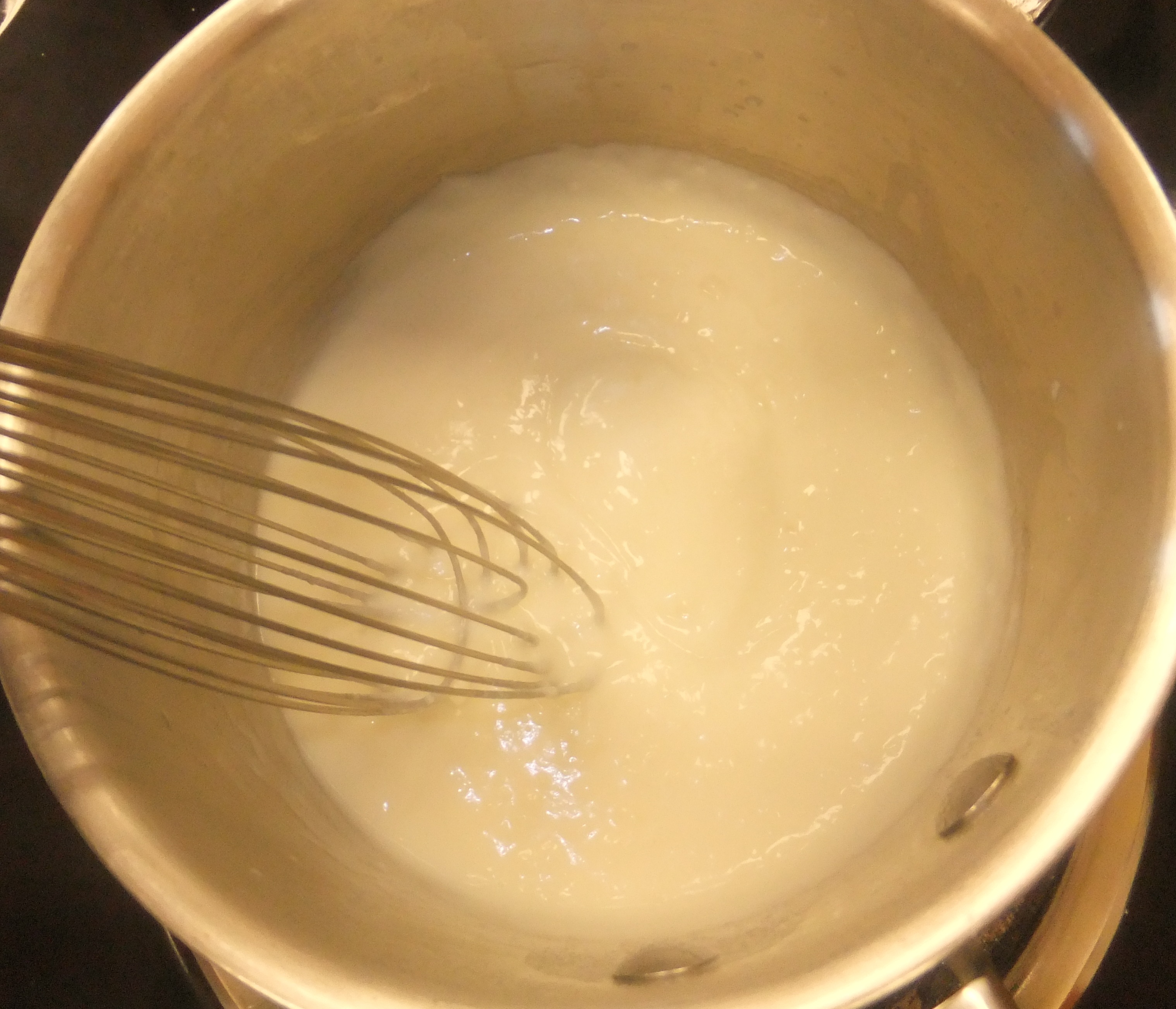
This is how the white sauce will look once all the floury clumps are worked in to the milk.
This next part is where it starts to get a little scary. You have to separate your eggs. I don’t quite understand how sometimes I can crack the eggs and roll them around and the shell comes off, and other times, Mama cracks the egg and out comes a runny gloppy mess. But this is one of those times when Mama has to crack the eggs. She notes that the whites must be meticulously free of yolk, and because she doesn’t take her own advice to separate the eggs one at a time over a small bowl (and then dumping each white into a larger bowl), she creates an opportunity to show me how to remove errant yolk from the white: use the shell to scoop it out!
Now Mama sets aside the bowl of whites and sets the bowl of yolks on a damp dishcloth—she explains that it’s to keep the bowl from sliding when she “tempers” the yolks. (I thought this must be why soufflés are considered temperamental, but Mama says it’s how you bring hot and cold liquids together without ruining them.) She whisks the yolks to break them up, and then she pours a little of the hot white sauce into them, whisking the whole time. She adds a bit more sauce, still whisking, and keeps at this until all the sauce is in the yolks. Now you have your soufflé base. Mama says this is the time to add any flavors—crumbled cooked bacon, puréed or small-dice cooked veggies, cheese, fruit, finely ground nuts, chocolate—but we’re keeping it plain today.
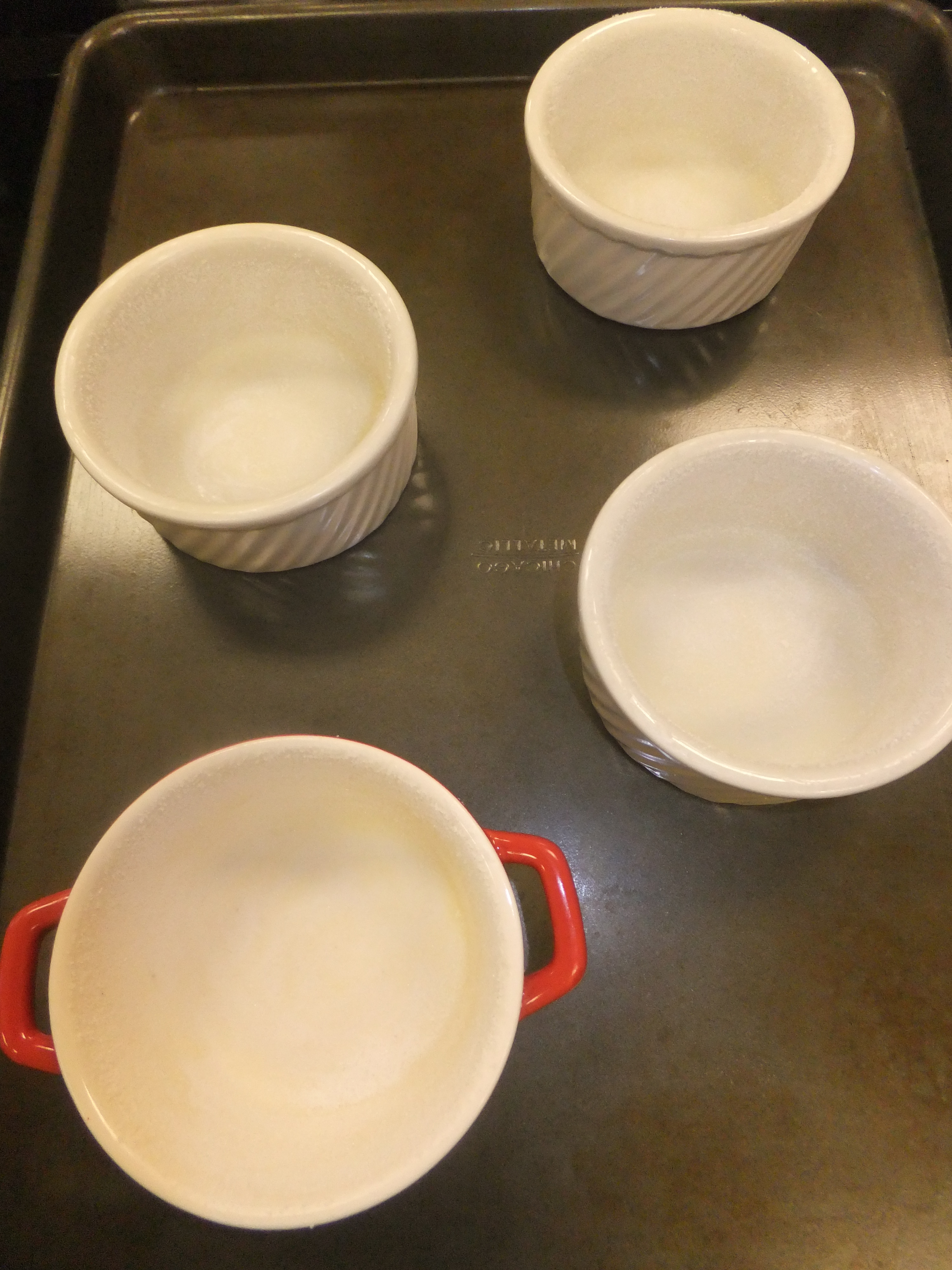
Mama notes that here’s a good place to stop, if you have to. If you’re making soufflés for breakfast the next day or for dessert later on, this is where you should stop, put everything in the fridge, then take it out about a half an hour before you want to resume cooking—to “take the chill off.” That’s when you should turn on your oven, too. But before finishing the recipe, there’s one more thing to be done: prepare the ramekins. I didn’t know these could be used in the oven or for food other than mine. Mama always used to feed me from these…until I discovered that they break into so many pieces when they hit the floor. (I’m just learning about gravity, you know.) Brush melted butter all around the inside of each ramekin (or other small ovenproof dish), then dust each with either parmesan cheese (if savory) or sugar (if sweet). (Mama thinks finely chopped nuts might work, too.) This step, Mama says, gives the soufflé something to grab onto as it climbs up the ramekin. Mama set the prepared ramekins on a baking sheet.
These are sugared.
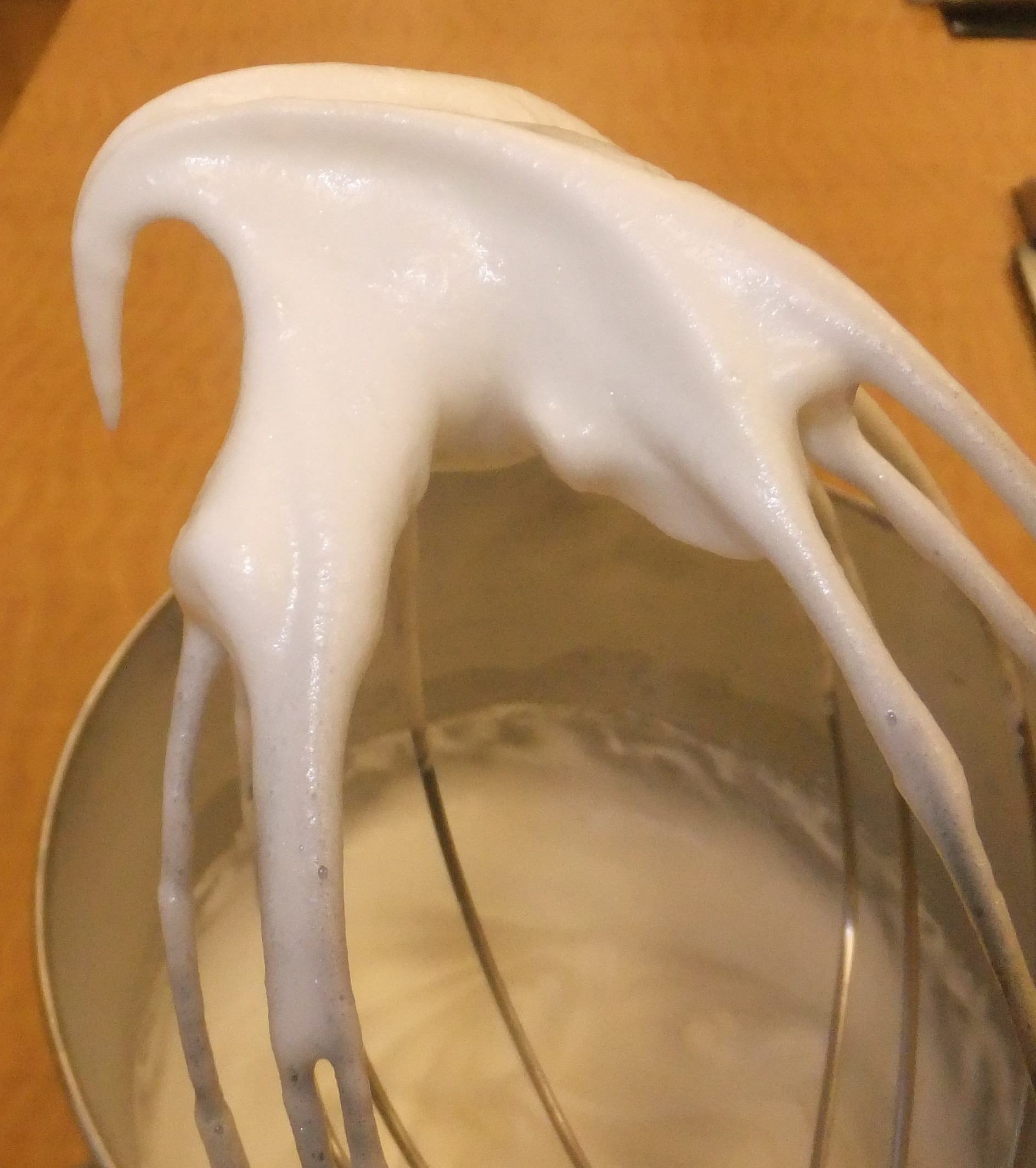
Next, Mama turned her attention to the egg whites. She plugged in the mixer and began to beat them until they formed soft peaks.
See how the “peak” flops over?
Then she folded the whites into the yolk mixture, being careful to not overmix—she explained that if she stirred too vigorously, she could deflate the whites, which would not bode well for the soufflés. Mama says that as soon as the whites are folded in, it’s time to pour the mixture into the prepared ramekins. Fill them nearly to the top (most ramekins have an inner rim that’s a good marking spot). She sprinkled a bit more parmesan on top and popped them in the oven.
Then we waited. Mama said we may not open the oven to check on them, otherwise they’ll deflat like a balloon. So when the time was up, we turned on the oven light to take a peek. Those soufflés had puffed up like my grandma’s hairdo and were golden brown. Mama called them gorgeous. The real test was taking them out of the oven… and they held! They stayed puffy until we dug in. They were eggy, and they tasted as soft and fluffy as they looked. I could eat these all day.
Love, Jude
Basic Soufflés
2 Tbsp butter
3 Tbsp flour
1 cup whole milk or half-and-half
4 eggs, separated
Salt and pepper, to taste
1/4 tsp nutmeg (optional)
Melted butter (about 2 Tbsp)
Grated parmesan cheese (or sugar, if making a dessert soufflé) (about 2 Tbsp)
Preheat the oven to 425°F. Brush six 6-ounce ramekins with melted butter, then dust with parmesan cheese (or sugar). Set aside on a baking sheet. Over medium heat, melt the 2 tablespoons butter in a medium saucepan, then add the flour, and cook, whisking constantly, until the flour is incorporated and the mixture begins to bubble, 1–2 minutes. Slowly add the milk and continue to whisk, working out any clumps. Then whisk occasionally until the mixture is hot and begins to thicken, 5–10 minutes. Do not let the mixture boil. Remove from heat and add the salt, pepper, and nutmeg.
Whisking constantly, pour a small amount of the milk mixture into the yolks. Add a bit more milk, continuing to whisk. Then add the remaining milk mixture to the bowl and whisk thoroughly. If adding flavors or cheese, do so now.
Beat the egg whites with a hand mixer on high speed until soft peaks form. Then immediately and carefully fold in to the yolk mixture in three additions. Immediately pour the mixture into the prepared ramekins, up until the inner line. Wipe the rims of any errant mixture. Sprinkle with additional parmesan, if desired.
Bake for 17–18 minutes in the center of the oven, until puffed and golden. The centers should look set and firm. Resist the urge to open the oven to check on them, but when you do take them out, a toothpick inserted into the center should come out clean. Serve immediately.
Yield: 6 soufflés
Note: Mama says it’s not a bad idea to add an additional yolk to the base if you’re going to be adding a lot of stuff to the soufflé; the extra yolk will make the base stronger. Try adding up to ½ cup shredded cheese and either ½ cup vegetable puree or 1/3 cup small-diced cooked vegetables or crumbled cooked bacon to the base (before folding in the egg whites). Some ideas: butternut squash-gruyere-paprika; onion-roasted pepper-rosemary-spinach; artichoke-red pepper-gruyere-thyme; red pepper-fennel-onion; or try blue cheese-walnuts by substituting finely ground walnuts for the parmesan cheese.
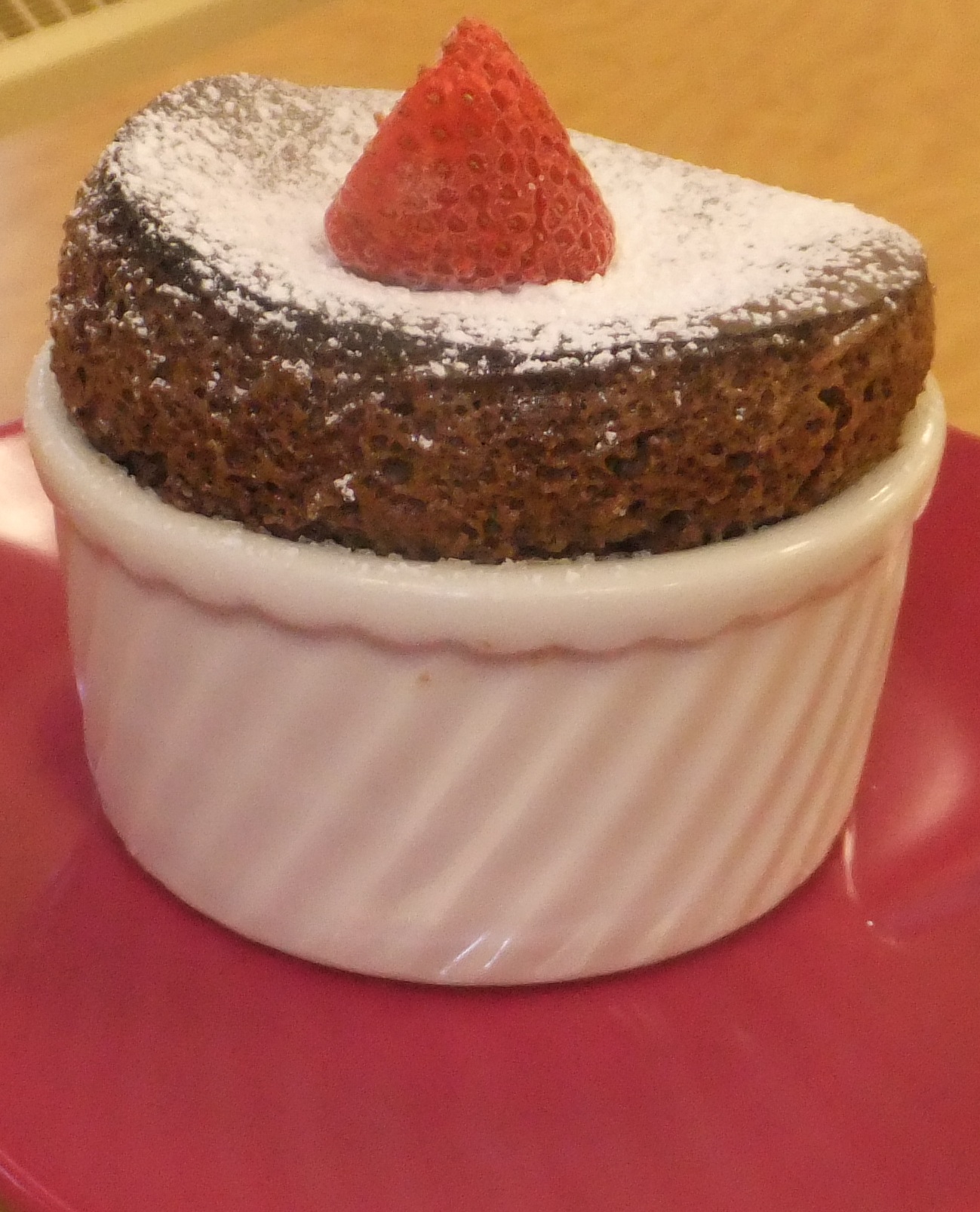
Variation: To make a chocolaty soufflé, whisk in 1/2 cup unsweetened cocoa powder and 1/2 cup sugar to the finished white sauce. After the mixture is tempered into the egg yolks, add 1 tsp vanilla extract. Add 1/4 cup sugar to the egg whites as they’re being whipped to soft peaks. Proceed with the rest of the recipe, but be sure to sugar your ramekins.
Soufflés will fall a little bit (cracking the tops) once they’re taken out of the oven, but they really should remain fairly puffy.
Poor Mama. She’s had a lot of “Misses” of late and has had to resort to her backup supply of purees and other mashed foods. Maybe she’s letting me graze too much during the day on things like fruit, cheese, and organic cereals. Or maybe I’m just being a picky baby.
But this weekend she made something that surprised even me. Eggplant has been hit or miss. “Baby” ganoush—miss. Ratatouille—hit. Last night she sliced a few eggplants, sprayed them with olive oil, and grilled theminside (even though it was gorgeous outside). While the slices cooked, she made a pesto to spread on them, telling me she’d have to substitute almonds for the pine nuts she was sure she had. She then made a filling with shredded mozzarella, tomato sauce, golden raisins, and some of the cooked eggplant chopped up. (She also cut up some kalamata olives for herself and me, for “on the side,” since Papa does not like them one bit.) She placed a bit of filling on one end of each slice of eggplant, rolled it up, and put each roll in a baking dish that had a little bit of sauce in it. Then she topped it all with more sauce, sprinkled more cheese over it, then baked it until the cheese turned golden. On the side, she made orzo, then grilled a pork chop for Papa.
I thought the eggplant was tender and flavorful, and the orzo was so much more pleasing in texture than the brown rice Mama usually serves. Even Papa, who’s not always a fan of eggplant either, enjoyed it (though he said the olives threatened to “contaminate” the whole dish). What was even more of a surprise was that I ate the leftovers for lunch today, and I usually cannot abide leftovers. Live and learn.
Love, Jude
Mama’s Pesto
(even Mama couldn’t come up with a more approximate recipe for this one—she just keeps tasting it until she gets it right)
[UPDATE: Mama finally sat down and drew up a recipe, which you can find here.]
About 1 cup loosely packed fresh basil leaves, rinsed and torn or cut chiffonade
A couple tablespoons pine nuts or other favorite nut, toasted or not
A couple tablespoons freshly grated parmesan cheese
Juice of half a lemon, or so
1 clove garlic, roughly chopped (or more if you really like garlic)
Salt and pepper, to taste
Good extra-virgin olive oil, as needed
Place all the ingredients in a food processor and pulse or blend until a paste forms. Stream in enough olive oil to give it body. The pesto should be intensely flavored, so that a little goes a long way. Adjust the tastes as you go along—you can always add more, but you can’t take away.
Note: Mama advises against toasting the nuts if you’re going to be baking the pesto, as in the eggplant dish, above. She also says that you don’t have to use basil—spinach, parsley, and arugula all work just as well.
Ever since I was about 9 months old, I’ve eaten a farm-fresh egg for breakfast. It started out as a soft-boiled egg yolk, and now it’s a nice scrambled egg that I can feed myself. Sometimes Mama puts cheese on it, sometimes even salsa (¿huevos rancheros, anyone?). Mama’s eggs are my favorite because she makes them soft and fluffy. She says the secret is taking them out of the pan before they’re fully cooked.
This morning I didn’t feel like eating my egg (though the dog sure appreciated it), so Mama decided on eggs for lunch. And this time, she did something I’ve never seen before. She put them in a pot of water and put them on the stove. Once the water started boiling, she turned off the heat, covered the pot, and let them sit about 10 minutes. Then she ran the eggs under cold water in the sink.
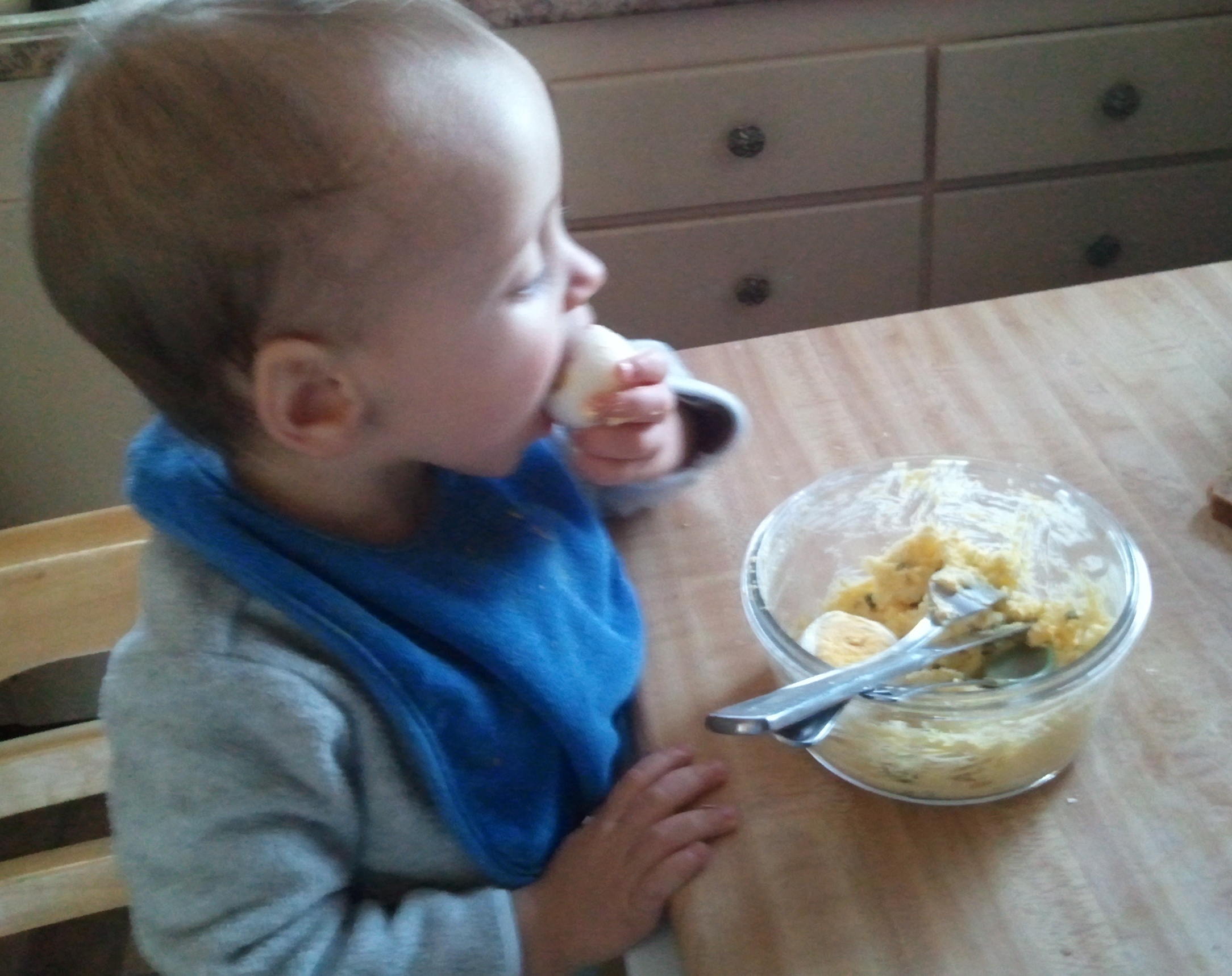
Then Mama showed me how to crack ’em: She knocked one on the counter, rolled it under her palm, then peeled the shell right off! Needless to say, I was hooked on this whole cracking business. We peeled four eggs, and then Mama mashed them with a fork. She added some mayonnaise (she told me I was too young for the homemade kind) and Dijon mustard, a splash of vinegar, salt, pepper, and capers. She had her “egg salad” on toast, but I liked it right off the spoon. Good show, Mama.
Love, Jude
I love eggs so much I couldn’t wait for them to be mashed.
Egg Salad*
4 hard-boiled eggs, mashed
1/4 cup mayonnaise
1 tsp Dijon mustard
Splash of vinegar
Salt & pepper, to taste
Capers (optional)
Dill (optional)
Mix the eggs, mayo, mustard, vinegar, and salt and pepper in a bowl and mash until well combined. Stir in the capers and/or dill, if using. Serve on bread or toast.
*Note: These amounts are approximate. Start small and taste as you go! The result should be creamy and hold together.
To say that Mama ate a lot of pizza when she was pregnant with me would be an understatement. She tells me that one week, she ate it four times. That was when Papa told her, “I’ll be glad to get you a pizza tonight, but I just can’t eat it again.” Even without the pregnancy excuse, Mama continues to eat pizza at least once a week.
So shame on her for keeping it from me for as long as she did! While some people choose to believe pizza’s actually sort of good for you (wheat in the crust, tomatoes in the sauce, dairy in the cheese, and all those other veggies you choose to put on top), Mama’s more on the fence about it. At least as far as it concerns me, pizza is a junk food. But as I grew up, I began to notice this interesting food she and Papa were putting into their mouths. It smells delicious, it’s shaped like a triangle (that’s a shape I know!), and it’s covered in cheese. Little by little, Mama relented. She started by giving me the tiniest pieces cut from a slice…
Little did she know what kind of floodgates she was opening. I can now eat a (small) slice all by myself. Her favorite (and I suppose mine, too) has tomatoes and pineapple on it. Sometimes olives or mushrooms, too, but I’m not always keen on them. I never get to eat Papa’s slices, though. Mama says pepperoni is definitely not good for babies.
So Mama finally showed me how to make a pizza so that I didn’t think they all come in a box (no matter how fun those boxes are to play with). She said dough seems scarier than it is because of the yeast. (It must be worse than the furnace kicking on to be that scary.) I thought it would be more fun, but after it was mixed, the dough just sat in the mixing bowl, hiding under a towel all afternoon. That thing slept longer than I do! Mama turned on the oven and put her big heavy pizza stone on the bottom to get it good and hot (this is a word I’m learning).
Mama said it’s important to have all your ingredients ready before you get your dough out because things move quickly then. When she removed the towel from the mixing bowl, I was shocked to see that the dough had grown! She called it “proofed,” but it looked like a big puffy pillow to me. She pulled it out and started smacking it around. “This is the best part,” she said and she let me touch it too. It was kind of warm and oh-so-soft. She pulled the stone from the oven, set it on the stove, and then dusted it with cornmeal. (She noted semolina would also work fine, but we just happened to have cornmeal.)
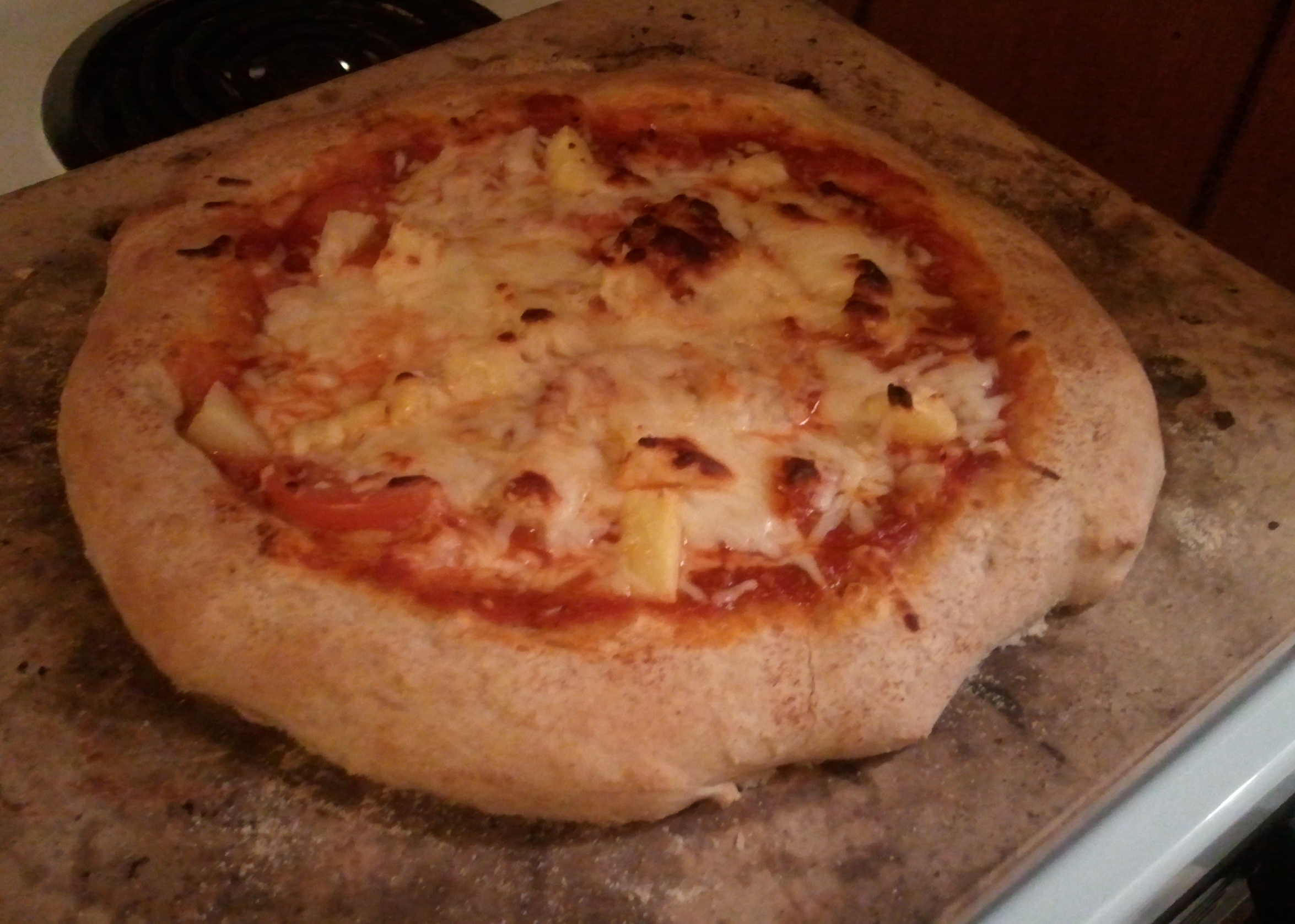
Then she started flinging the dough between her hands! Back and forth, back and forth, back and forth. The dough started stretching and sagging, and before I could say “Chicago style,” she flopped it onto the stone with a thwack. She patted it a few times to make a ridge around the edge, then she brushed the edge with olive oil and sprinkled it with garlic powder. She spooned lots of sauce around the middle, put our favorite toppings on it, then smothered it with mozzarella and parmesan. I couldn’t even see the pineapple there was so much cheese.
It only took about 10 minutes to bake, but we had to wait a long time before it was cool enough to eat. Something about a burning palate. All I know is I’ll take pizza any way I can get it.
Love, Jude
Once we cut into the pizza, there was no time to stop and take a picture. Be glad Mama paused to take this one.
Pizza Dough
2½–2¾ cups bread flour (mix in some whole wheat flour, if desired, but use 2¾ cups total)
1½ teaspoons salt
2 tablespoons olive oil
Scant tablespoon baking (active dry) yeast
1 cup warm water (ideally 105°–110°, but Mama says it just needs to be hot enough that it feels hot but that you don’t scald your finger)
Semolina or cornmeal
Pizza sauce, cheese, & toppings
Put the flour, salt, and olive oil in the bowl of an electric stand mixer. Separately, mix the yeast and water with a whisk until foamy. (Be sure you dissolve all the yeast.) Add to the mixer, and mix on low speed with the dough hook about 4 minutes, then on the next speed up for another 4 minutes. The dough will be slightly sticky. Remove the hook and cover the bowl with a towel. Let it sit for 3–4 hours, or until the dough is doubled in size (if you put it on your stove, the pilot light will make this process go a little faster). Pull it out of the bowl and give it a few kneads before shaping it.
Preheat oven to 500°. If you don’t have a pizza stone, liberally grease a cookie sheet before putting down the dough (otherwise, dust the stone). Spread out the dough, brush the edges with olive oil (optional), and top with desired sauce, cheese, and toppings. Mama says you can jazz up any store-bought sauce by sautéing some chopped onions and garlic and adding in a few fresh herbs. Bake for 10 minutes and enjoy. But watch you don’t burn your palate.
Being from Wisconsin, Mama tends to keep a lot of cheese in the house. I happen to love the stuff. (People say I take after my Uncle Scotty in that way.) My first cheese was an organic, raw-milk farmer’s cheese from a certified raw dairy a few miles from where we live. (The cows there are really nice!) The cheese was piquant and creamy and lovely.
I’ve since had different varieties of raw cheeses, both fresh and aged, as well as your run-of-the-mill store-bought varieties: Parmesan (from the wedge, not the can, of course!), Gruyère, feta, fresh mozzarella, Muenster, Manchego, sharp cheddar, chèvre (that’s from a goat), even cottage, though that wasn’t really my favorite. I did draw the line at bleu and Esrom, a real stinker of a cheese from Denmark. But I was a much younger baby when Mama gave those to me, so I’d be willing to try them again.
One of my first words was “cheese” (after “moo” and “Mama,” in that order). When we go out for the day, and I see my insulated lunch sack coming with us, I know there’s an organic cheese stick inside. Now that I have nearly all my teeth, I get to eat it by myself. Mama has to help peel it, but she no longer has to break it into tiny bites (some of which usually ended up in her own mouth anyway). At home, I have to fight off the dog when I have cheese in my hands, as she goes bonkers for the stuff.
What I haven’t eaten, though, is macaroni and cheese from a box. Mama says it’s just as easy to make it from scratch, so I’ll let you be the judge. (She can have the sauce made before the pasta’s even cooked!) To be honest, I wasn’t crazy about it at first—but then again, I wasn’t in love with pasta. But the cheesy stuff’s grown on me, as Mama’s started sprinkling a teensy bit of sea salt on her mac and cheese. (You try eating plain cream and butter over plain pasta and see how you like it. Mama says sea salt is not as bad for your health as regular table salt.) It’s still not my favorite-favorite, but I’ll eat it.
While the water boils for the pasta, Mama shows me how to grate the cheese without getting my fingers involved. She’s using my raw cheddar today, but she tells me most any cheese will work. Then she melts some butter in a small saucepan, adds some flour, and stirs. She calls this a “roo.” (What’s Roo doing in my mac and cheese? And where’s Tigger?) Then she adds the cream. She’d also use milk, but because I’m a baby, I can use all the fat I can get. (It’s great being a baby!) Mama whisks the cream gently until it starts to thicken, but she doesn’t want it to be too thick now since the cheese will thicken it further. (Add a bit more cream if necessary.) Then she stirs in the grated cheese, and it’s all gooey and melty. She’s drained the pasta and has added it to the sauce. Mama explains that hot pasta absorbs more of the cheesy goodness, though I prefer it a bit on the saucy side—it makes more of a mess that way, of course.
Love, Jude
Enjoying my mac & cheese.
Playing with my mac & cheese.
Wearing my mac & cheese.
Homemade Macaroni and Cheese
(Mama makes this one by feel, so amounts are approximate)
½ cup uncooked pasta
1–2 Tbsp, each, butter and flour
1 cup milk, half-and-half, or cream
½ cup grated cheese of choice (or more, to taste)
Sea salt, to taste
Cook the pasta according to package directions in very salty water. (Mama uses veggie spirals or kamut shells or quinoa letters or really anything other than white pasta.) Meanwhile, melt the butter over medium heat. Add the flour and whisk until combined, making a roux. Cook about 1 minute more. Add the milk in a steady stream, while whisking. Continue to steadily whisk the sauce until it begins to thicken, 3–5 minutes. Stir or whisk in the cheese, and mix until smooth. If it’s too thick, add some more cream. Mama says you can’t wreck it at this point. Taste it and see if it needs salt. Drain the pasta and add it right into the sauce, stirring to coat. This is a very cheesy dish. If you like it a little less cheesy (who are you?), make more pasta.
Yield: Enough to feed a baby and his mama lunch (or, about 2 cups)
Note: Mama sometimes tries sneaking veggies, such as baby spinach or chopped grape tomatoes, into this dish. As if I can’t tell they’re there! She tells me she’s going to try pouring some of the “mornay sauce,” as she calls it, on broccoli. We’ll see about that. She also notes that it’s very important to choose organic dairy products. They’re the best!
At the market today, Mama spied some “beautiful leeks” and thought about what she could make with them. “I’m feeling uninspired today,” she sighed as she pushed the cart among the produce bins. Then she mumbled something about organic potatoes, plopped a bag of them in our cart, and an idea was born.
I haven’t been partial to potatoes. Garlicky, buttery, salty, fried, or even cooked in a pot pie… I just haven’t taken to them. Mama started me on locally grown, organic, mashed fingerlings last summer. This was before she read that you shouldn’t give young babies potatoes because they belong to the nightshade family. Or something like that. Perhaps my finickiness was a self-preservation technique. Not the first time, and it certainly won’t be the last, I’m sure.
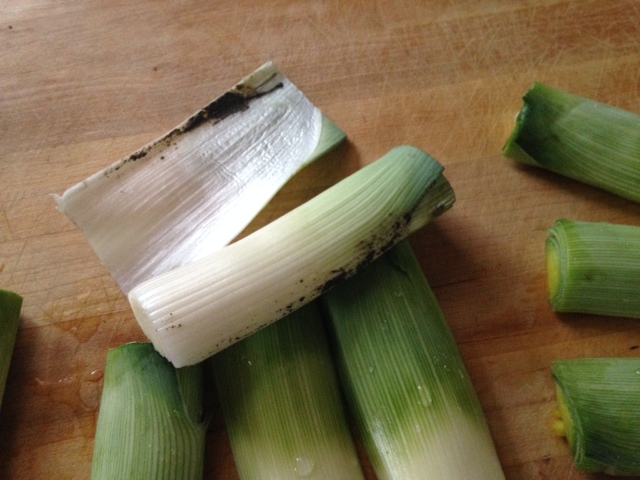
So what made Mama think I’d like vichyssoise, or potato-leek soup, is beyond me. But made it she did. She showed me how to trim the leeks, using just the white and light green parts, then run them under the tap to rinse out any sand.
These leeks sure are dirty.
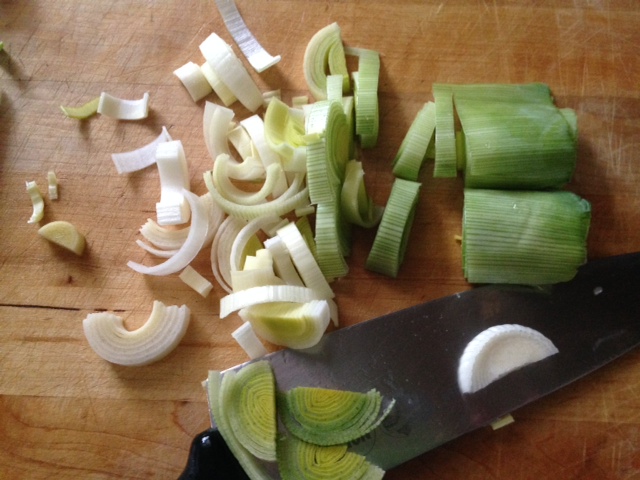
Then she sliced them into little half-moons (moon is one of the words I know!)…
The leeks don’t have to be sliced too-too thinly. Stop when you get to the very green part.
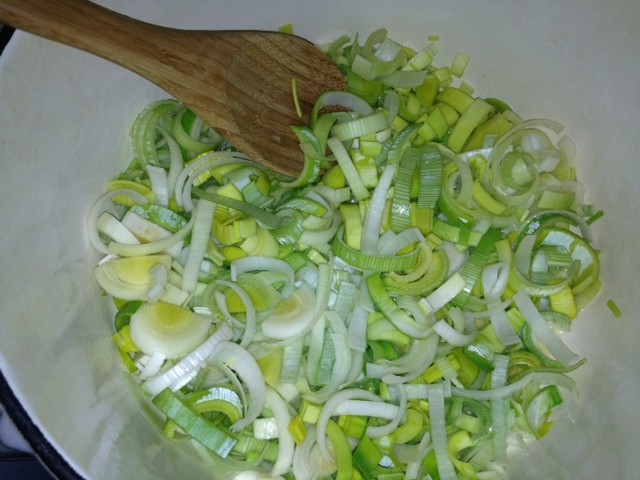
…and sautéed them in butter until they were soft, but not browned. She was adamant that they not brown, but still, some of them did.
Try to keep any color out of the leeks by gently sweating them.
So she deglazed the pot with homemade vegetable stock and scraped up any brown bits from the bottom. Once the stock was brought to a boil, she added the peeled and chopped potatoes and simmered them until they were soft. Then she took out a silly tool—a handheld blender! She whirred it through the soup, pureeing the vegetables until they were silky smooth. Some salt, pepper, and heavy cream to finish, and the soup was done.
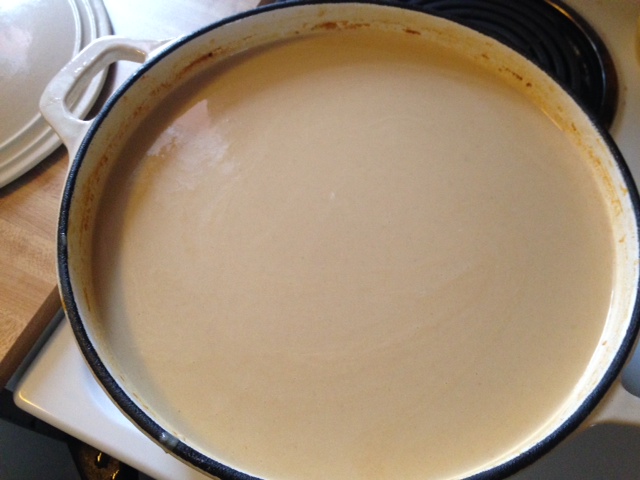
Don’t be intimidated. Mama made a quadruple batch for a soup swap. Doesn’t it look silky?
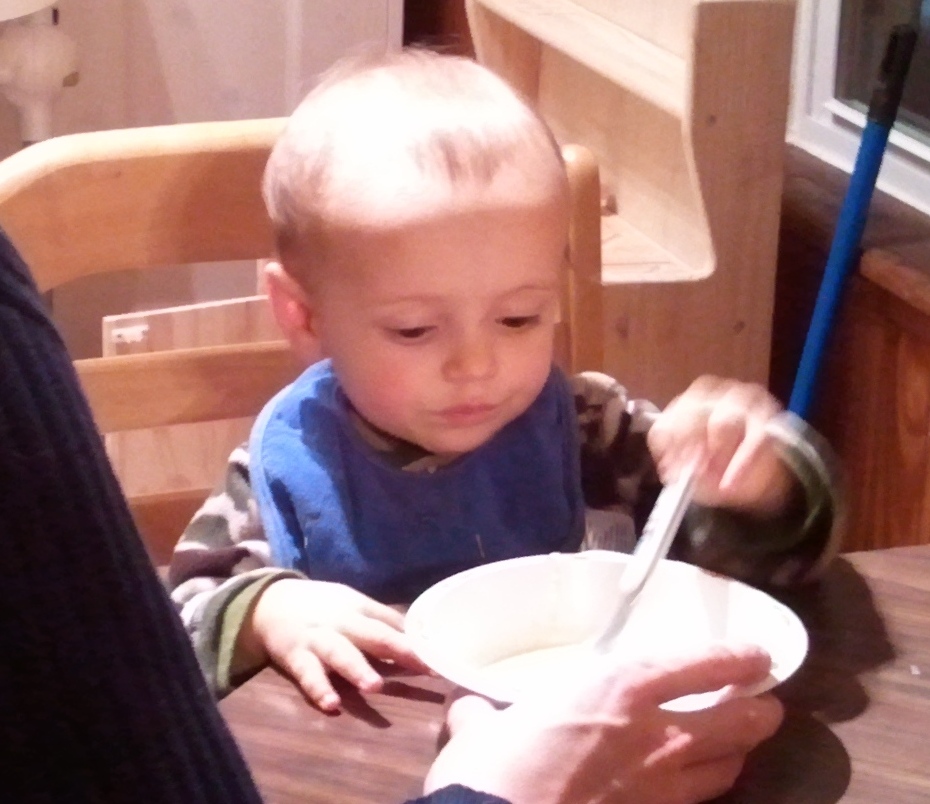
Though vichyssoise is traditionally eaten cold, it is the middle of winter after all. Mama served it to me warm, and she let me sit at the table, instead of in my high chair. Papa supervised, since I’m sort of all thumbs with a spoon. The soup was delicious. Creamy, and slightly oniony, and even a bit potato-y, it was velvety and soft, like new fleece pajamas. I had two bowls, and Mama showed me how to sop up the last bits with a piece of bread. Yes, please!
Mama posted this photo on Facebook, to show what a big boy I’ve become, and a friend suggested I start a blog. Mama’s never been very keen on blogs, but she agreed to help me out (see above re: “all thumbs”). I hope you enjoy what’s to come…as I most surely will not! I’m a baby, and it’s my prerogative to not eat whatever is placed before me.
Love, Jude
Not only am I enjoying my first bites of vichyssoise, but I’m feeding myself with a spoon while sitting at the table. Such a big boy!
Vichyssoise (and yes, do pronounce the last “s”)
1 leek, rinsed and thinly sliced (use just the white portion for a “purer” soup)
1 Tbsp butter
1 qt veg or chicken stock
1 lb potatoes, peeled and rough chopped
1 c heavy cream
salt and pepper, to taste (use white for a “purer” look)
Garnish with chopped chives, if desired
In a Dutch oven or soup pot, sweat the leeks in the butter over medium heat until soft, stirring occasionally so as not to brown them. Deglaze the pot with the stock. Bring to a boil, add the potatoes, reduce heat, and simmer until the potatoes are soft. Puree in the pot with an imersion blender (or carefully in a blender) until smooth. Add the cream and seasonings. Serve cold or hot.
To make a more traditional vichyssoise (Mama’s vegetarian), omit the butter and cook a couple strips of bacon, cut into pieces, or lardons, with kitchen shears. Once fat has been rendered from the bacon, remove the bacon and cook the leeks in the fat. Crumble the bacon for garnish.





 LittleJudeonFood