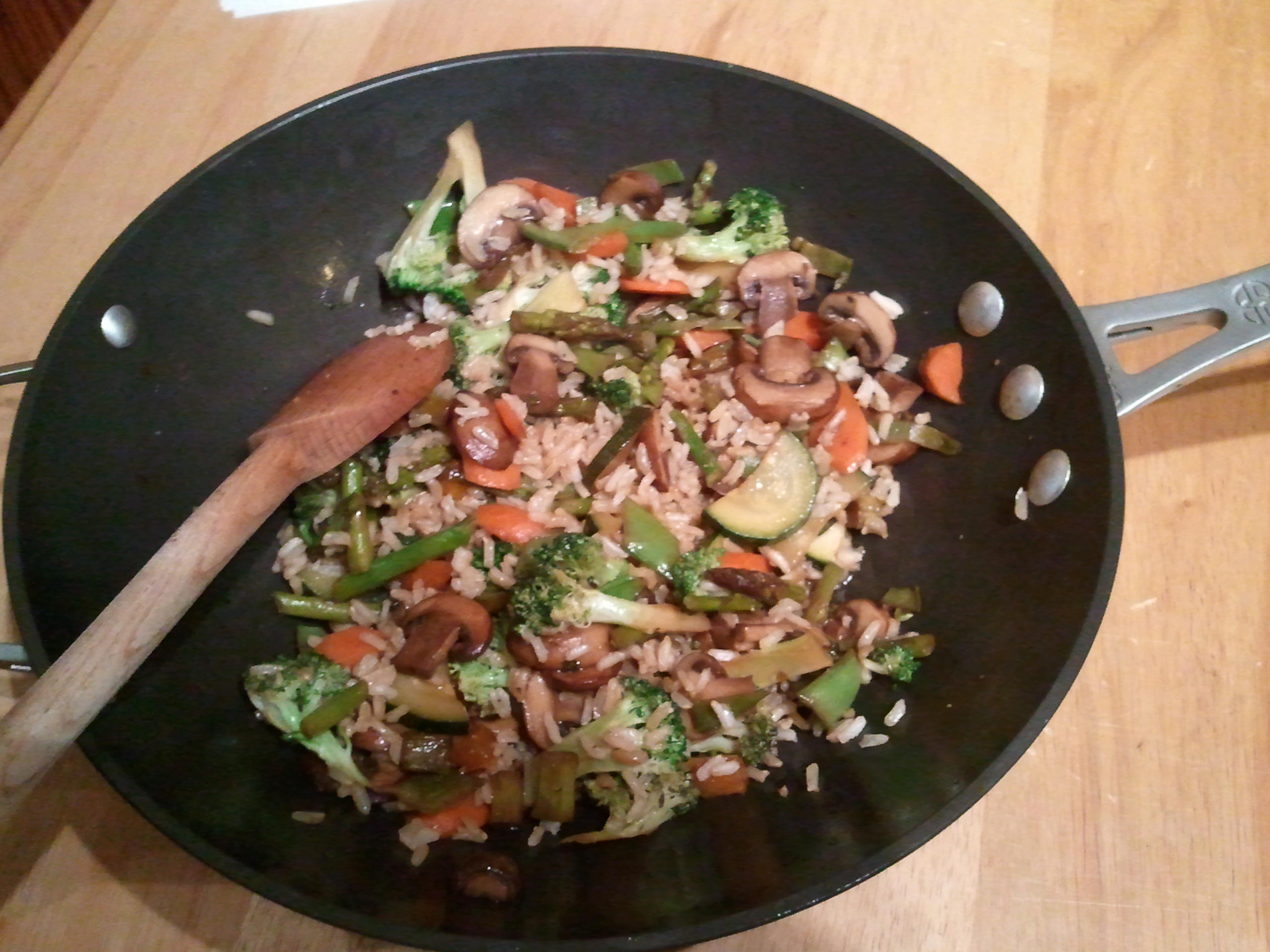
Tonight it was just Mama and me for dinner, so she kept it simple and showed me how to stir-fry. She explained that there are two tricks to stir-frying: a hot pan (not necessarily a wok) and thinly cut vegetables. The high heat cooks the small pieces quickly so they retain some of their natural crispness.
Start by cutting all your veggies to a relatively equal size. Your stir-fry won’t work if you’re scrambling to cut more items once you get your pan going. Tonight, Mama sliced cremini mushrooms, snow peas, carrots, asparagus, yellow pepper, broccoli, and zucchini. She heated toasted sesame oil, which has a higher smoke point—that’s how hot you can get your oil before it begins to smoke and set off that horrible screeching alarm in your kitchen. Plus, it has a nice nutty flavor. (I tasted it, so I know.)
First Mama sautéed the mushrooms to get them golden, then added the remaining vegetables, stirring constantly. Some folks would add scallions or garlic at this point, but Mama opted not to. Then she added about equal amounts of seasoned rice vinegar and tamari, which is similar to soy sauce. And that’s it! Serve with brown rice, top with cilantro or lime or chopped peanuts/cashews (if desired), and you have dinner.
Just look at all those yummy veggies!
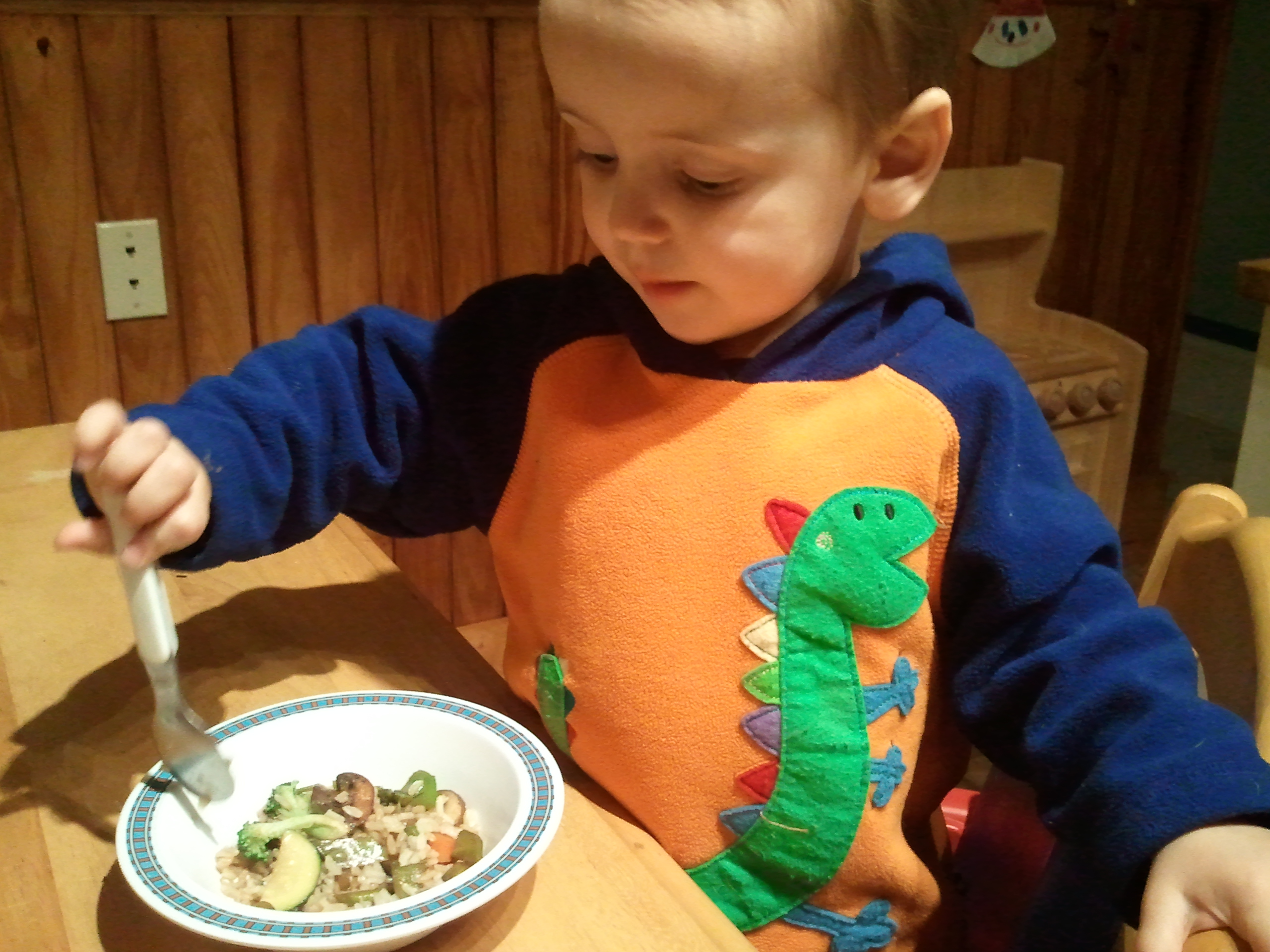
Now, I like rice as much as the next baby, but let me tell you about those vegetables. First I ate all the broccoli. Then the carrots. Then the asparagus, and next the mushrooms. I ate that stir-fry right up! But my favorite part was the fortune cookie Mama produced for me for eating such a good dinner. I love opening them. This one read, “If you care enough for a result, you will most certainly attain it.”
In bed…which is where I’m headed.
Love, Jude
All the veggies looked good, but I decided to start with the broccoli.
In an effort to fill a Sunday, Mama and I traipsed around to different farm stands (with a stop at the zoo somewhere in between). Next to the zucchini that was almost as big as me, she spied some gorgeous giant yellow peppers and thought they would make good stuffers. At a later stand, she bought a couple ears of sweet corn (this is important, so pay attention).
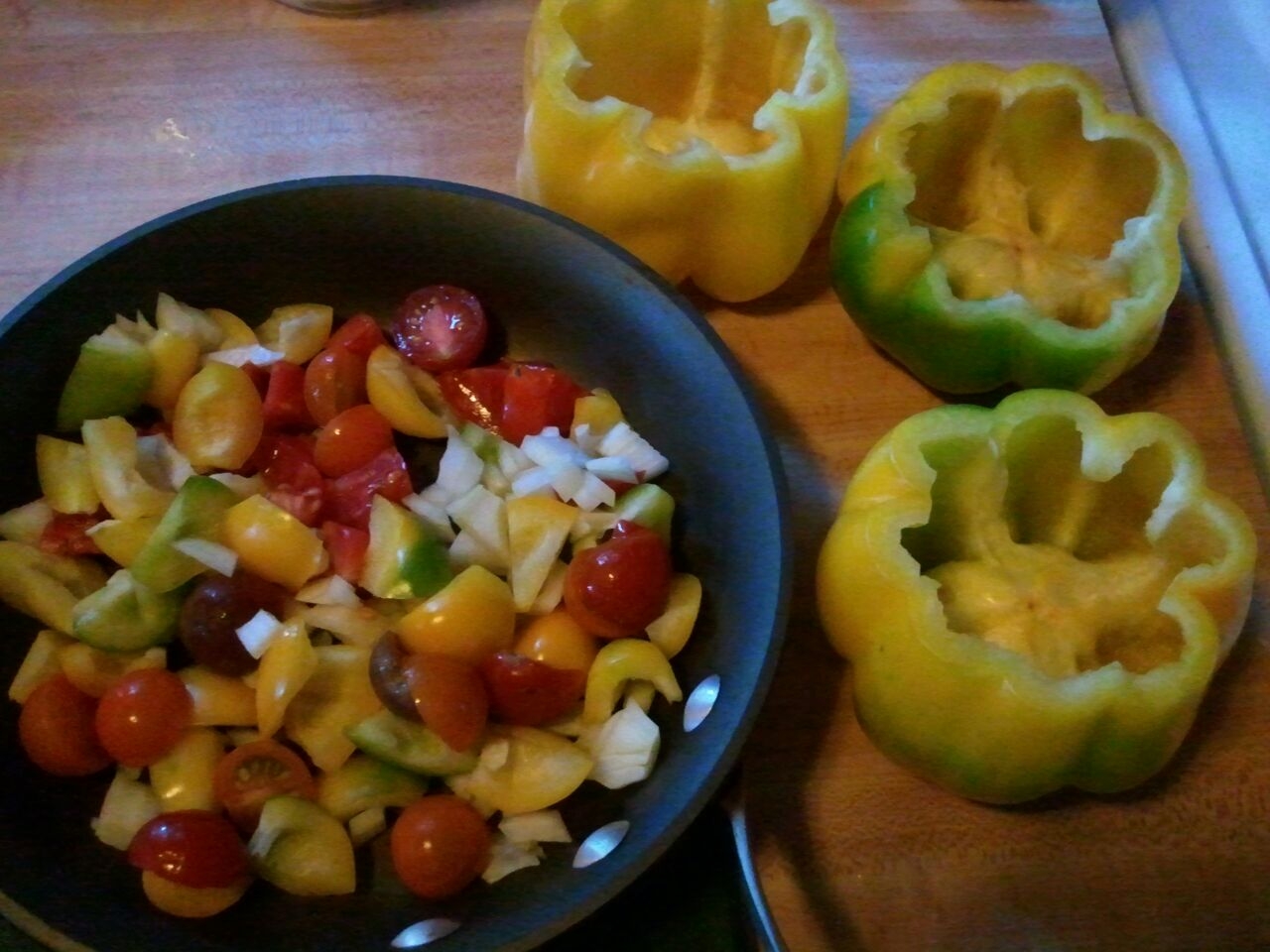
Much like our ham-and-pea roll-ups, these peppers were stuffed with things we already had in the house. Mama says you can cram practically anything into them. She cut around the top of the pepper and pulled out the seedy core. Then she broke off the pieces of the pepper top and chopped it so she could add it to the pepper stuffing mix. We still had some tiny heirloom tomatoes from my friend Walter, and we had an already-cut onion in the fridge. She put these veggies into a small frying pan with olive oil, cumin, coriander, and salt & pepper and sautéed them until the pepper and onion were soft and the tomatoes were cooked down. She added the kernels from an ear of corn and some crumbled veggie meatballs she had made a few weeks ago and had in the freezer.
How can these not be good?
She stuffed a pepper for me, then added to the rest of the stuffing some adobo sauce from a can of chipotle peppers that were also leftover in the freezer. Mama tented foil over the peppers and baked them in a 375°F oven until they softened, 20–30 minutes. She took the foil off towards the end of cooking, to brown the tops of the peppers.
You can see the added corn & broken up “meat”balls added to the filling.
Meanwhile, Mama cooked some brown rice, but she could very well have used quinoa or couscous. You can certainly add this to the pepper stuffing, but she kept it on the side and added it to the peppers before we ate them. She also made a fast guacamole and baked some tortilla chips by breaking up a whole-wheat wrap, spraying the pieces with cooking spray, and putting them in the oven for 10 minutes while the peppers cooked. (You can season these with salt & cumin, but Mama left them plain.)
Though I’m generally a fan of avocados, I wasn’t too keen on the guacamole. I did dip my chips in it (just barely), though. And to everyone’s surprise, I ate more than a few bites of the pepper stuffing. I had to examine each bite first to figure out what was on my fork, and I wasn’t much in the mood to eat (having missed my nap), but eat it I did. Mama and Papa kept asking, “Isn’t it silly that there’s a pepper for a bowl?” I’ll tell you what’s silly: they ate their bowls. Now, isn’t that silly?
In a medium skillet over medium heat, heat 1 teaspoon olive oil. Add the beef and cook, stirring occasionally, until just barely cooked through, about 6 minutes. (If using frozen soy crumbles, cook until heated through.)
Meanwhile, carefully cut around the top of each pepper, right below the “shoulder,” then pull out the seedy core. (Save the tops.) Pull out any remaining ribs and seeds. Set cored peppers aside. Break off the pepper tops from the stems, and roughly chop.
To the skillet, add the remaining tablespoon olive oil, if necessary. Add the chopped pepper tops, onion, tomatoes, cumin, coriander, and salt and pepper to taste. Cook, stirring occasionally, until the pepper and onion are soft and the tomatoes have cooked down, about 8 minutes.
Add the corn and the chipotle pepper, if using, with as much adobo sauce as clings to it. Stir to heat through.
Divide the mixture among the peppers, setting them in a baking dish just big enough to hold them, such as a pie plate or 8 x 8” pan. Loosely tent the peppers with aluminum foil, then bake for 20 minutes. Remove the foil, then bake another 10 minutes, or until the peppers are softened and the tops are browned.
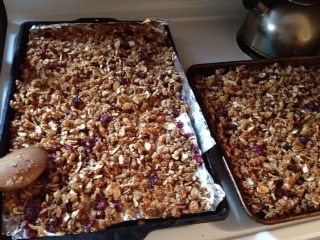
I helped Mama make granola the other day. We like to eat it with yogurt, but it’s also pretty good on its own. And it’s so simple to make! The beauty of granola, as Mama explained it, is that you can add whatever you like to it.
Your base is going to be rolled oats, of course, but you can add any nut, seed, or grain that suits your fancy. I helped add sliced almonds and some wheat germ. Then you need something to bind it all together–remember, a little goes a long way–plus, a bit of oil to keep it from sticking to your pan (and to help it toast). We used honey and maple syrup, but you don’t even need both. And we added some flavorings like vanilla and almond extracts and cinnamon & cloves.
You spread it out in a single layer on 1 or 2 baking sheets, then bake for 25–35 minutes in a low oven (275–325°F), stirring once during cook-time and rotating the sheets, if you have more than one. When you stir it, it’s a good time to add any other dried ingredients, like raisins, cranberries, dried apricots, or shredded coconut. You could add it when you first mix your batch of granola, but you risk these add-ons burning or turning too hard. Or so says Mama. Cool the granola completely before putting it in an airtight container, otherwise it’ll get soggy. And nobody likes soggy granola.
maple syrup (the really good kind), agave nectar, brown sugar (in oil or melted butter), canola oil, coconut oil, peanut butter, cashew butter, almond butter
vanilla, almond, orange extracts
spices such as cinnamon, cardamom, nutmeg, cloves, allspice–or try something altogether different, like curry
Papa announced that he had a hankering for pad thai. Now, normally he and Mama would just order in Chinese, but for some reason, they decided to make it themselves.
If there were a signature dish to Thailand, this would be it. There are oodles of variations on it, but your basic components include rice noodles, tofu and/or shrimp, cooked egg, fish sauce, chilies, garlic, bean sprouts, cilantro, lime, and crushed peanuts—all done in the same wok. Often there’s carrot, scallion, basil, and tamarind in some form, as well.
Mama said I could be in charge of the noodles, but as they required being steeped in boiling water, she thought better of it, so off I went to play with my trains. Papa was in charge of chopping, while Mama made the sauce and got everything ready to go. When you stir-fry, you’re cooking over very high heat, so it goes quickly. If you start cooking, then stop to chop your garlic or mince your chilies, what’s in the wok will probably already be burned before you’re done. So get your mise en place together.
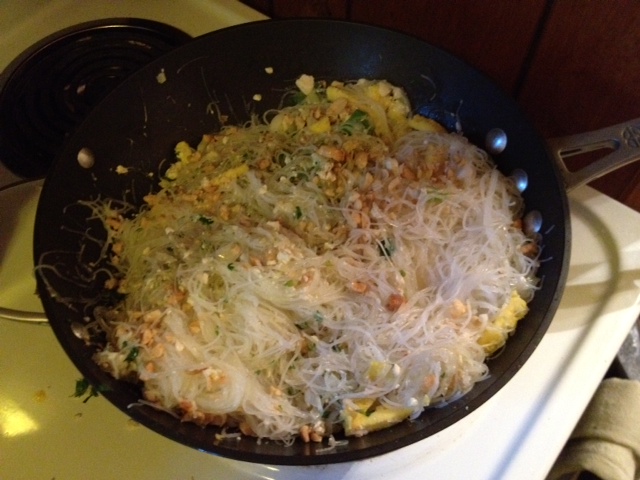
The first step is to cook your egg, as a kind of tiny, very flat omelet. First you lightly beat your egg, then when it hits the hot oil in the pan, you continue to beat it for about a minute before it starts to set. Once it’s cooked, remove it from the pan, slice it into thin strips, then add more oil to the wok. From there, you start to quickly cook your protein (cut into small pieces if it’s not tofu or shrimp); then remove it from the pan and then add your veggies. Follow with your sauce and your noodles, mixing it all up. Add back the egg and protein, and keep mixing everything. You want your noodles to absorb the yummy sauce and begin to fry a little bit. Then top with crushed peanuts and raw sprouts. Serve with wedges of lime.
You don’t have to use a wok, but the deep sides of the pan sure help to keep all the noodly goodness in one place.
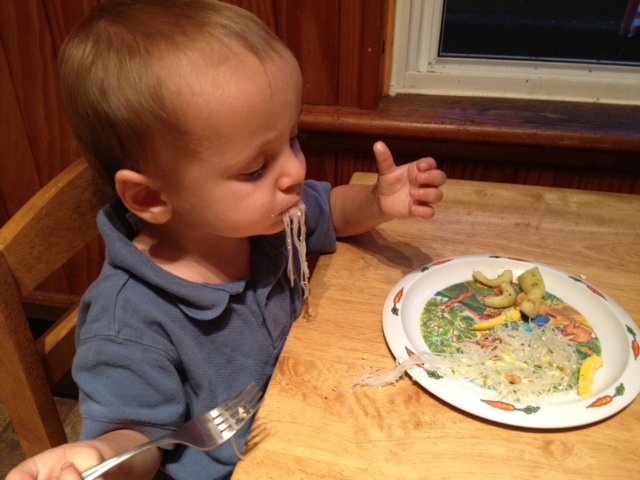
Mama had the back of her mind on alternate dinners for me, so sure she was that I wouldn’t eat the pad thai. But since she opted to go without the chilies, there was nothing about this I didn’t like. Those springy noodles were great, and I really liked the egg! The crunch of peanut was nice, too. But you know… I felt it needed more lime. So I said so. “I need lime.” And the reward for my fledgling sentence was more lime. Mama also served a cucumber-soy-ginger salad on the side. I had one salty bite, but I preferred the pad thai. What can I say? I’m a simple guy.
Next to tastiness, these noodles were just plain fun to eat.
I’m a quarter Italian, just under half Irish/U.K., and just a little over a quarter Eastern European mixed breeding. That’s a lot of heritage for this young lad to shoulder. But just think of all the wonderful foods I get to eat as a result. Take, for example, pierogies.Mama says my Great-Baba made the best pierogies. When she was growing up, Mama would visit her for two weeks every summer, and they were the first meal she’d eat when she arrived. She and her parents and brother and sister would swarm like locusts around the kitchen table, devouring little dough pillows of mashed potatoes with cheddar, caramelized onions, sauerkraut, stewed prunes, or thick and chunky applesauce. They even had a funny name for them, something that sounded a lot like pudaheya. There was—and still is—much discussion as to the best way to prepare pierogies: boiled, then pan-fried leftovers the next day. And always, always served with buttermilk, sour cream, fried onions, and home-canned wild mushrooms that Great-Baba and her sisters foraged in the woods.
But this post isn’t about pierogies. Not really. You see, Mama knows how to make them, and she plans on showing me sometime this fall (stay tuned—maybe my Auntie Karen will chime in!), but since I’m such a handful, she hasn’t really had the opportunity to make them. So sometimes she takes advantage of those that are already made. And come in a box. In the freezer section.
The horror!
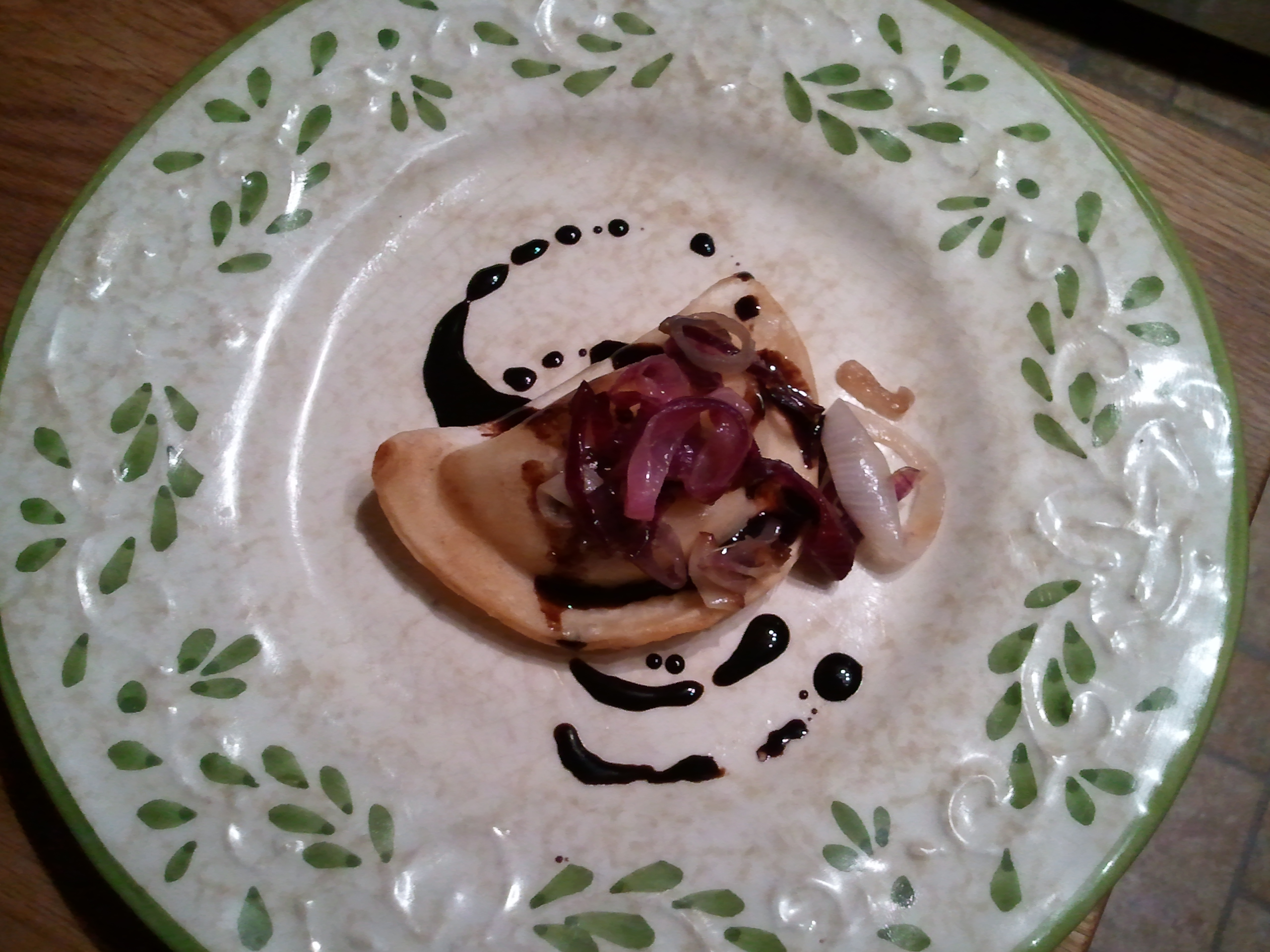
So what to do? How do you dress up what’s essentially pub fare? First, you caramelize some onions. We happened to have some lovely purple beauties from my friend Walter’s farm. They’re very easy to do—slow cook thinly sliced onions in butter and olive oil (or either/or) with a pinch of salt until they’re melted and browned. But if you really want to class ’em up, you whip out the balsamic reduction.
In the time it takes to fry the pierogies (Mama skips the boiling stage these days), you can make a tangy, viscous, shimmering bit of deliciousness that you can put on just about anything. Mama likes to have it on-hand, but as we were out, she wanted to make a very fast batch. She poured about half a cup of balsamic vinegar into a small saucepan and cranked the heat until it started bubbling. Then she lowered it to medium, threw in a large pinch of brown sugar (honey would work too), and let it simmer until it reduced…and reduced…and reduced. When it’s ready, it shouldn’t be as thick as chocolate syrup, but it should be rich, like good maple syrup. And it should coat your spoon like a silk shirt.
Just try convincing yourself that you don’t want to eat this.
When combined, the sweet and buttery onions meld with the slightly sweet and oh-so-tart balsamic reduction over the crisp pieorgies—whatever their provenance. Mama didn’t think I would like the reduction (since I’ve never been very keen on the vinegar), so she served me a naked pierogi with a few onions. Absurd! But Papa… now there’s a man who knows what it’s like to be fed well. He gave me big bites of his black gold–speckled potato puffs. And now I can look forward to when we can serve it over our own homemade pierogies, and do Great-Baba proud.
A great way to use up half-used vegetables is to wrap them in phyllo dough. Mama has made a spinach pie before, and she’s done many roulades (fancy talk for roll-ups). Tonight she made too much filling and decided to just lay it all out on sheets of phyllo then lay a few more sheets on top and seal it like a big phyllo pillow.
We had half-used packages of baby spinach, cremini mushrooms, leeks, and goat cheese, and three-quarters of a russet potato (don’t ask), which she grated. These she sautéed in olive oil with chopped garlic and salt and pepper, then set it aside to cool as we started our assembly.
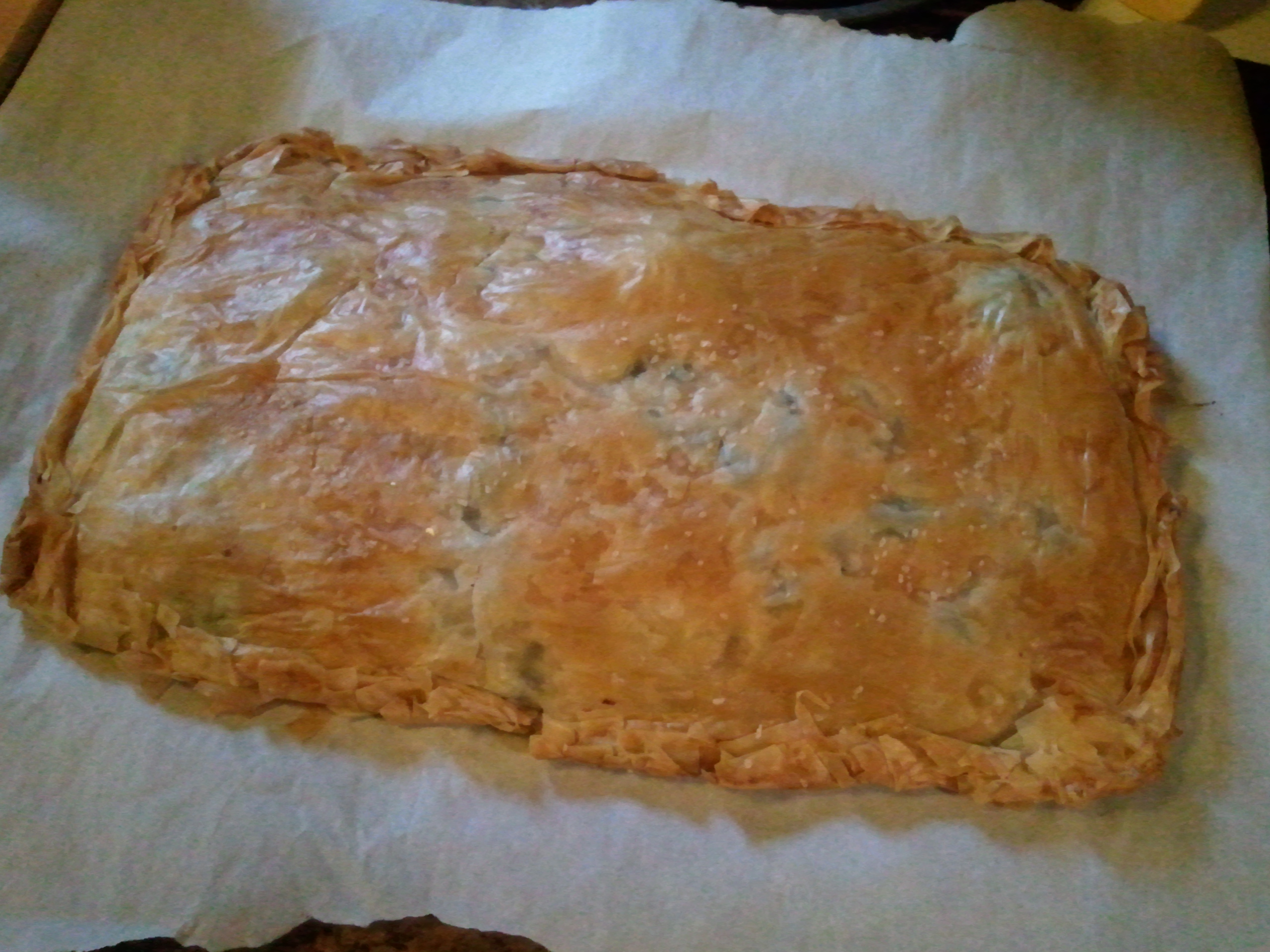
Mama reminded me that, when using sheets of phyllo, it’s important to brush melted butter (or olive oil) thoroughly over each layer. You need at least 4 layers to give your finished product some strength. I helped Mama brush the phyllo and the counter with the butter. When the base was ready, Mama spread the filling over it, nearly to the edges. She repeated her 4 buttery layers of phyllo, brushing butter over the top and lightly dusting it with salt. She transferred the whole thing to a parchment-covered baking sheet (since she thought she was going to roll it up, she hadn’t thought to start on the baking sheet—learn from her mistake!), then baked it at 350°F for 20–30 minutes.
It might not look like much, but… who am I kidding? I didn’t eat it.
I had my obligatory no-thank-you bite, munched a bit more on the flaky phyllo, and moved on. But it was fun to make, and Mama and Papa ate the whole thing anyway.
I used to eat beets. A lot. Mostly they were pureed, sometimes mixed with apples and carrots. I’d make a real mess out of them, that’s for sure! But when we got some beets from my friend Walter’s farm, Mama decided to try something that the whole family could enjoy. Yet, she wanted something fast, and if you know anything about beets, you know that they take time to prepare. There’s boiling them until soft, and there’s roasting them until soft. So what to do?
Grate ’em! If given her druthers, Mama would rather use a mandoline than a box grater any day, and it was probably because of this attitude that she knicked her thumb knuckle on it. So let me warn you now: be careful! Anyway, grating the beets (after peeling them) turned them into small enough pieces that could be cooked in a skillet…to which she added butter, the grated beets, the zest and juice of 1 lime, then some salt and pepper. Aside from the afore-mentioned grated knuckle, it was an easy dish to fix and tasted quite yummy. The tart lime contrasted with the sweet beets, and the slight creaminess of the butter played off the tiny bit of saltiness. And we all had pink pee!
Mama paired these beets with organic, whole-wheat farfalle pasta (that’s the kind shaped like bow-ties, but if you really want to know why they’re called farfalle, it’s because that’s the Italian word for “butterflies”), dressed in the leftover kale pesto that she brought back to life with a bit of the pasta cooking liquid. Papa grilled a simple salt-and-pepper pork chop to share with me, and dinner was done!
I wish I could say I ate more than my requisite one bite of pasta and chop…but I was feeling pretty beet after the long day I’d had picking blueberries and making muffins (stay tuned).
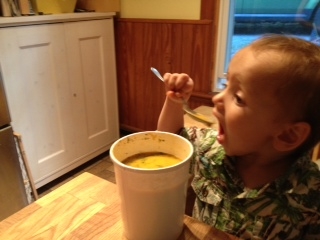
Not everyone enjoys curry, but I do. Mama cooks her version of Indian food, and she and Papa once took me out for Indian. But I’ve found I really like it in a soup. Mama made a soup that she packed up for the freezer, and it never even made it there. Just look at me devouring it:
I pulled my chair over to the counter and dived right in. The soup wasn’t even warm, but I couldn’t stop eating it.
Mama tells me that even though curry comes in a spice jar, it isn’t actually a spice that grows as curry. It’s a blend of different ingredients, and people all over India and other parts of Asia have their own way of making it, as it is passed down from generation to generation. Some blends are hot, some are sweet. Some are orange, some are yellow, and some are green. Sometimes the whole spices (such as coriander and cumin) are toasted in a dry pan to enhance their flavor before they are ground into a powder.
We don’t make our own curry, but we could. And maybe we will! What I like about the idea of making a curry powder, is that we can’t really go wrong. We’ll add a little of this and a lot of that until we like the taste we’ve developed. Here are some individual spices that could go into a curry:
Coriander
Cumin
Turmeric
Pepper
Salt
Mustard
Garlic
Fenugreek
Fennel seed
Cardamom
Cinnamon
Cloves
Red chili
Poppy seeds
Alas, I cannot give you the soup recipe, but Mama said that in addition to curry, it had turmeric and some cayenne, along with red lentils (because they cook quicker), onion, carrots, fresh lime juice, and cilantro. She cooked them in a pot, and once the lentils and vegetables were soft, she pureed it. The soup was creamy a flavorful, but not overly pungent. And I really liked the color.
I ate this soup for dinner and again for lunch the next day (out of a bowl, sitting at the table). And you know I’m not a big fan of leftovers. If anyone makes their own curry, please feel free to post your recipe here, as I’d sure like to try it.
Mama had a mess of heirloom tomatoes ripening on the counter and more kale in the fridge than she knew what to do with. Even I can’t eat that many kale chips. So she decided to make a tomato tart with kale pesto.
You can use beefsteaks or romas…but why would you want to?
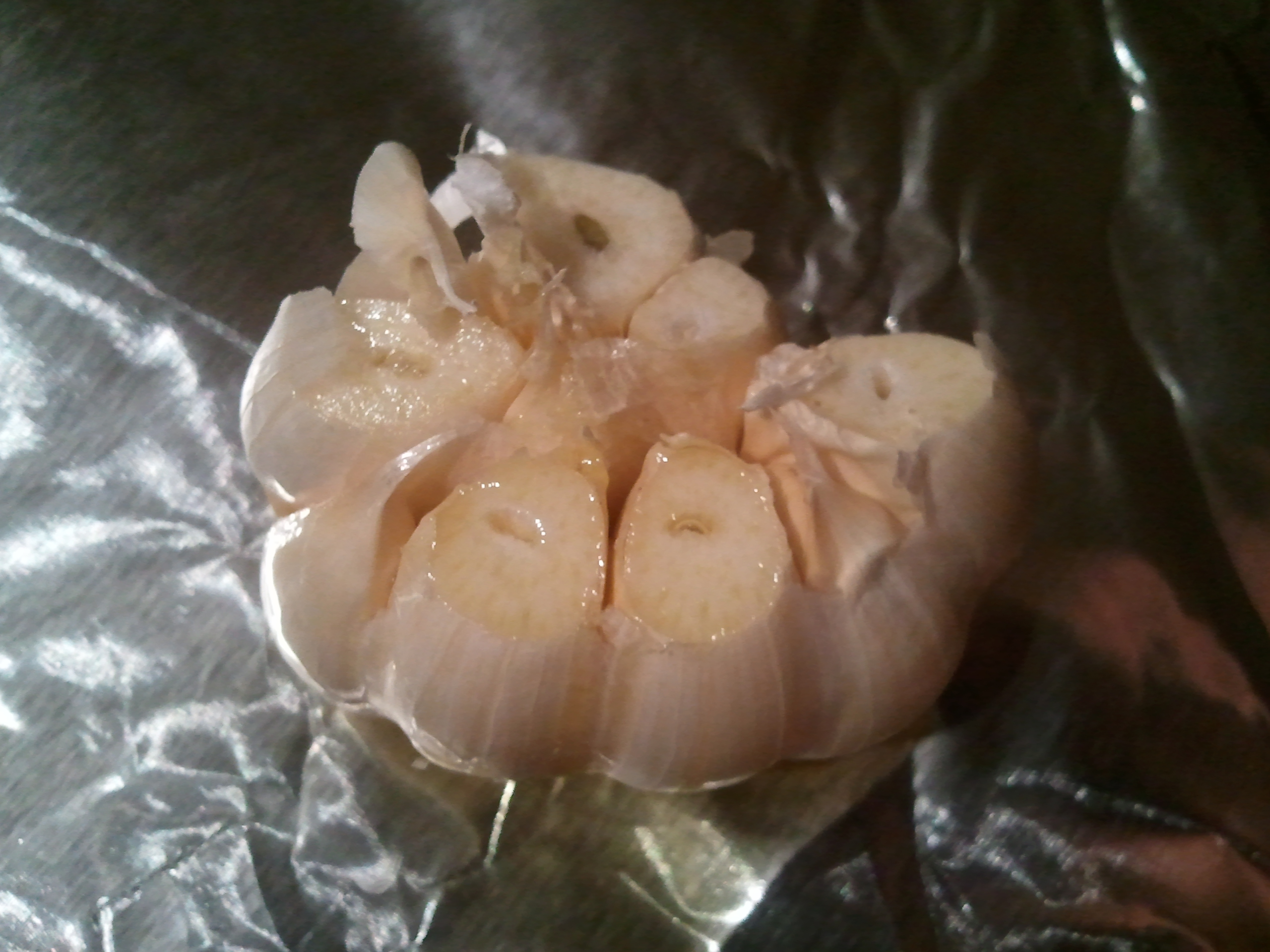
The first thing she did was lop off the top of a head of garlic. She laid it in foil, drizzled it with olive oil, scrunched it all up, then put it in the oven for about half an hour. Just until the garlic softened and started becoming golden. She told me this is a really yummy thing to spread over crostini, which she said I’ve actually eaten before, but my baby memory isn’t recalling that.
A drizzle of oil transforms garlic into something YUM.
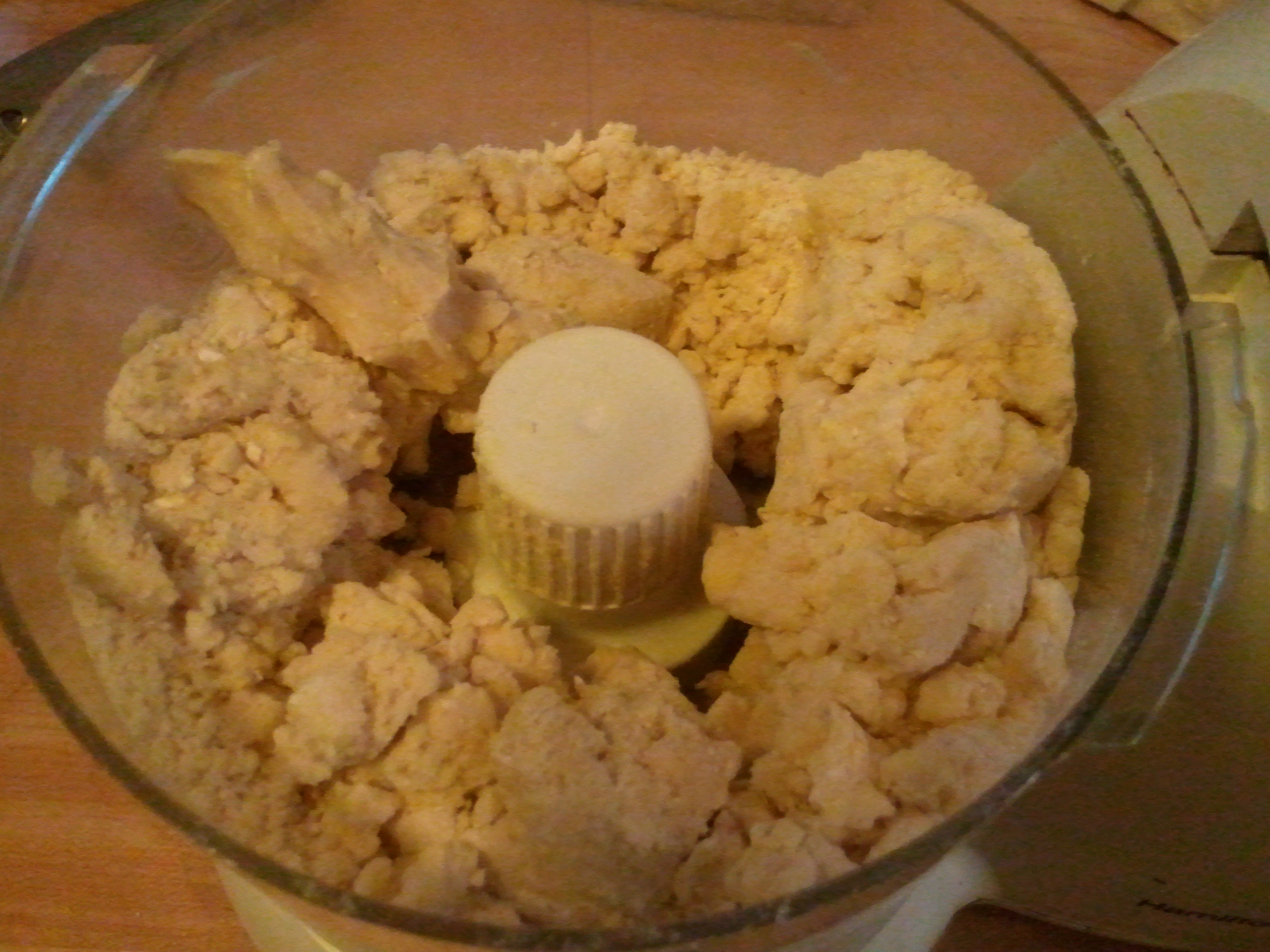
Meanwhile, Mama made the crust. She explained to me that she doesn’t generally like making crust in the food processor because then she has to clean the darn thing, but since she would be making pesto with it anyway, she figured why not? To the processor, she added her flour, oats, and salt. Then she added her butter and processed it just until little clumps formed.
This is how you want your butter cut in to the flour, whether it’s by hand or machine.
She said you don’t want to process the butter so much that it melts–the cold butter is what makes for a flakey crust. Then she added the ice-cold water and processed it again just until large clumps formed and began pulling from the side. She tested the dough by squeezing a bit in her hand, and she saw that it held together. You don’t want to process it into a smooth ball, otherwise you’ve overdeveloped something called gluten, and your crust will be tough.
This is how you your dough should look when it’s ready. See the squished clump in the top left?
Once she had the crust chilling in the fridge, Mama moved on to the pesto. Ordinarily, Mama makes a pretty traditional pesto, which she first ate, ironically enough, at a friend’s mother’s house in Bad Bramstedt, Germany, back in the ’90s. When you use basil or other fresh green like arugula, you can make the pesto fresh from the garden. When you use something hardier, like kale, it’s better to first blanch the greens. Mama generously salted her boiling water (and I stayed far away from the burner) and blanched the kale for a minute or two, in batches. She then ran the cooked kale under cold water (she said she’s cheating because she really should be putting it in an ice bath…but there are only so many dishes she wants out of the cupboards at any given time). The kale went into the food processor, to which she added olive oil, more salt, pepper, fresh lemon juice, toasted pine nuts (you don’t have to toast them–they just develop a nicer flavor), some freshly grated Parmesan cheese, and the roasted garlic. When the cloves were cool enough to handle, a gentle squeeze popped them right out of their papery skins! She whirred the ingredients in the processor and stopped to taste. I reached in and grabbed a chunk of the pesto to try for myself. I was not happy with it. But neither was Mama! She added more lemon and more salt.
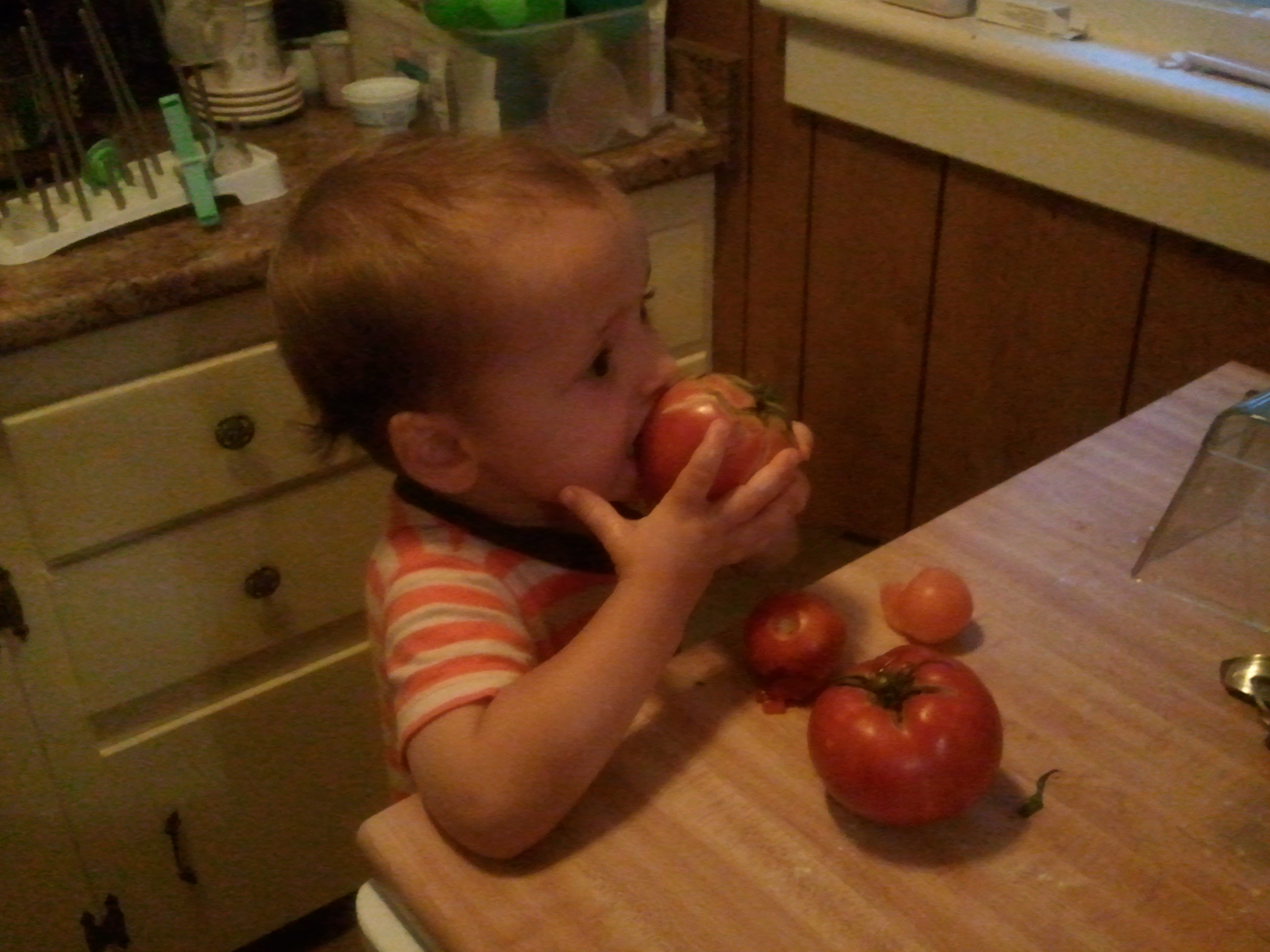
A tart is so pretty and sophisticated (like myself), but Mama had so many tomatoes that she decided to turn this into a deep-dish pie. I sampled many of the tomatoes to be sure of their ripeness, which is rather strange considering that I rarely eat raw tomatoes.
If I see something sitting on the counter, I’m going to eat it!
Then Mama rolled out the dough. I took my bitten tomatoes and stamped them on the dough to make pretty patterns. She showed me how to wrap the dough around the rolling pin to lay it into the pie pan easier. There was really a lot of dough, so Mama trimmed the edges and was sure to have leftovers. Then she spread some pesto along the bottom of the pie. She neatly layered some sliced tomatoes, then sprinkled some mozzarella on top.
I like the pretty colors of the heirloom tomatoes.
She explained that if this were a shallow tart, she’d be done, but she continued with two more layers in the same manner. (The leftover pesto she put in the fridge for pasta, but it would also freeze fine.) She put the whole thing in the oven until the top was brown, about 30 minutes, then grated some asiago cheese on top. She could’ve put it back in the oven for another minute or so, but she didn’t.
I had a few bites, which tricksy Mama was trading off for bites of the crust, which I really enjoyed. She kept telling me that if it were horrible she wouldn’t be bartering, but I’m not so sure. I hear this pie tastes good cold, too. Guess I’ll find out for lunch tomorrow.
Love, Jude
Heirloom Tomato & Kale–Roasted Garlic Pesto Tart
Roasted Garlic
1 head garlic
1 Tbsp extra-virgin olive oil
Pastry Crust (or, Pâte Brisée if you’re really interested)
2 1/2 cups all-purpose flour (you can substitute whole-wheat, if you like)
1/3–1/2 cup ground rolled oats (optional)
1 tsp sea salt
2 sticks cold unsalted butter, cubed
1/3 cup ice water
Pesto
1 large bunch kale, ribs removed and torn into rough pieces
Extra-virgin olive oil (about 2 swirls around the food processor)
Juice of a lemon (or more, to taste)
Kosher salt (to taste)
Freshly ground black pepper (a few grinds)
2 Tbsp toasted pine nuts (toasting optional)
3 Tbsp freshly grated Parmesan cheese
Tart
1–2 pounds ripe heirloom tomatoes (however many you need, depending on size & variety)
1–1½ cups shredded mozzarella
Freshly grated asiago cheese
To roast the garlic: Preheat the oven to 350°F. Trim the tops off the garlic bulb, place it (cut side up) in the center of a square of foil, drizzle with the olive oil, seal the top of the foil, then place the bundle in the center of the oven. Roast until the garlic is soft and fragrant, and slightly brown, about 30 minutes. (You can certainly make the pesto with regular ol’ garlic, too, without the roasting.)
For the pastry crust: Combine the dry ingredients in a food processor. (Mama already had ground oats, but if you don’t have them, grind them in the processor first.) Give it a few pulses to distribute. Add the butter and pulse about 10 times, just until the butter and flour begins to form pea-sized lumps throughout. With the machine running, add the water in a stream and process just until the dough starts to clump. Turn it out onto your counter, give it a few quick kneads to bring it all together, flatten it into a disk, and wrap it in plastic. Refrigerate for half an hour.
For the pesto: To blanch the kale, bring a large pot of salted water to a boil. Working in batches, if necessary, add the kale to the water and stir to submerge. Boil for 1–2 minutes, until the kale is bright green. Transfer with a slotted spoon or tongs to a bowl of ice water (or to a colander that you’ll then run under cold water in the sink). If using toasted pine nuts, toast them in a dry pan over medium heat for a few minutes, shaking every so often, just until fragrant. You can also put them on a piece of foil or on a baking sheet and stick them in the oven, since it’s on. As soon as you smell them, they’re done! Place all the ingredients in a food processor and blend until pasty. You might need to add a little more oil—you can even add some of the blanching water. Taste and adjust seasonings. (Mama notes that all these amounts are approximate.)
To finish the tart: Slice the tomatoes—about as thick as you would a sandwich tomato. Set aside. Take the pastry crust out of the fridge and remove the wrap. Generously flour a surface, then gently roll the dough. Lay into pie or tart pan, then trim the edges, fluting if desired. Spread a layer of pesto along the bottom. Arrange slices of tomato to cover, then sprinkle with mozzarella. Repeat layers, if desired, ending with cheese. Bake until golden, about 30 minutes. Shave additional cheese on top, then pop back in the oven until melted and browned, a few minutes more.
…to “Kale Chip.” You might recall that last summer my cousins began calling me “Kale Puff,” in reference to my snack of choice (in lieu of sugary, o-shaped, or fake-cheese snacks). While I’ve been a bit turned off to green foods of late, I feel the need to come clean on something. This morning, I climbed up onto the counter (I have been getting taller and stronger!), took down the container of freshly made kale chips, and proceeded to eat them. For breakfast. Go past “moo-moo milk” and yogurt, and head directly to greens.
I’m holding a chip in one hand, eating one with the other, and getting ready to feed my fleet of trucks.
I can’t explain it. Perhaps it’s their slight crunch. Perhaps it’s their saltiness (Mama can be a bit heavy handed with the stuff). Perhaps it’s because I can munch and munch until I stuff a pretty big leaf in my mouth. Perhaps it’s because these chips were made with kale from my friend Walter’s organic farm. (In fact, he helps his mama harvest the kale; she tells us it just keeps growing and growing.) Or maybe I just really like kale. There are worse things for a kid to like, you know.
Love, Jude
Supereasy Kale Chips
1 bunch of kale, torn from the ribs into manageable pieces
Olive oil spray (not the kind that comes in an aerosol can)
Sea or kosher salt
There are tons of places you can look to find a recipe that suits you, but this just happens to be how Mama made the chips last night. Preheat your oven to 300°F. Lay a sheet of foil, if desired, onto a baking sheet and spread out the torn kale. It’s okay if the pieces overlap—they’ll still dry out. Spray the leaves with the olive oil, then sprinkle liberally with the salt. Bake, checking on them periodically, until crispy, about 10–15 minutes. Store in an airtight container at room temperature until gone.
Note: Mama said to tear your kale into uniform pieces, as bigger pieces won’t dry out as much as smaller pieces. I should also point out that I didn’t like the pieces with even the small veins in them—I kept chewing and chewing, and eventually I had to spit out a little kale blob. If that sounds gross to you, think of how Mama felt when I put it in her hand!






 LittleJudeonFood