Though Mama’s a vegetarian, she does eat some seafood—and Papa’s become pretty adept at cooking it for us. For starters tonight, he sautéed some yummy bay scallops. They’re creamy white, firm, and fleshy. They can be as big as my hand or as tiny as my toes. Papa chose bite-size scallops for him and Mama (they were three-biters for me) as appetizers. I haven’t had many chances to pick up seashells on the shore, but Mama tells me that if you think of a “traditional” shell pattern, that’s what a scallop comes in! And because this round fleshy disk is attached to a shell, it sometimes comes with the connective muscle still on it. You can see it looking like a small flap alongside the muscle, and it’s very easy to peel off. If won’t hurt you if you eat it, but it is rather chewy.
A long time ago, Mama taught Papa how to sear scallops, and now he’s able to show me! There are two secrets: start with a dry scallop and a hot pan. You might be wondering how you dry your scallops since they come from the sea! If they’re very fresh, you just set them out on a paper towel, lay another paper towel on top, and let them sit for a couple minutes. If they’ve been previously frozen, it’s going to be difficult to get that crisp, golden restaurant-quality sear—but you can come close if you dust the scallops lightly with flour. Either way, be sure you salt and pepper your scallops before putting them in the pan.
Start with medium-high heat, melt a pat of butter, and add your scallops. (If your scallops are very small, they’ll cook quickly and can take a higher heat.) Now don’t move them! Leave them alone for 1–2 minutes. And if you don’t have a pair of kitchen tongs, don’t make these until you get a pair. They’re really the only way you can turn over the scallops without losing that yummy crust of deliciousness you just developed. You can very gently lift up an edge of a scallop with the tongs to check on its color, but that’s it. When ready, turn them and cook for just another minute or so, again without disturbing them. Be careful not to overcook them, or you’ll be eating rubber (though I don’t quite understand why this is a bad thing, considering all the toys I put in my mouth). This isn’t the time to be setting the table. Stay right there and man your scallops. Act like a chef and give them a gentle squeeze around the middle. If they’re supersoft, they’re not quite done. There should be a firmness with just the slightest bit of give. Scallops will continue to cook once you remove them from the pan, so you really want them to be oh-so-slightly underdone. Actually, a perfectly cooked scallop with have a small blush in its very center when you cut into it—which you should be able to do with child’s spoon.
Papa did a great job! The scallops were golden on the outside and supple on the inside. They tasted buttery and like an afternoon at the beach. I ate three of them.
Then, because it’s still halibut season, Papa decided to cook up a favorite dish of ours, something along the lines of this one. Mama apologizes for not having a picture of me eating this, but she was too busy scarfing it down herself. Of course I ate the oranges (even with all the green on it), and I had a few bites of the halibut—Papa got a good sear on it, as well—but I really took to the fennel. Did you know that it takes on a very different flavor when it’s cooked? It’s much sweeter. Mama tells me this is what licorice tastes like, and I hope I get to have some soon. What do you think my chances are?
You might recall that I used to eat a lot of spinach, in the form of something we called “gruel.” But now that I’m beyond all that baby food, Mama serves me sautéed spinach and kale, and I notice she puts herbs in everything. I am no longer such a fan.
Mama had some leftover halibut from fish tacos, so she decided fish cakes would make for a good dinner. Papa peeled and boiled the potatoes, and Mama raided the garden for the mint and parsley. The cakes came together pretty quickly, so Mama decided on her favorite chickpea salad as an accompaniment.
While Mama’s a proponent of cooking beans, she feels this is only something a person who has her act together can do, and Mama is not one of those people. She doesn’t have various pots of beans and grains cooking and all her vegetables cut for the week ahead on a Sunday. She just doesn’t. So when it comes to a superfast side dish (or sometimes, in Mama’s case, a main dish), she likes being able to reach into her cupboard and pull out a can of beans. Just drain, rinse, and serve. Now, I’ve been slow to come to chickpeas (though I like to say “chick-pea”), but I very recently ate half a can all on my own. So Mama felt pretty confident I’d share her gusto for garbanzo salad.
Not so much. I couldn’t find one that was just a plain old chickpea. All that basil and parsley. Doesn’t she get that toddlers have a clinical aversion to green showing up on non-green foods? As for the fish cakes, I took my obligatory one bite, but that was enough for me. I liked the crispy fried part okay, but it still tasted fishy—and there was all that greenery. I ended up sharing it with the dog. The green I didn’t mind was the avocado I ended up eating for dinner.
Love, Jude
Herbed Chickpea Salad
1 can chickpeas, drained & rinsed
Handful of fresh parsley, minced
Handful of fresh basil, minced
1–2 cloves garlic, minced
Juice of ½ lemon (or more, to taste)
Kosher salt & freshly ground black pepper
Drizzle of olive oil
Freshly grated Parmesan cheese
As you can see, this is a pretty loose recipe. Mama just does it all to taste. Start with a little of an ingredient and add more. Remember, you can always add more, but you can’t take it away!
Mama made a tart. A leek tart, to be more precise. First, she showed me how to rinse then cut the leeks into half moons. We’ve done this before. Leeks can be very dirty, so it’s important to rinse in between all the layers. She had 3 leeks, so that was a lot of little moons to cut. These she sautéed in butter and a little olive oil—“to raise the smoke point,” she said—until they were soft. Then she peeled and grated 2 russet potatoes on the big square grater. She let me help her hold the vegetable peeler, but she said the box grater was too dangerous for my little fingers. When the leeks were soft, she added the potatoes, along with some salt and pepper and a few sprigs of thyme. The kitchen smelled so good as everything cooked!
Meanwhile, Mama did something she said chefs everywhere would shake their heads at: She took scraps from the various pies and tarts she’s made over the past couple months out of the freezer, let them thaw, and then smooshed them together to make one new tart crust. She showed me how to flour the counter surface and then roll out the dough with something called a rolling pin until it was smooth and flat. She wrapped the dough on the rolling pin, then unrolled it over the tart pan. She said you have to gently lay the dough inside the pan so as not to tear it. Then she let me prick it a few times with a fork, and we put it into the oven to bake.
And by the time it was done, the vegetables were cooked. She poured them into the hot tart shell, sprinkled some goat cheese over top and drizzled some balsamic vinegar over it, then put it all back in the oven. Not long after that, it was ready.
I don’t know what I liked more—the potatoes, the balsamic vinegar, the leeks, the goat cheese, the crust…. The whole thing was just so darn yummy, I had an entire piece. Now Mama just has to make a bunch more pies so she has more scraps for a last-minute tart.
Some kids get smoothies year-round, but Mama likes them in the summer when the fruit is fresh and ripe. But even though the weather’s been cool off and on lately, Mama’s decided smoothie season has begun. At least for me. She tells me she used to make a big blender of smoothie for her and Papa, but now she just uses a cup and this funny little machine she calls a hand blender. She lets me help hold it when it goes whirrrrr! and before I know it all the chunks of pineapple, banana, and mango are blended with the yogurt and coconut milk, and it’s all smooth and creamy.
Smooth + creamy = smoothie?!
Sometimes Mama adds a bit of local honey. Other times, she adds cinnamon or cardamom. Today Mama added something called flax. Not bad. Mama says smoothies are really good for me. I love everything that goes into them, so what’s not to like? The part about a smoothie I like the most is that I can drink it with a straw, and I can take it with me (though I’m not supposed to leave the kitchen with it).
Love, Jude
This is my special smoothie cup. It's been getting a lot of use lately.
By now, it’s no secret that I love eggs. I’ll take them any way I can get them. But Mama says people are a little afraid of soufflés because they have a reputation for being temperamental [insert joke about soufflés being like Mama here]. Kidding aside, Mama showed me that there’s nothing to fear about this puffy little delicacy whose name comes from the French word for “blow.” I blow on my food when it’s hot, and just yesterday I blew my first bubbles outside, so I’m excited to learn how to make these.
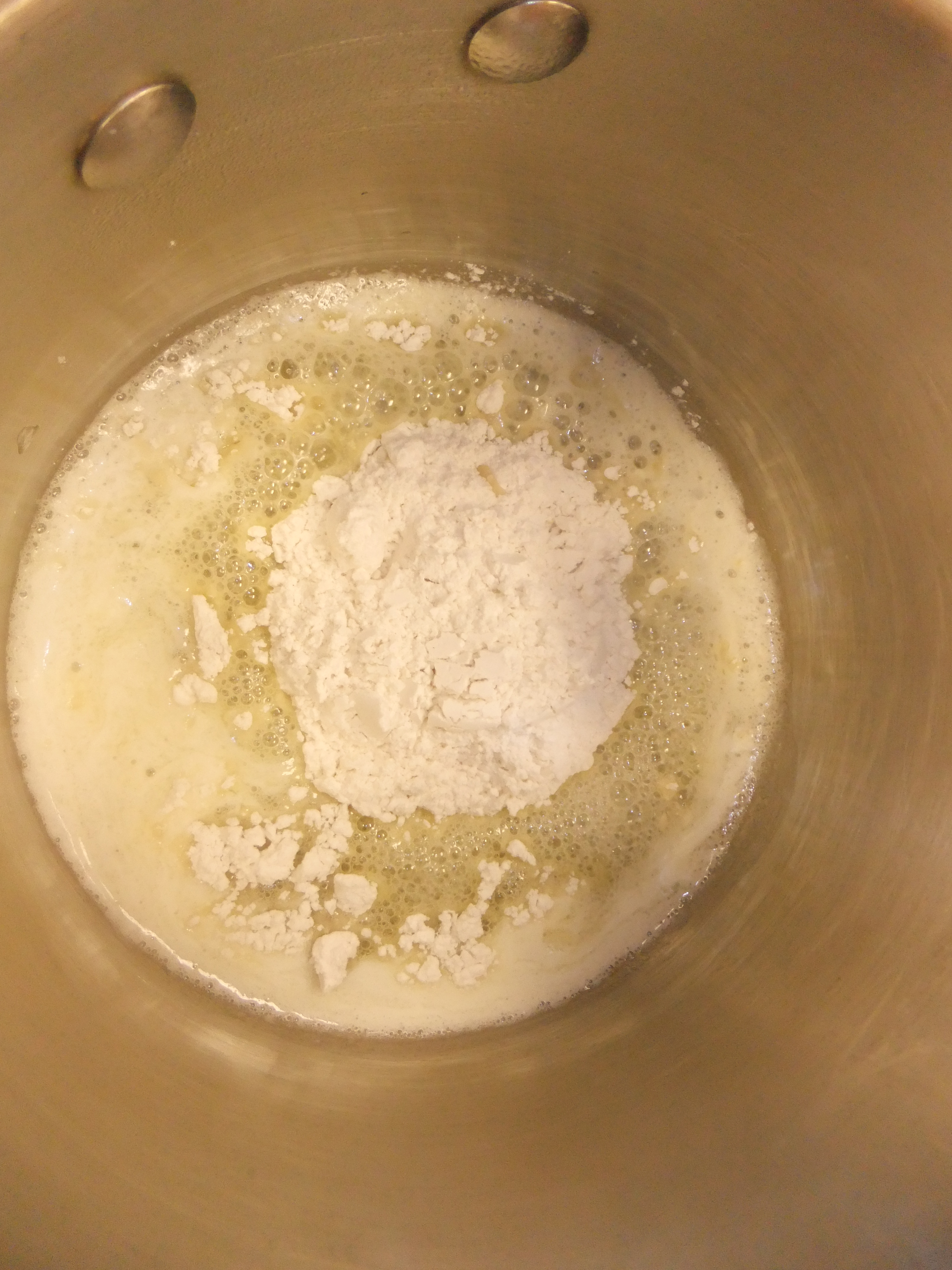
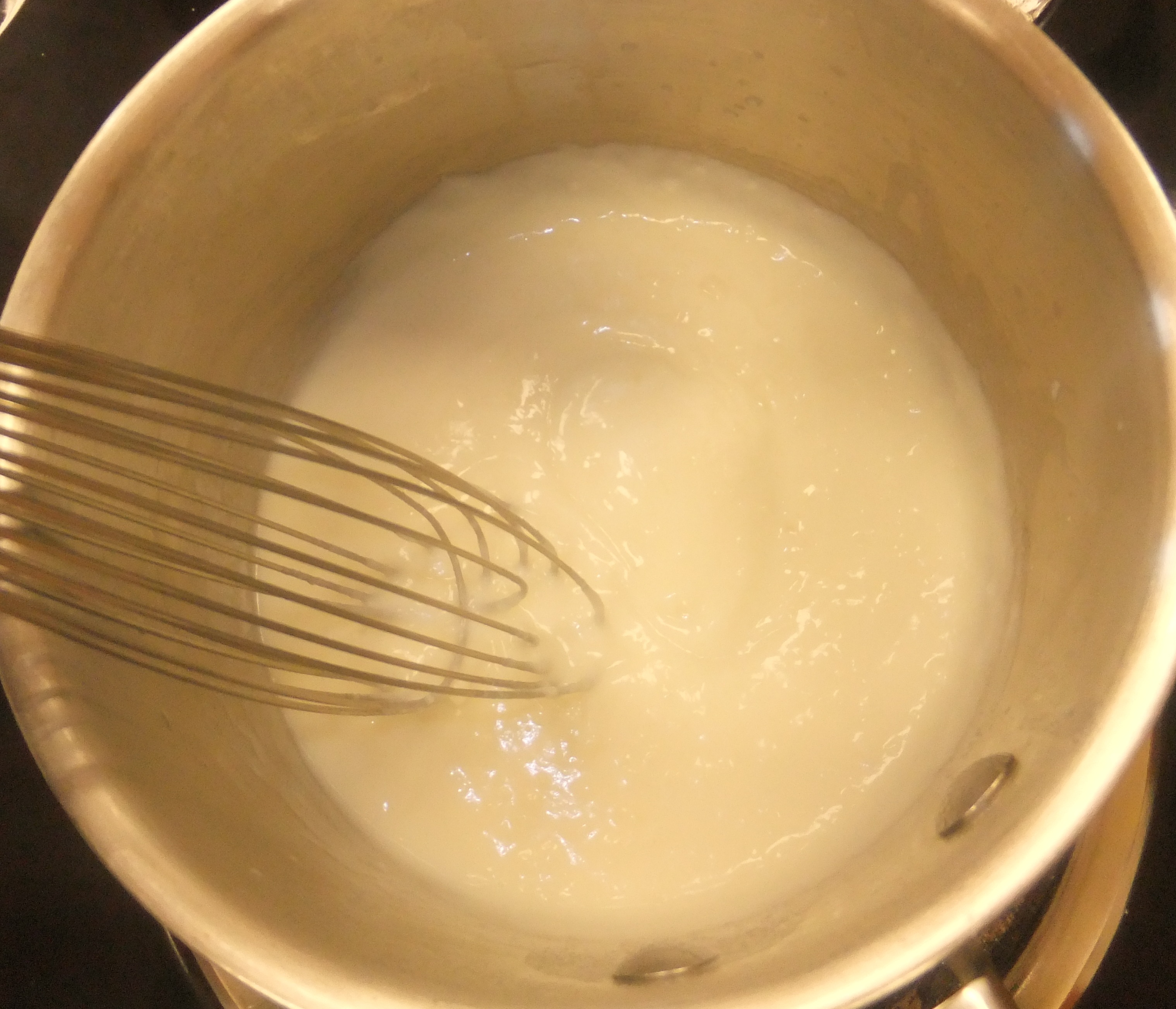
First, Mama said we have to make a “roo.” We’ve made this before by melting butter in a saucepan, then whisking in flour until it’s all cooked and bubbly. Then we add milk. Mama says some people say to use cold milk, while others say to use hot milk. She “splits the difference” by using milk that’s been taken out of the fridge for a little while, “just to take the chill off.” Once the milk’s added to the saucepan, we stir and stir until it thickens. (Well, Mama took care of the stirring because it was very hot.) She said this is what’s called a béchamel, but it looked like a white sauce to me.
When butter’s all foamy, add the flour all at once and start whisking.
This is how the white sauce will look once all the floury clumps are worked in to the milk.
This next part is where it starts to get a little scary. You have to separate your eggs. I don’t quite understand how sometimes I can crack the eggs and roll them around and the shell comes off, and other times, Mama cracks the egg and out comes a runny gloppy mess. But this is one of those times when Mama has to crack the eggs. She notes that the whites must be meticulously free of yolk, and because she doesn’t take her own advice to separate the eggs one at a time over a small bowl (and then dumping each white into a larger bowl), she creates an opportunity to show me how to remove errant yolk from the white: use the shell to scoop it out!
Now Mama sets aside the bowl of whites and sets the bowl of yolks on a damp dishcloth—she explains that it’s to keep the bowl from sliding when she “tempers” the yolks. (I thought this must be why soufflés are considered temperamental, but Mama says it’s how you bring hot and cold liquids together without ruining them.) She whisks the yolks to break them up, and then she pours a little of the hot white sauce into them, whisking the whole time. She adds a bit more sauce, still whisking, and keeps at this until all the sauce is in the yolks. Now you have your soufflé base. Mama says this is the time to add any flavors—crumbled cooked bacon, puréed or small-dice cooked veggies, cheese, fruit, finely ground nuts, chocolate—but we’re keeping it plain today.
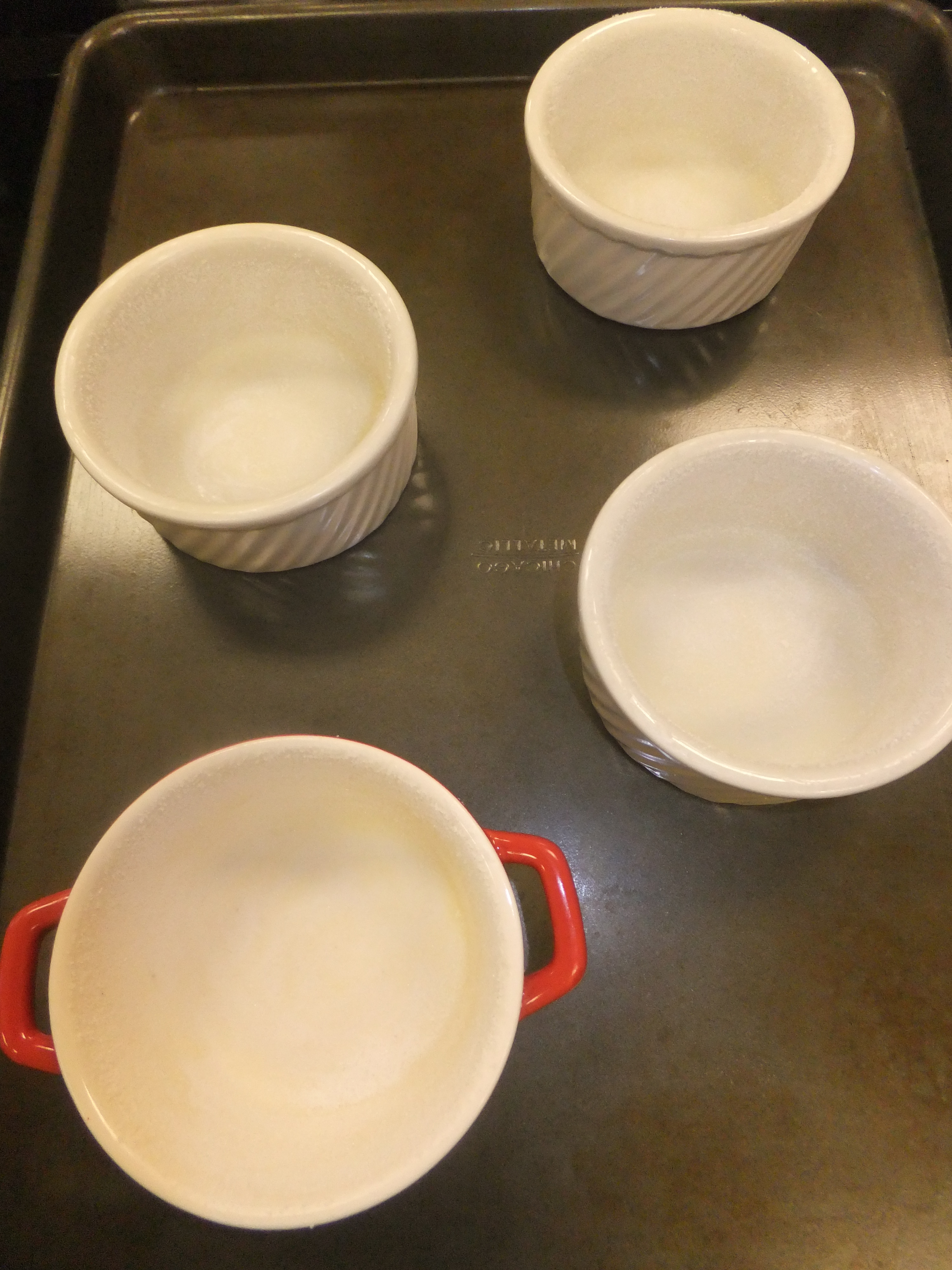
Mama notes that here’s a good place to stop, if you have to. If you’re making soufflés for breakfast the next day or for dessert later on, this is where you should stop, put everything in the fridge, then take it out about a half an hour before you want to resume cooking—to “take the chill off.” That’s when you should turn on your oven, too. But before finishing the recipe, there’s one more thing to be done: prepare the ramekins. I didn’t know these could be used in the oven or for food other than mine. Mama always used to feed me from these…until I discovered that they break into so many pieces when they hit the floor. (I’m just learning about gravity, you know.) Brush melted butter all around the inside of each ramekin (or other small ovenproof dish), then dust each with either parmesan cheese (if savory) or sugar (if sweet). (Mama thinks finely chopped nuts might work, too.) This step, Mama says, gives the soufflé something to grab onto as it climbs up the ramekin. Mama set the prepared ramekins on a baking sheet.
These are sugared.
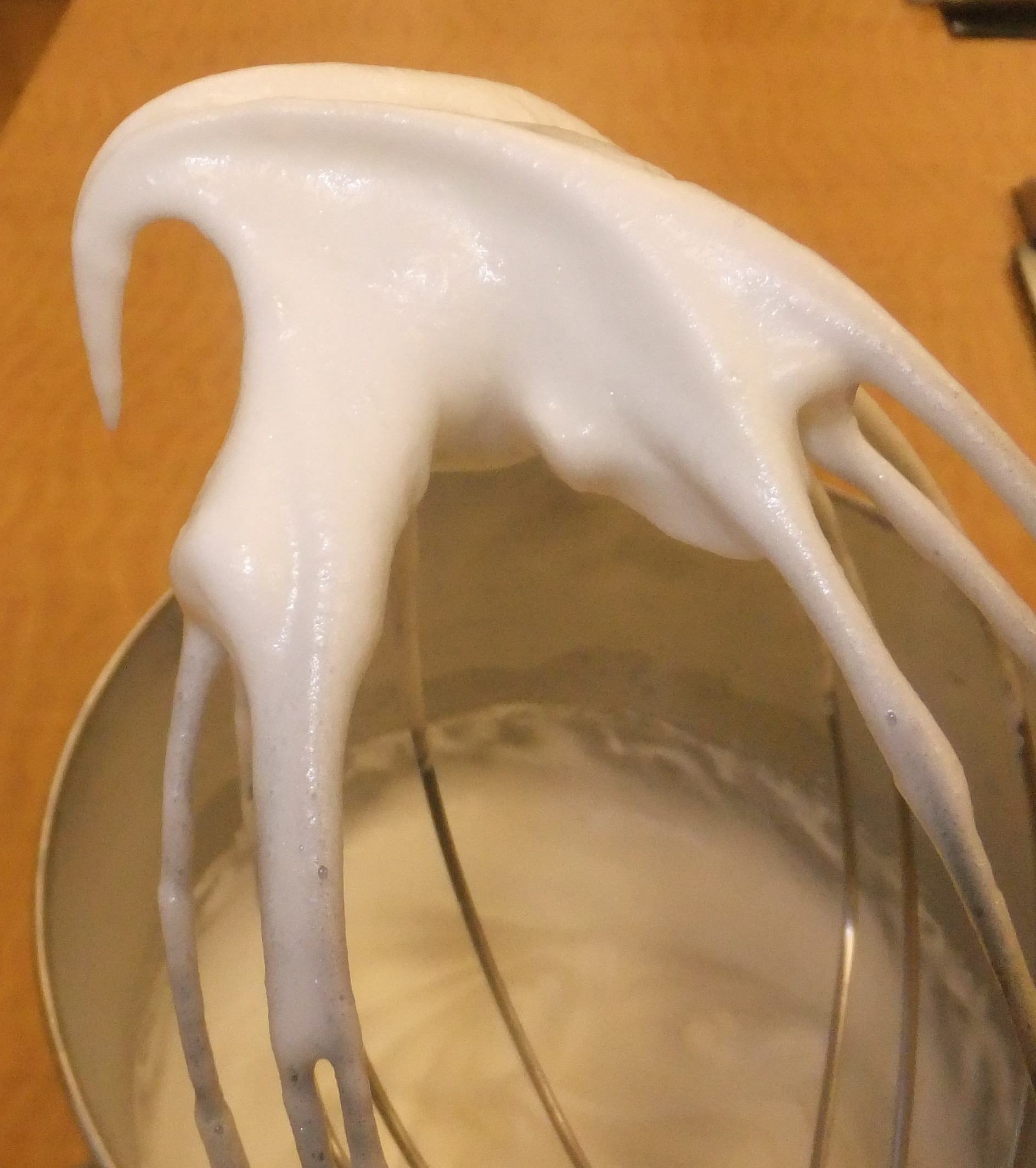
Next, Mama turned her attention to the egg whites. She plugged in the mixer and began to beat them until they formed soft peaks.
See how the “peak” flops over?
Then she folded the whites into the yolk mixture, being careful to not overmix—she explained that if she stirred too vigorously, she could deflate the whites, which would not bode well for the soufflés. Mama says that as soon as the whites are folded in, it’s time to pour the mixture into the prepared ramekins. Fill them nearly to the top (most ramekins have an inner rim that’s a good marking spot). She sprinkled a bit more parmesan on top and popped them in the oven.
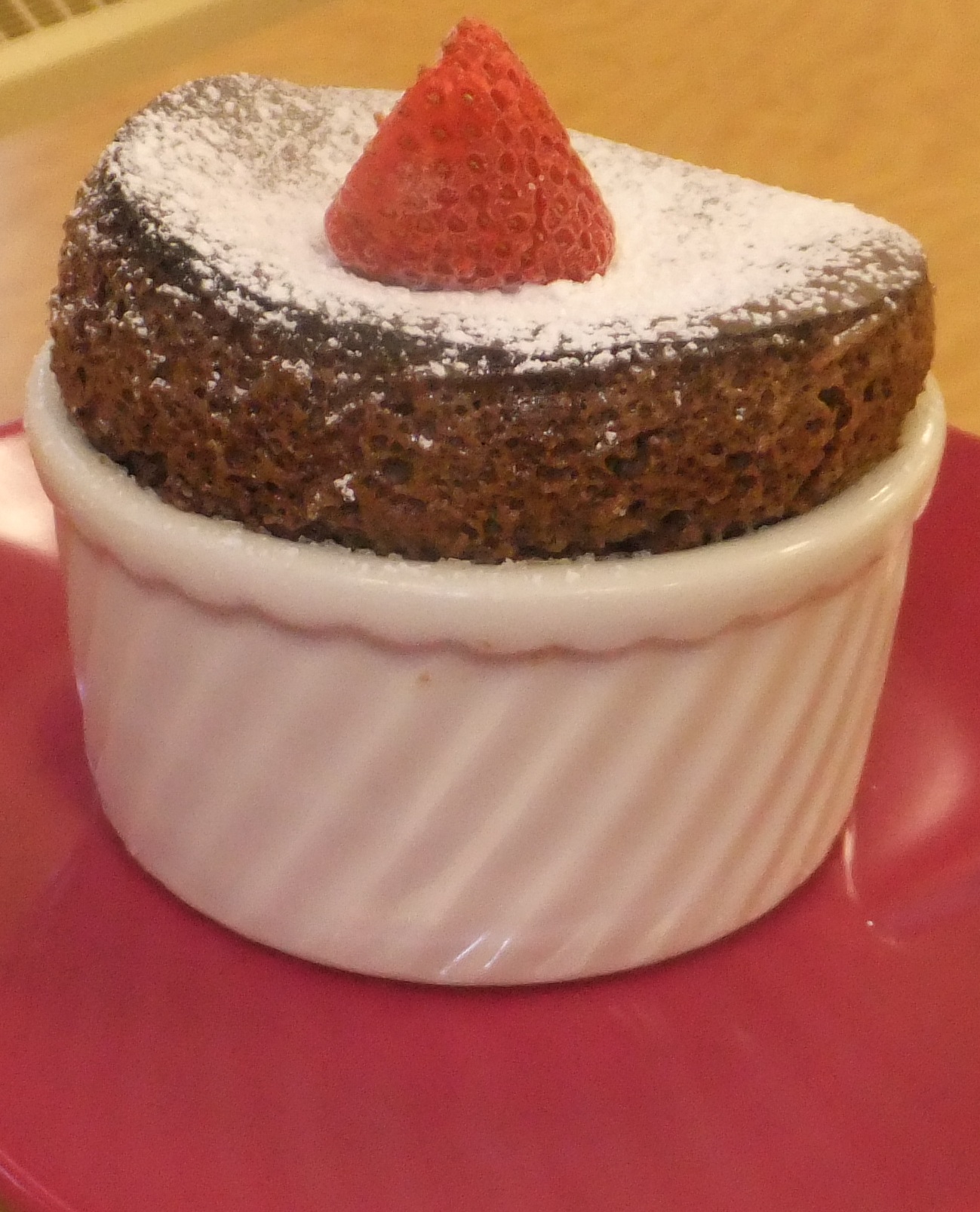
Then we waited. Mama said we may not open the oven to check on them, otherwise they’ll deflat like a balloon. So when the time was up, we turned on the oven light to take a peek. Those soufflés had puffed up like my grandma’s hairdo and were golden brown. Mama called them gorgeous. The real test was taking them out of the oven… and they held! They stayed puffy until we dug in. They were eggy, and they tasted as soft and fluffy as they looked. I could eat these all day.
Love, Jude
Basic Soufflés
2 Tbsp butter
3 Tbsp flour
1 cup whole milk or half-and-half
4 eggs, separated
Salt and pepper, to taste
1/4 tsp nutmeg (optional)
Melted butter (about 2 Tbsp)
Grated parmesan cheese (or sugar, if making a dessert soufflé) (about 2 Tbsp)
Preheat the oven to 425°F. Brush six 6-ounce ramekins with melted butter, then dust with parmesan cheese (or sugar). Set aside on a baking sheet. Over medium heat, melt the 2 tablespoons butter in a medium saucepan, then add the flour, and cook, whisking constantly, until the flour is incorporated and the mixture begins to bubble, 1–2 minutes. Slowly add the milk and continue to whisk, working out any clumps. Then whisk occasionally until the mixture is hot and begins to thicken, 5–10 minutes. Do not let the mixture boil. Remove from heat and add the salt, pepper, and nutmeg.
Whisking constantly, pour a small amount of the milk mixture into the yolks. Add a bit more milk, continuing to whisk. Then add the remaining milk mixture to the bowl and whisk thoroughly. If adding flavors or cheese, do so now.
Beat the egg whites with a hand mixer on high speed until soft peaks form. Then immediately and carefully fold in to the yolk mixture in three additions. Immediately pour the mixture into the prepared ramekins, up until the inner line. Wipe the rims of any errant mixture. Sprinkle with additional parmesan, if desired.
Bake for 17–18 minutes in the center of the oven, until puffed and golden. The centers should look set and firm. Resist the urge to open the oven to check on them, but when you do take them out, a toothpick inserted into the center should come out clean. Serve immediately.
Yield: 6 soufflés
Note: Mama says it’s not a bad idea to add an additional yolk to the base if you’re going to be adding a lot of stuff to the soufflé; the extra yolk will make the base stronger. Try adding up to ½ cup shredded cheese and either ½ cup vegetable puree or 1/3 cup small-diced cooked vegetables or crumbled cooked bacon to the base (before folding in the egg whites). Some ideas: butternut squash-gruyere-paprika; onion-roasted pepper-rosemary-spinach; artichoke-red pepper-gruyere-thyme; red pepper-fennel-onion; or try blue cheese-walnuts by substituting finely ground walnuts for the parmesan cheese.
Variation: To make a chocolaty soufflé, whisk in 1/2 cup unsweetened cocoa powder and 1/2 cup sugar to the finished white sauce. After the mixture is tempered into the egg yolks, add 1 tsp vanilla extract. Add 1/4 cup sugar to the egg whites as they’re being whipped to soft peaks. Proceed with the rest of the recipe, but be sure to sugar your ramekins.
Soufflés will fall a little bit (cracking the tops) once they’re taken out of the oven, but they really should remain fairly puffy.
So… I started daycare this week. And because of that, I haven’t had a lot of time to blog, even though I’ve been eating all kinds of new foods. (I even napped today for 2 hours!) But since there’s so much to tell, I think I’ll just keep tonight simple and write about the spanikopita Mama made.
First, let me tell you that I’m down with spinach. Not everyone is. Even Mama and Papa can only handle it in small quantities. Mama had me eating it when I was quite young, in something she and Papa called “gruel.” She tells me it was steamed organic baby spinach, steamed organic pears, and a mango all pureed together until smooth. Sometimes she let me watch as the blender whirred it up, but mostly, she just gave me the good stuff. I think I must have eaten at least a little bit of gruel every day for a while there. So anyway, Mama wanted to make something that I was sure to eat, but also something that she and Papa would like, too.
She sauteed some scallions (isn’t that a funny word?), then added bunches and bunches of baby spinach, and covered it to cook it all down. In a separate bowl, she combined eggs, very fragrant dill, and lots and lots of feta cheese. I love feta; it’s so salty. While the spinach cooked, Mama took out the phyllo dough. I’ve never seen anything like it before. It’s dough, but it’s very thin—I could almost see right through it. Mama brushed a pie plate with olive oil, laid a sheet of dough in it, then added another sheet. She brushed it again, laid down another sheet. And then another. When the spinach was cooked—it sure shrinks!—she carefully added it to the eggs. You have to keep stirring it, Mama pointed out, otherwise the eggs will scramble. She poured the egg-spinach mixture into the pie plate, then started adding layers of phyllo again, carefully brushing each with olive oil before adding the next. (Melted butter is also acceptable, she noted, as is laying out the sheets of phyllo and rolling it up with the spinach like a log, rather than putting it in a pie plate.) She baked the spinach pie until it was golden, and the kitchen smelled so good.
I loved the egg in this. It really held the spinach in place and gave the whole thing a lovely custardlike texture. And of course eggs and feta go together better than peas and carrots, in my opinion. The phyllo wasn’t my favorite part (Mama felt it could’ve used butter rather than oil), but altogether, I ate two pieces! I even ate the steamed green beans that Mama served with it (and threw only one on the floor).
First naps, now dinner. I don’t know… this daycare thing is having quite an effect on me.
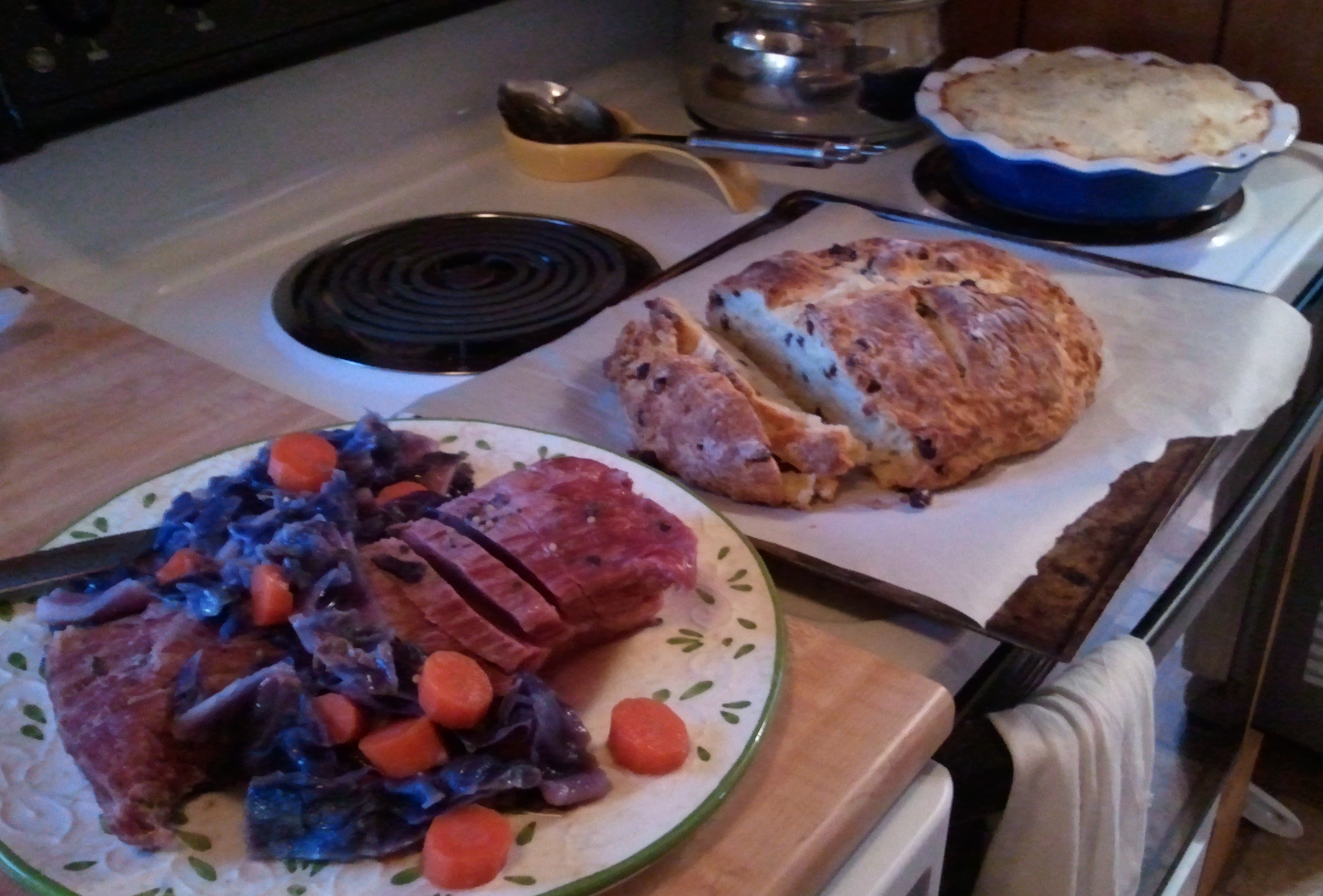
No, really, I am. Papa’s grandpap was Irish, so I don’t know what that makes me. (I’m just a baby—I can’t do that kind of math.) So Mama decided to treat us to some Irish fare for dinner. She had all the burners going, plus the oven, so there was a lot to take in.
First, she put a hunk of corned beef in a pot of water and set that to simmer with assorted spices. She would later add chopped cabbage and carrots.
Meanwhile, she started on the shepherd’s pie. First, she sautéed carrots, onion, and celery with salt, pepper, and Worcestershire sauce until the veggies began to soften. Then she added her faux meat, which just needed to be heated through. Sometimes Mama makes a beef shepherd’s pie for Papa, or she does it half-and-half, but since he had the corned beef tonight, she went for a full veggie pie. When the meat and veggies were all combined and hot, she spread them in the bottom of a pie plate. She poured some frozen corn on top of that. She didn’t have any peas—even though we planted some today!—otherwise, she would have added those, too. Meanwhile, she peeled and chopped a couple russet potatoes and boiled them in salted water until they softened. She told me that potatoes can be boiled with or without their skins, but chopping them definitely makes them cook faster. On the back burner, she heated a small saucepan of butter and buttermilk, which she happened to have because she was making soda bread. After the potatoes were cooked, she drained them, returned them to the pot, and mashed them with the hot milk and butter, which she told me keeps the potatoes from being lumpy. She spread the potatoes over the corn and popped the pie into the oven.
But not before she made Irish soda bread. She wanted a quick recipe, and boy did she find it. I’ve made bread with Mama before, and this recipe seemed more like scones to me. That’s how easy it was. We mixed a few ingredients, shaped it into a loaf, and into the oven it went. We couldn’t find dried currants, though, so we used raisins. I love raisins. Then Mama made honey butter to go with it. Then we just had to wait for it all to cook. (I helped Papa take down the storm windows. He let me use a screwdriver!)
Even Mama was a little surprised all this was done at the same time.
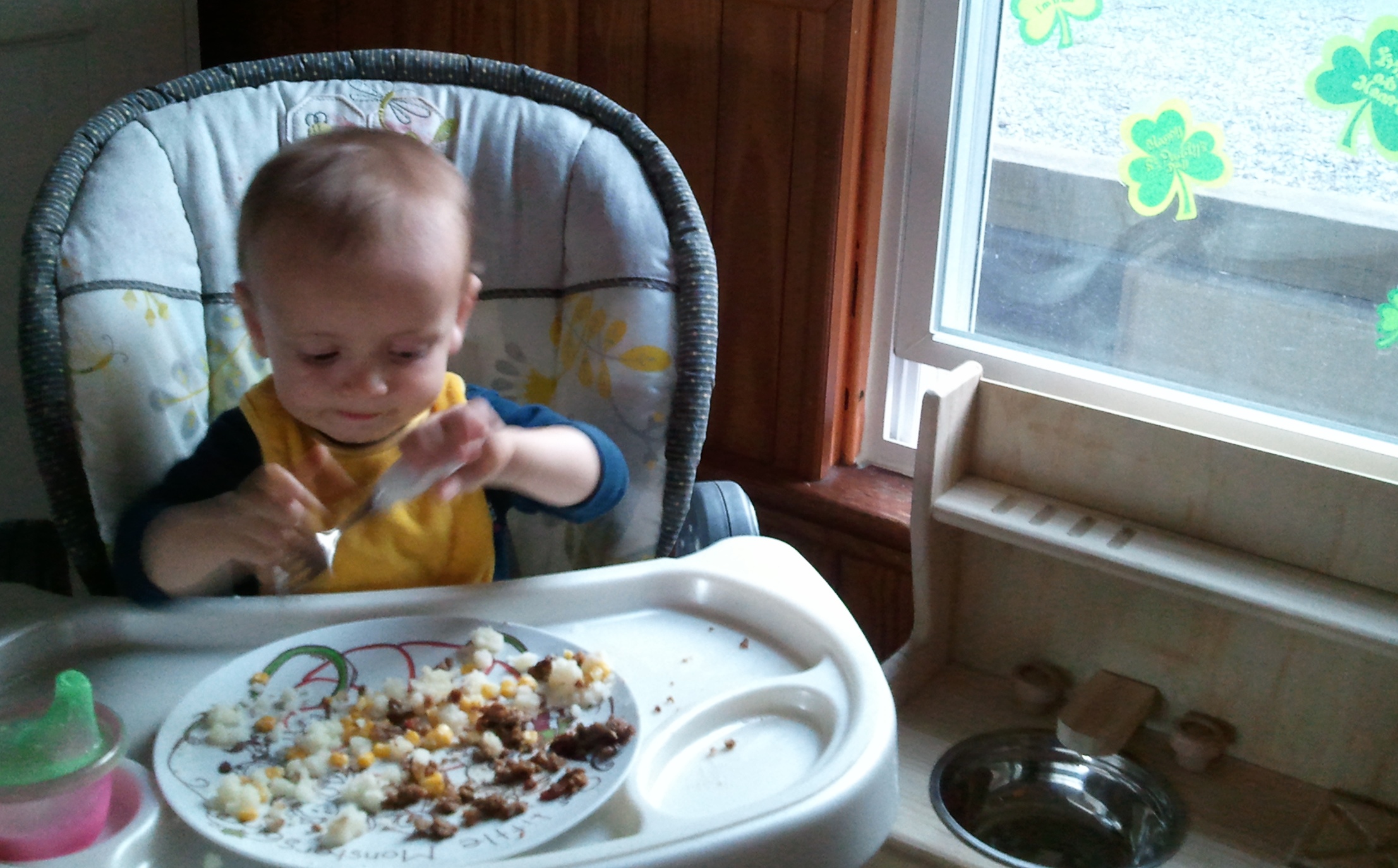
Sometimes I have a funny reaction to potatoes, and sometimes to corn, and sometimes even to carrots. Not funny-ha-ha, but rather funny-I-don’t-like-it. Not tonight, though. I thought the shepherd’s pie was really tasty. I even tried to feed myself with my own fork, but I became impatient with that. I didn’t have the corned beef, but Mama says I can have that for lunch tomorrow, even though she knows I don’t do leftovers. Papa declared it “delicious.” And the soda bread was soft on the inside and crunchy on the outside; it was yummy with the honey butter.
This shepherd’s pie was pretty good. Now, if only someone would explain to me what those shamrocks have to do with it…
I got down from my high chair, danced a jig to Flogging Molly, and went to bed with a full belly. Happy St. Patrick’s Day!
Love, Jude
Shepherd’s Pie
Canola oil (or other, favorite cooking oil)
2 carrots, peeled and diced small
2 stalks organic celery, diced small
½ onion, diced small
1–2 dashes Worcestershire sauce
Salt and pepper
1 package soy crumbles or other meat replacement (or 1 pound grass-fed ground beef)
½ package (8–12 oz.) frozen corn
½ package (8–12 oz.) frozen peas
2–3 large organic russet potatoes (or 4–6 red bliss potatoes), chopped large
4 Tbsp butter, melted (optional)
1/3–1/2 cup buttermilk, milk, or cream, heated (optional)
Preheat oven to 350°F (375° is okay, if you’re doing the soda bread at the same time).
Coat the bottom of a skillet with oil, then sauté the veggies until they begin to soften and caramelize. Season with W. sauce and s&p. Add the soy crumbles and heat through. (If using ground beef, sauté this first, breaking it up into small bits, until cooked through. Remove from the pan with a slotted spoon and cook the veggies in the remaining fat. Then combine it all before proceeding.) Place in a pie plate.
Top with corn and peas. (If omitting either corn or peas, use the full package of the other.)
Meanwhile, boil the potatoes in salted water until soft. Drain, return to the pot, then add melted butter and hot milk, if using. Season with s&p, if necessary, then spread over the corn & peas.
Bake, uncovered, for 40–60 minutes, until the potatoes start to brown. (You may dot the top with butter before baking, if desired.)
Note: Mama said if you really don’t want to cook the carrots, onion, and celery, you can add a packet of onion soup mix to the soy crumbles or ground beef and omit the W. sauce and s&p. Regarding organic produce, Mama tells me something called the Environmental Working Group publishes an annual list on the worst pesticide offenders. Celery is #2, and potatoes are #9. Onions, sweet corn, and peas are #s 1, 2, and 6, respectively, on the list of foods that are okay to buy nonorganic (if you really wanted to).
Mama suffers from what she calls a “dinner malaise.” She doesn’t like to prepare the same meals close together, even if they’re successful, and as a result, she’s at a loss for what to make. Every night. Papa’s often asked her, “Remember when you used to make…?” But when someone mentions tacos, Mama always thinks, “Oh yeah, tacos. They’re easy, and they’re good.”
So she made tacos the other night. More often than not, it’s fish tacos, but since we had just had a fish fry, she opted for grass-fed beef for me and Papa, and something called tempeh for herself (whatever that is). She showed me how to brown the ground beef in its own fat, and told me that beef’s flavor by itself isn’t that appealing. She demonstrated how to properly dice an onion, and then she sautéed it right alongside the beef, “to add flavor.” Then she seasoned the meat with spices such as cumin, coriander, chili powder, and salt & pepper. She chopped up tomatoes, cabbage, avocados, and cheese to top the tacos, and served it all with a side of seasoned red beans, brown rice, and pineapple. I ate the pineapple and the avocado.
A few nights later, Papa thought he would try his hand at it and made red bean enchiladas with a corn salsa on the side. I didn’t mind the sauce, and I ate a few kernels of corn, but I had to call it quits on this south-of-the-border fare. Give me a grilled cheese sandwich, please. Or ratatouille.
I’ve had a busy week. (Plus, Mama was sick, and I had an icky rash all over.) Mama has tried feeding me everything but the kitchen sink—and I love to play in the sink.
One day, she made me hummus. She claims I used to eat it when I was a younger baby, but I’m not so sure. It’s way garlicky. And because she cooked the chickpeas herself, instead of opening a can, she decided to roast a few before pureeing the rest into hummus. They became crispy but were still kind of soft. I thought they were terrible, but Mama gobbled them up. Meanwhile, she put the garbanzos (isn’t that a funny word?) in the food processor, squeezed in a lemon (and let me suck on the rind), plopped in tahini (which she said is like peanut butter, except made with sesame seeds, but I didn’t think it tasted like peanut butter at all!), and added garlic, fresh parsley, and a couple other seasonings. Truth: I had a few bites, but I preferred the pita…with actual peanut butter.
Then Mama had the notion to make a wheat berry salad. Wheat berries. For dinner. Now I can’t say that it was all bad. She did make a walnut oil vinaigrette and added spinach, red pepper, peaches from the freezer that I helped pick last summer, and raisins. I just couldn’t get over the chewy texture of the wheat berries. Mama says they’re supposed to be that way, but I didn’t get very far beyond the “no-thank-you” bite. Wheat berries for dinner? No thank you!
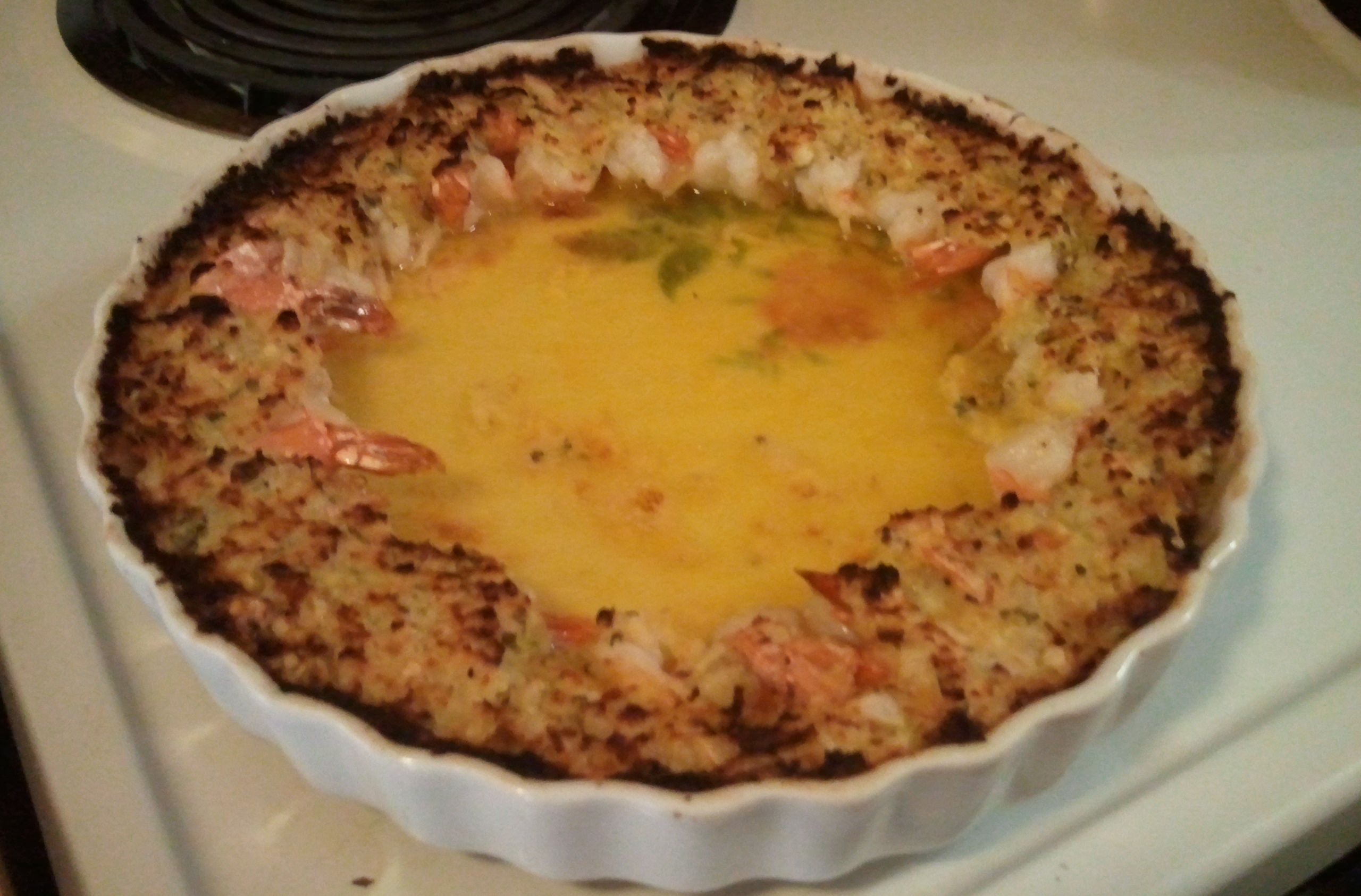
Papa took a turn with a shrimp scampi he baked in the oven. He showed me how he “butterflies” shrimp. I once went to a butterfly hatchery, but I didn’t know there were shrimp butterflies! Then Papa chopped lots of shallots and herbs and smooshed them with a lot of butter. I like butter. Mama made rice, and I have to admit this was one tasty dish. Mama said it was too bad I decided to like this one because she would have liked some more. You and me both, Mama.
Papa did a pretty good job and used all that butter on the rice. How bad could that be?
I think my folks were tired of the kitchen scene by the end of the week because they took me out for Indian food on Sunday. There were gold elephants! On the walls! And sparkly pictures with even more elephants! And music I’ve never heard before! Mama’s not so bad at Indian food herself (maybe she’ll make naan again soon, so I can tell you all about it), but she doesn’t make all the different things the way this place does. She and Papa thought I’d gobble up everything, but they were wrong. Mama, though—that smart cookie—ordered me a mango lassi. She said it was like a smoothie, but it didn’t matter. It was delicious, and I got to drink it with a big-boy straw. Mama traded me a sip of the lassi for every bite of mutter paneer, aalo gobi, and channa saag I ate. It was worth it. Then I finished the meal with rus malai and kheer (“Who doesn’t like kheer?” Mama and Papa asked). All in all, I’d say it was a good meal…and not too much ended up on the restaurant floor. Did I mention the elephants?
Maybe this week will be different. But I wouldn’t bet on it.
Ever since I was about 9 months old, I’ve eaten a farm-fresh egg for breakfast. It started out as a soft-boiled egg yolk, and now it’s a nice scrambled egg that I can feed myself. Sometimes Mama puts cheese on it, sometimes even salsa (¿huevos rancheros, anyone?). Mama’s eggs are my favorite because she makes them soft and fluffy. She says the secret is taking them out of the pan before they’re fully cooked.
This morning I didn’t feel like eating my egg (though the dog sure appreciated it), so Mama decided on eggs for lunch. And this time, she did something I’ve never seen before. She put them in a pot of water and put them on the stove. Once the water started boiling, she turned off the heat, covered the pot, and let them sit about 10 minutes. Then she ran the eggs under cold water in the sink.
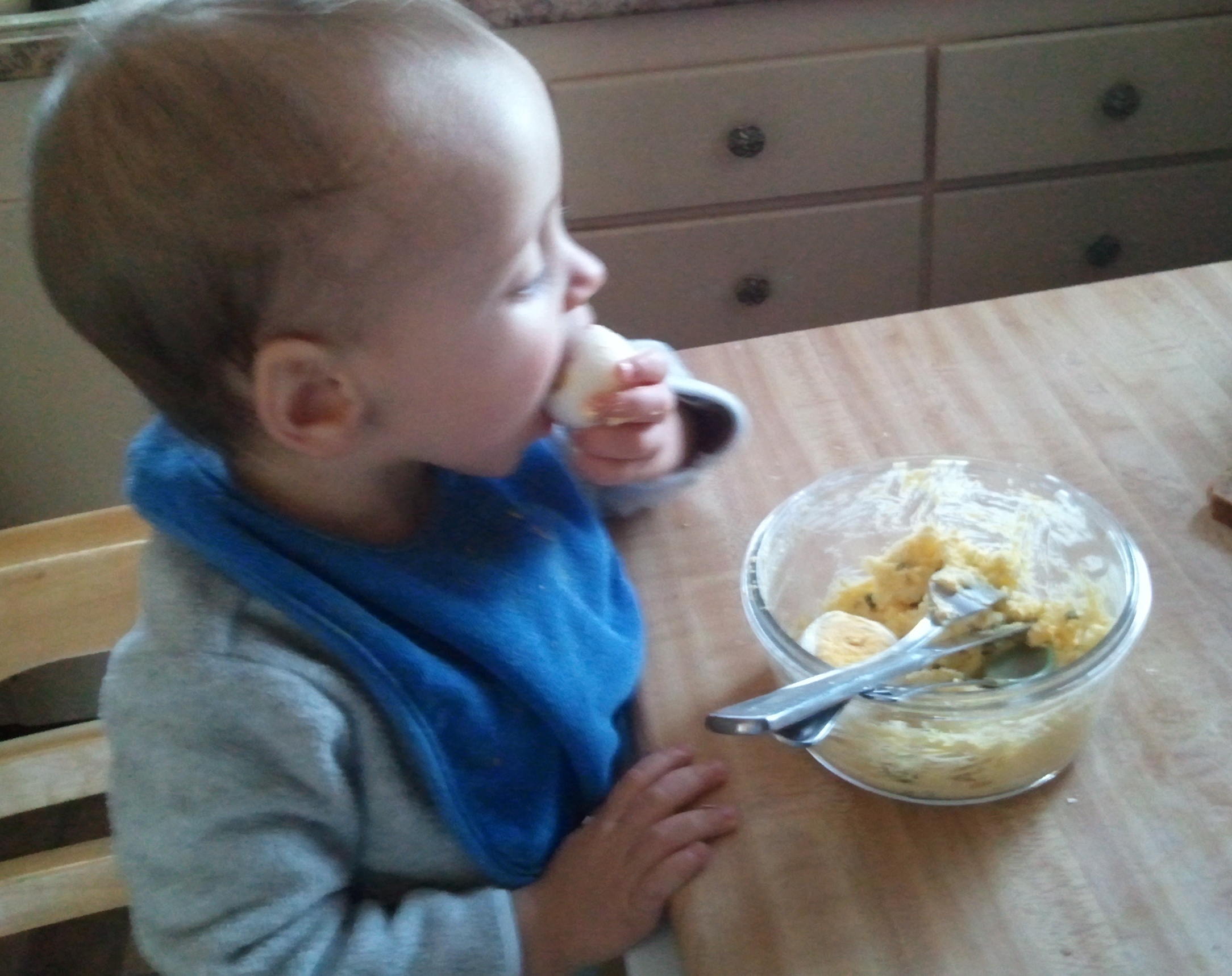
Then Mama showed me how to crack ’em: She knocked one on the counter, rolled it under her palm, then peeled the shell right off! Needless to say, I was hooked on this whole cracking business. We peeled four eggs, and then Mama mashed them with a fork. She added some mayonnaise (she told me I was too young for the homemade kind) and Dijon mustard, a splash of vinegar, salt, pepper, and capers. She had her “egg salad” on toast, but I liked it right off the spoon. Good show, Mama.
Love, Jude
I love eggs so much I couldn’t wait for them to be mashed.
Egg Salad*
4 hard-boiled eggs, mashed
1/4 cup mayonnaise
1 tsp Dijon mustard
Splash of vinegar
Salt & pepper, to taste
Capers (optional)
Dill (optional)
Mix the eggs, mayo, mustard, vinegar, and salt and pepper in a bowl and mash until well combined. Stir in the capers and/or dill, if using. Serve on bread or toast.
*Note: These amounts are approximate. Start small and taste as you go! The result should be creamy and hold together.


 LittleJudeonFood